Q767L6
Gene name |
FLOT1 |
Protein name |
Flotillin-1 |
Names |
|
Species |
Sus scrofa (Pig) |
KEGG Pathway |
ssc:100151746 |
EC number |
|
Protein Class |
|
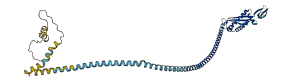
Descriptions
The autoinhibited protein was predicted that may have potential autoinhibitory elements via cis-regPred.
Autoinhibitory domains (AIDs)
Target domain |
|
Relief mechanism |
|
Assay |
cis-regPred |
Accessory elements
No accessory elements
Autoinhibited structure

Activated structure
1 structures for Q767L6
| Entry ID | Method | Resolution | Chain | Position | Source |
|---|---|---|---|---|---|
| AF-Q767L6-F1 | Predicted | AlphaFoldDB |
7 variants for Q767L6
| Variant ID(s) | Position | Change | Description | Diseaes Association | Provenance |
|---|---|---|---|---|---|
| rs712201078 | 110 | A>G | No | EVA | |
| rs696170732 | 162 | H>Q | No | EVA | |
| rs80792372 | 178 | I>M | No | EVA | |
| rs80904816 | 270 | Q>E | No | EVA | |
| rs786993765 | 274 | R>C | No | EVA | |
| rs80986296 | 327 | I>M | No | EVA | |
| rs694092073 | 376 | K>N | No | EVA |
No associated diseases with Q767L6
5 regional properties for Q767L6
| Type | Name | Position | InterPro Accession |
|---|---|---|---|
| conserved_site | Actinin-type actin-binding domain, conserved site | 213 - 237 | IPR001589 |
| domain | Calponin homology domain | 124 - 241 | IPR001715-1 |
| domain | Calponin homology domain | 269 - 372 | IPR001715-2 |
| domain | Calponin homology domain | 393 - 499 | IPR001715-3 |
| domain | Calponin homology domain | 514 - 622 | IPR001715-4 |
Functions
19 GO annotations of cellular component
| Name | Definition |
|---|---|
| adherens junction | A cell-cell junction composed of the epithelial cadherin-catenin complex. The epithelial cadherins, or E-cadherins, of each interacting cell extend through the plasma membrane into the extracellular space and bind to each other. The E-cadherins bind to catenins on the cytoplasmic side of the membrane, where the E-cadherin-catenin complex binds to cytoskeletal components and regulatory and signaling molecules. |
| apical part of cell | The region of a polarized cell that forms a tip or is distal to a base. For example, in a polarized epithelial cell, the apical region has an exposed surface and lies opposite to the basal lamina that separates the epithelium from other tissue. |
| basolateral plasma membrane | The region of the plasma membrane that includes the basal end and sides of the cell. Often used in reference to animal polarized epithelial membranes, where the basal membrane is the part attached to the extracellular matrix, or in plant cells, where the basal membrane is defined with respect to the zygotic axis. |
| cell-cell contact zone | Extended zone of intimate apposition between two cells containing one or more types of intercellular junctions, e.g., the intercalated disk of muscle. |
| centriolar satellite | A small (70-100 nm) cytoplasmic granule that contains a number of centrosomal proteins; centriolar satellites traffic toward microtubule minus ends and are enriched near the centrosome. |
| COP9 signalosome | A protein complex that catalyzes the deneddylation of proteins, including the cullin component of SCF ubiquitin E3 ligase; deneddylation increases the activity of cullin family ubiquitin ligases. The signalosome is involved in many regulatory process, including some which control development, in many species; also regulates photomorphogenesis in plants; in many species its subunits are highly similar to those of the proteasome. |
| cortical actin cytoskeleton | The portion of the actin cytoskeleton, comprising filamentous actin and associated proteins, that lies just beneath the plasma membrane. |
| cytoplasmic vesicle | A vesicle found in the cytoplasm of a cell. |
| dopaminergic synapse | A synapse that uses dopamine as a neurotransmitter. |
| early endosome | A membrane-bounded organelle that receives incoming material from primary endocytic vesicles that have been generated by clathrin-dependent and clathrin-independent endocytosis; vesicles fuse with the early endosome to deliver cargo for sorting into recycling or degradation pathways. |
| endosome | A vacuole to which materials ingested by endocytosis are delivered. |
| external side of plasma membrane | The leaflet of the plasma membrane that faces away from the cytoplasm and any proteins embedded or anchored in it or attached to its surface. |
| flotillin complex | A protein complex that contains flotillin-1 and flotillin-2, and may contain associated proteins. Flotillins associate into membrane microdomains resembling caveolae. |
| lamellipodium | A thin sheetlike process extended by the leading edge of a migrating cell or extending cell process; contains a dense meshwork of actin filaments. |
| melanosome | A tissue-specific, membrane-bounded cytoplasmic organelle within which melanin pigments are synthesized and stored. Melanosomes are synthesized in melanocyte cells. |
| membrane raft | Any of the small (10-200 nm), heterogeneous, highly dynamic, sterol- and sphingolipid-enriched membrane domains that compartmentalize cellular processes. Small rafts can sometimes be stabilized to form larger platforms through protein-protein and protein-lipid interactions. |
| plasma membrane | The membrane surrounding a cell that separates the cell from its external environment. It consists of a phospholipid bilayer and associated proteins. |
| sarcolemma | The outer membrane of a muscle cell, consisting of the plasma membrane, a covering basement membrane (about 100 nm thick and sometimes common to more than one fiber), and the associated loose network of collagen fibers. |
| uropod | A membrane projection with related cytoskeletal components at the trailing edge of a cell in the process of migrating or being activated, found on the opposite side of the cell from the leading edge or immunological synapse, respectively. |
1 GO annotations of molecular function
| Name | Definition |
|---|---|
| protease binding | Binding to a protease or a peptidase. |
24 GO annotations of biological process
| Name | Definition |
|---|---|
| axonogenesis | De novo generation of a long process of a neuron, including the terminal branched region. Refers to the morphogenesis or creation of shape or form of the developing axon, which carries efferent (outgoing) action potentials from the cell body towards target cells. |
| cellular response to exogenous dsRNA | Any process that results in a change in state or activity of a cell (in terms of movement, secretion, enzyme production, gene expression, etc.) as a result of an exogenous double-stranded RNA stimulus. |
| dsRNA transport | The directed movement of dsRNA, double-stranded ribonucleic acid, into, out of or within a cell, or between cells, by means of some agent such as a transporter or pore. |
| extracellular matrix disassembly | A process that results in the breakdown of the extracellular matrix. |
| plasma membrane raft assembly | The aggregation, arrangement and bonding together of a set of components to form a plasma membrane raft. |
| positive regulation of cell junction assembly | Any process that activates or increases the frequency, rate or extent of cell junction assembly. |
| positive regulation of cell-cell adhesion mediated by cadherin | Any process that activates or increases the frequency, rate or extent of cell-cell adhesion mediated by cadherin. |
| positive regulation of endocytosis | Any process that activates or increases the frequency, rate or extent of endocytosis. |
| positive regulation of heterotypic cell-cell adhesion | Any process that activates or increases the frequency, rate, or extent of heterotypic cell-cell adhesion. |
| positive regulation of interferon-beta production | Any process that activates or increases the frequency, rate, or extent of interferon-beta production. |
| positive regulation of myoblast fusion | Any process that activates or increases the frequency, rate or extent of myoblast fusion. |
| positive regulation of NF-kappaB transcription factor activity | Any process that activates or increases the frequency, rate or extent of activity of the transcription factor NF-kappaB. |
| positive regulation of protein binding | Any process that activates or increases the frequency, rate or extent of protein binding. |
| positive regulation of protein phosphorylation | Any process that activates or increases the frequency, rate or extent of addition of phosphate groups to amino acids within a protein. |
| positive regulation of skeletal muscle tissue development | Any process that activates, maintains or increases the rate of skeletal muscle tissue development. |
| positive regulation of synaptic transmission, dopaminergic | Any process that activates, maintains or increases the frequency, rate or extent of dopaminergic synaptic transmission, the process of communication from a neuron to another neuron across a synapse using the neurotransmitter dopamine. |
| positive regulation of toll-like receptor 3 signaling pathway | Any process that activates or increases the frequency, rate, or extent of toll-like receptor 3 signaling pathway. |
| protein kinase C signaling | A series of reactions, mediated by the intracellular serine/threonine kinase protein kinase C, which occurs as a result of a single trigger reaction or compound. |
| protein localization to plasma membrane | A process in which a protein is transported to, or maintained in, a specific location in the plasma membrane. |
| protein stabilization | Any process involved in maintaining the structure and integrity of a protein and preventing it from degradation or aggregation. |
| regulation of neurotransmitter uptake | Any process that modulates the frequency, rate or extent of the directed movement of a neurotransmitter into a neuron or glial cell. |
| regulation of receptor internalization | Any process that modulates the frequency, rate or extent of receptor internalization. |
| regulation of Rho protein signal transduction | Any process that modulates the frequency, rate or extent of Rho protein signal transduction. |
| response to endoplasmic reticulum stress | Any process that results in a change in state or activity of a cell (in terms of movement, secretion, enzyme production, gene expression, etc.) as a result of a stress acting at the endoplasmic reticulum. ER stress usually results from the accumulation of unfolded or misfolded proteins in the ER lumen. |
11 homologous proteins in AiPD
| UniProt AC | Gene Name | Protein Name | Species | Evidence Code |
|---|---|---|---|---|
| A6QLR4 | FLOT2 | Flotillin-2 | Bos taurus (Bovine) | PR |
| Q08DN8 | FLOT1 | Flotillin-1 | Bos taurus (Bovine) | PR |
| Q7YR41 | FLOT1 | Flotillin-1 | Pan troglodytes (Chimpanzee) | PR |
| O61491 | Flo1 | Flotillin-1 | Drosophila melanogaster (Fruit fly) | PR |
| Q14254 | FLOT2 | Flotillin-2 | Homo sapiens (Human) | PR |
| O75955 | FLOT1 | Flotillin-1 | Homo sapiens (Human) | PR |
| Q60634 | Flot2 | Flotillin-2 | Mus musculus (Mouse) | PR |
| O08917 | Flot1 | Flotillin-1 | Mus musculus (Mouse) | PR |
| Q9Z2S9 | Flot2 | Flotillin-2 | Rattus norvegicus (Rat) | PR |
| Q9Z1E1 | Flot1 | Flotillin-1 | Rattus norvegicus (Rat) | PR |
| Q5TM70 | FLOT1 | Flotillin-1 | Macaca mulatta (Rhesus macaque) | PR |
| 10 | 20 | 30 | 40 | 50 | 60 |
| MFFTCGPNEA | MVVSGFCRSP | PVMVAGGRVF | VLPCIQQIQR | ISLNTLTLNV | KSEKVYTRHG |
| 70 | 80 | 90 | 100 | 110 | 120 |
| VPISVTGIAQ | VKIQGQNKEM | LAAACQMFLG | KTEAEIAHIA | LETLEGHQRA | IMAHMTVEEI |
| 130 | 140 | 150 | 160 | 170 | 180 |
| YKDRQKFSEQ | VFKVASSDLV | NMGISVVSYT | LKDIHDDQDY | LHSLGKARTA | QVQKDARIGE |
| 190 | 200 | 210 | 220 | 230 | 240 |
| AEAKRDAGIR | EAKAKQEKVS | AQYLSEIEMA | KAQRDYELKK | AAYDIEVNTR | RAQADLAYQL |
| 250 | 260 | 270 | 280 | 290 | 300 |
| QVAKTKQQIE | EQRVQVQVVE | RAQQVAVQEQ | EIARREKELE | ARVRKPAEAE | RYKLERLAAA |
| 310 | 320 | 330 | 340 | 350 | 360 |
| EKSQLIMQAE | AEAESVRMRG | EAEAFAIGAR | ARAEAEQMAK | KAEAFQLYQE | AAQLDMLLEK |
| 370 | 380 | 390 | 400 | 410 | 420 |
| LPQVAEEISG | PLTSAKKITL | VSSGSGTMGA | AKVTGEVLDI | LSRLPESVER | LTGVSISQVN |
| HKPLRTA |