Q9Z1D1
Gene name |
Eif3g (Eif3p42, Eif3s4) |
Protein name |
Eukaryotic translation initiation factor 3 subunit G |
Names |
eIF3g, Eukaryotic translation initiation factor 3 RNA-binding subunit, eIF-3 RNA-binding subunit, Eukaryotic translation initiation factor 3 subunit 4, eIF-3-delta, eIF3 p42, eIF3 p44 |
Species |
Mus musculus (Mouse) |
KEGG Pathway |
mmu:53356 |
EC number |
|
Protein Class |
|
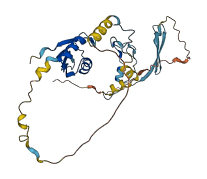
Descriptions
The autoinhibited protein was predicted that may have potential autoinhibitory elements via cis-regPred.
Autoinhibitory domains (AIDs)
Target domain |
|
Relief mechanism |
|
Assay |
cis-regPred |
Accessory elements
No accessory elements
Autoinhibited structure

Activated structure
1 structures for Q9Z1D1
| Entry ID | Method | Resolution | Chain | Position | Source |
|---|---|---|---|---|---|
| AF-Q9Z1D1-F1 | Predicted | AlphaFoldDB |
17 variants for Q9Z1D1
| Variant ID(s) | Position | Change | Description | Diseaes Association | Provenance |
|---|---|---|---|---|---|
| rs3389001815 | 16 | V>* | No | EVA | |
| rs3389032786 | 44 | E>D | No | EVA | |
| rs3389020928 | 86 | R>S | No | EVA | |
| rs3389026584 | 117 | V>M | No | EVA | |
| rs3389033679 | 167 | T>A | No | EVA | |
| rs3389032829 | 176 | G>A | No | EVA | |
| rs3389027512 | 186 | L>I | No | EVA | |
| rs3389026533 | 189 | S>Y | No | EVA | |
| rs3389007570 | 198 | G>E | No | EVA | |
| rs3389032852 | 199 | E>D | No | EVA | |
| rs3389025007 | 200 | L>V | No | EVA | |
| rs3389019652 | 209 | K>M | No | EVA | |
| rs3411763431 | 233 | R>H | No | EVA | |
| rs3389014211 | 269 | Y>C | No | EVA | |
| rs3389020936 | 298 | A>T | No | EVA | |
| rs3389019705 | 306 | D>G | No | EVA | |
| rs3389033726 | 316 | K>N | No | EVA |
No associated diseases with Q9Z1D1
7 GO annotations of cellular component
| Name | Definition |
|---|---|
| cytoplasm | The contents of a cell excluding the plasma membrane and nucleus, but including other subcellular structures. |
| cytosol | The part of the cytoplasm that does not contain organelles but which does contain other particulate matter, such as protein complexes. |
| eukaryotic 43S preinitiation complex | A protein complex composed of the 40S ribosomal subunit plus eIF1A, eIF3, and eIF2-GTP-bound methionyl-initiator methionine tRNA. |
| eukaryotic 48S preinitiation complex | A protein complex composed of the small ribosomal subunit, eIF3, eIF1A, methionyl-initiatior methionine and a capped mRNA. The complex is initially positioned at the 5'-end of the capped mRNA. |
| eukaryotic translation initiation factor 3 complex | A complex of several polypeptides that plays at least two important roles in protein synthesis: First, eIF3 binds to the 40S ribosome and facilitates loading of the Met-tRNA/eIF2.GTP ternary complex to form the 43S preinitiation complex. Subsequently, eIF3 apparently assists eIF4 in recruiting mRNAs to the 43S complex. The eIF3 complex contains five conserved core subunits, and may contain several additional proteins; the non-core subunits are thought to mediate association of the complex with specific sets of mRNAs. |
| nucleus | A membrane-bounded organelle of eukaryotic cells in which chromosomes are housed and replicated. In most cells, the nucleus contains all of the cell's chromosomes except the organellar chromosomes, and is the site of RNA synthesis and processing. In some species, or in specialized cell types, RNA metabolism or DNA replication may be absent. |
| perinuclear region of cytoplasm | Cytoplasm situated near, or occurring around, the nucleus. |
2 GO annotations of molecular function
| Name | Definition |
|---|---|
| RNA binding | Binding to an RNA molecule or a portion thereof. |
| translation initiation factor activity | Functions in the initiation of ribosome-mediated translation of mRNA into a polypeptide. |
3 GO annotations of biological process
| Name | Definition |
|---|---|
| formation of cytoplasmic translation initiation complex | Joining of the large subunit, with release of IF2/eIF2 and IF3/eIF3. This leaves the functional ribosome at the AUG, with the methionyl/formyl-methionyl-tRNA positioned at the P site. |
| translational initiation | The process preceding formation of the peptide bond between the first two amino acids of a protein. This includes the formation of a complex of the ribosome, mRNA or circRNA, and an initiation complex that contains the first aminoacyl-tRNA. |
| viral translational termination-reinitiation | A process which occurs as part of viral mRNA translation which allows expression of a downstream open reading frame (ORF) in a dicistronic mRNA. In this process, ribosomes translate the upstream ORF but following termination, a proportion of 40S subunits remain tethered to the mRNA and go on to re-initiate translation at the start codon of the downstream ORF. |
11 homologous proteins in AiPD
| UniProt AC | Gene Name | Protein Name | Species | Evidence Code |
|---|---|---|---|---|
| Q04067 | TIF35 | Eukaryotic translation initiation factor 3 subunit G | Saccharomyces cerevisiae (strain ATCC 204508 / S288c) (Baker's yeast) | PR |
| Q3ZC12 | EIF3G | Eukaryotic translation initiation factor 3 subunit G | Bos taurus (Bovine) | PR |
| Q9VDM6 | eIF3g2 | Eukaryotic translation initiation factor 3 subunit G-2 | Drosophila melanogaster (Fruit fly) | PR |
| Q9W4X7 | eIF3g1 | Eukaryotic translation initiation factor 3 subunit G-1 | Drosophila melanogaster (Fruit fly) | PR |
| O75821 | EIF3G | Eukaryotic translation initiation factor 3 subunit G | Homo sapiens (Human) | PR |
| Q60900 | Elavl3 | ELAV-like protein 3 | Mus musculus (Mouse) | PR |
| Q61701 | Elavl4 | ELAV-like protein 4 | Mus musculus (Mouse) | PR |
| Q60899 | Elavl2 | ELAV-like protein 2 | Mus musculus (Mouse) | PR |
| Q5RK09 | Eif3g | Eukaryotic translation initiation factor 3 subunit G | Rattus norvegicus (Rat) | PR |
| Q19706 | eif-3.G | Eukaryotic translation initiation factor 3 subunit G | Caenorhabditis elegans | PR |
| Q28CY2 | eif3g | Eukaryotic translation initiation factor 3 subunit G | Xenopus tropicalis (Western clawed frog) (Silurana tropicalis) | PR |
| 10 | 20 | 30 | 40 | 50 | 60 |
| MPTGDFDSKP | SWADQVEEEG | EDDKCVTSEL | LKGIPLPTGD | TSPEPELLPG | DPLPPPKEVI |
| 70 | 80 | 90 | 100 | 110 | 120 |
| NGNIKTVTEY | KIEEDGKKFK | IVRTFRIETR | KASKAVARRK | NWKKFGNSEF | DPPGPNVATT |
| 130 | 140 | 150 | 160 | 170 | 180 |
| TVSDDVSMTF | ITSKEDLNCQ | EEEDPMNKLK | GQKIVSCRIC | KGDHWTTRCP | YKDTLGPMQK |
| 190 | 200 | 210 | 220 | 230 | 240 |
| ELAEQLGLST | GEKEKLPGEL | EPVQAAQSKT | GKYVPPSLRD | GASRRGESMQ | PNRRADDNAT |
| 250 | 260 | 270 | 280 | 290 | 300 |
| IRVTNLSEDT | RETDLQELFR | PFGSISRIYL | AKDKTTGQSK | GFAFISFHRR | EDAARAIAGV |
| 310 | |||||
| SGFGYDHLIL | NVEWAKPSTN |