Q9SEI2
Gene name |
RPT5A |
Protein name |
26S proteasome regulatory subunit 6A homolog A |
Names |
26S proteasome AAA-ATPase subunit RPT5a, Proteasome 26S subunit 6A homolog A, Regulatory particle triple-A ATPase subunit 5a, Tat-binding protein 1 homolog A, TBP-1 homolog A |
Species |
Arabidopsis thaliana (Mouse-ear cress) |
KEGG Pathway |
ath:AT3G05530 |
EC number |
|
Protein Class |
|
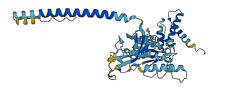
Descriptions
The autoinhibited protein was predicted that may have potential autoinhibitory elements via cis-regPred.
Autoinhibitory domains (AIDs)
Target domain |
|
Relief mechanism |
|
Assay |
cis-regPred |
Accessory elements
No accessory elements
Autoinhibited structure

Activated structure
1 structures for Q9SEI2
| Entry ID | Method | Resolution | Chain | Position | Source |
|---|---|---|---|---|---|
| AF-Q9SEI2-F1 | Predicted | AlphaFoldDB |
1 variants for Q9SEI2
| Variant ID(s) | Position | Change | Description | Diseaes Association | Provenance |
|---|---|---|---|---|---|
| tmp_3_1605727_G_T | 370 | A>S | No | 1000Genomes |
No associated diseases with Q9SEI2
5 regional properties for Q9SEI2
| Type | Name | Position | InterPro Accession |
|---|---|---|---|
| domain | AAA+ ATPase domain | 204 - 343 | IPR003593 |
| domain | ATPase, AAA-type, core | 208 - 340 | IPR003959 |
| conserved_site | ATPase, AAA-type, conserved site | 311 - 329 | IPR003960 |
| domain | Proteasomal ATPase OB C-terminal domain | 74 - 150 | IPR032501 |
| domain | AAA ATPase, AAA+ lid domain | 363 - 407 | IPR041569 |
5 GO annotations of cellular component
| Name | Definition |
|---|---|
| cytoplasm | The contents of a cell excluding the plasma membrane and nucleus, but including other subcellular structures. |
| cytosol | The part of the cytoplasm that does not contain organelles but which does contain other particulate matter, such as protein complexes. |
| nucleus | A membrane-bounded organelle of eukaryotic cells in which chromosomes are housed and replicated. In most cells, the nucleus contains all of the cell's chromosomes except the organellar chromosomes, and is the site of RNA synthesis and processing. In some species, or in specialized cell types, RNA metabolism or DNA replication may be absent. |
| proteasome complex | A large multisubunit complex which catalyzes protein degradation, found in eukaryotes, archaea and some bacteria. In eukaryotes, this complex consists of the barrel shaped proteasome core complex and one or two associated proteins or complexes that act in regulating entry into or exit from the core. |
| proteasome regulatory particle, base subcomplex | The subcomplex of the proteasome regulatory particle that directly associates with the proteasome core complex. |
3 GO annotations of molecular function
| Name | Definition |
|---|---|
| ATP binding | Binding to ATP, adenosine 5'-triphosphate, a universally important coenzyme and enzyme regulator. |
| ATP hydrolysis activity | Catalysis of the reaction: ATP + H2O = ADP + H+ phosphate. ATP hydrolysis is used in some reactions as an energy source, for example to catalyze a reaction or drive transport against a concentration gradient. |
| proteasome-activating activity | Catalysis of the reaction: ATP + H2O = ADP + phosphate, which promotes unfolding of protein substrates, and channel opening of the core proteasome. |
4 GO annotations of biological process
| Name | Definition |
|---|---|
| embryo sac development | The process whose specific outcome is the progression of the embryo sac over time, from its formation to the mature structure. The process begins with the meiosis of the megasporocyte to form four haploid megaspores. Three of the megaspores disintegrate, and the fourth undergoes mitosis giving rise to a binucleate syncytial embryo sac. The two haploid nuclei migrate to the opposite poles of the embryo sac and then undergo two rounds of mitosis generating four haploid nuclei at each pole. One nucleus from each set of four migrates to the center of the cell. Cellularization occurs, resulting in an eight-nucleate seven-celled structure. This structure contains two synergid cells and an egg cell at the micropylar end, and three antipodal cells at the other end. A binucleate endosperm mother cell is formed at the center. The two polar nuclei fuse resulting in a mononucleate diploid endosperm mother cell. The three antipodal cells degenerate. |
| pollen development | The process whose specific outcome is the progression of the pollen grain over time, from its formation to the mature structure. The process begins with the meiosis of the microsporocyte to form four haploid microspores. The nucleus of each microspore then divides by mitosis to form a two-celled organism, the pollen grain, that contains a tube cell as well as a smaller generative cell. The pollen grain is surrounded by an elaborate cell wall. In some species, the generative cell immediately divides again to give a pair of sperm cells. In most flowering plants, however this division takes place later, in the tube that develops when a pollen grain germinates. |
| proteasomal protein catabolic process | The chemical reactions and pathways resulting in the breakdown of a protein or peptide by hydrolysis of its peptide bonds that is mediated by the proteasome. |
| proteasome-mediated ubiquitin-dependent protein catabolic process | The chemical reactions and pathways resulting in the breakdown of a protein or peptide by hydrolysis of its peptide bonds, initiated by the covalent attachment of ubiquitin, and mediated by the proteasome. |
7 homologous proteins in AiPD
| UniProt AC | Gene Name | Protein Name | Species | Evidence Code |
|---|---|---|---|---|
| P17980 | PSMC3 | 26S proteasome regulatory subunit 6A | Homo sapiens (Human) | PR |
| O88685 | Psmc3 | 26S proteasome regulatory subunit 6A | Mus musculus (Mouse) | PR |
| Q63569 | Psmc3 | 26S proteasome regulatory subunit 6A | Rattus norvegicus (Rat) | PR |
| P46465 | TBP1 | 26S proteasome regulatory subunit 6A homolog | Oryza sativa subsp japonica (Rice) | PR |
| Q9SL67 | RPT2B | 26S proteasome regulatory subunit 4 homolog B | Arabidopsis thaliana (Mouse-ear cress) | PR |
| Q9SZD4 | RPT2A | 26S proteasome regulatory subunit 4 homolog A | Arabidopsis thaliana (Mouse-ear cress) | PR |
| P54776 | TBP1 | 26S proteasome regulatory subunit 6A homolog | Solanum lycopersicum (Tomato) (Lycopersicon esculentum) | PR |
| 10 | 20 | 30 | 40 | 50 | 60 |
| MATPMVEDTS | SFEEDQLASM | STEDITRATR | LLDNEIRILK | EDAQRTNLEC | DSYKEKIKEN |
| 70 | 80 | 90 | 100 | 110 | 120 |
| QEKIKLNKQL | PYLVGNIVEI | LEMNPEDDAE | EDGANIDLDS | QRKGKCVVLK | TSTRQTIFLP |
| 130 | 140 | 150 | 160 | 170 | 180 |
| VVGLVDPDSL | KPGDLVGVNK | DSYLILDTLP | SEYDSRVKAM | EVDEKPTEDY | NDIGGLEKQI |
| 190 | 200 | 210 | 220 | 230 | 240 |
| QELVEAIVLP | MTHKERFEKL | GVRPPKGVLL | YGPPGTGKTL | MARACAAQTN | ATFLKLAGPQ |
| 250 | 260 | 270 | 280 | 290 | 300 |
| LVQMFIGDGA | KLVRDAFQLA | KEKAPCIIFI | DEIDAIGTKR | FDSEVSGDRE | VQRTMLELLN |
| 310 | 320 | 330 | 340 | 350 | 360 |
| QLDGFSSDER | IKVIAATNRA | DILDPALMRS | GRLDRKIEFP | HPTEEARARI | LQIHSRKMNV |
| 370 | 380 | 390 | 400 | 410 | 420 |
| HPDVNFEELA | RSTDDFNGAQ | LKAVCVEAGM | LALRRDATEV | NHEDFNEGII | QVQAKKKASL |
| NYYA |