Q9SZD4
Gene name |
RPT2A |
Protein name |
26S proteasome regulatory subunit 4 homolog A |
Names |
26S proteasome AAA-ATPase subunit RPT2a, 26S proteasome subunit 4 homolog A, Protein HALTED ROOT, Regulatory particle triple-A ATPase subunit 2a |
Species |
Arabidopsis thaliana (Mouse-ear cress) |
KEGG Pathway |
ath:AT4G29040 |
EC number |
|
Protein Class |
|
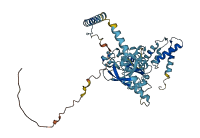
Descriptions
The autoinhibited protein was predicted that may have potential autoinhibitory elements via cis-regPred.
Autoinhibitory domains (AIDs)
Target domain |
|
Relief mechanism |
|
Assay |
cis-regPred |
Accessory elements
No accessory elements
Autoinhibited structure

Activated structure
1 structures for Q9SZD4
| Entry ID | Method | Resolution | Chain | Position | Source |
|---|---|---|---|---|---|
| AF-Q9SZD4-F1 | Predicted | AlphaFoldDB |
5 variants for Q9SZD4
| Variant ID(s) | Position | Change | Description | Diseaes Association | Provenance |
|---|---|---|---|---|---|
| ENSVATH12290638 | 121 | E>D | No | 1000Genomes | |
| ENSVATH12290640 | 162 | V>I | No | 1000Genomes | |
| tmp_4_14313585_G_T | 270 | V>L | No | 1000Genomes | |
| tmp_4_14313654_G_A | 293 | V>I | No | 1000Genomes | |
| tmp_4_14313873_G_C | 339 | S>T | No | 1000Genomes |
No associated diseases with Q9SZD4
5 regional properties for Q9SZD4
| Type | Name | Position | InterPro Accession |
|---|---|---|---|
| domain | AAA+ ATPase domain | 221 - 360 | IPR003593 |
| domain | ATPase, AAA-type, core | 225 - 358 | IPR003959 |
| conserved_site | ATPase, AAA-type, conserved site | 328 - 346 | IPR003960 |
| domain | Proteasomal ATPase OB C-terminal domain | 112 - 166 | IPR032501 |
| domain | AAA ATPase, AAA+ lid domain | 380 - 423 | IPR041569 |
5 GO annotations of cellular component
| Name | Definition |
|---|---|
| nucleus | A membrane-bounded organelle of eukaryotic cells in which chromosomes are housed and replicated. In most cells, the nucleus contains all of the cell's chromosomes except the organellar chromosomes, and is the site of RNA synthesis and processing. In some species, or in specialized cell types, RNA metabolism or DNA replication may be absent. |
| P-body | A focus in the cytoplasm where mRNAs may become inactivated by decapping or some other mechanism. Protein and RNA localized to these foci are involved in mRNA degradation, nonsense-mediated mRNA decay (NMD), translational repression, and RNA-mediated gene silencing. |
| plasma membrane | The membrane surrounding a cell that separates the cell from its external environment. It consists of a phospholipid bilayer and associated proteins. |
| proteasome complex | A large multisubunit complex which catalyzes protein degradation, found in eukaryotes, archaea and some bacteria. In eukaryotes, this complex consists of the barrel shaped proteasome core complex and one or two associated proteins or complexes that act in regulating entry into or exit from the core. |
| proteasome regulatory particle, base subcomplex | The subcomplex of the proteasome regulatory particle that directly associates with the proteasome core complex. |
3 GO annotations of molecular function
| Name | Definition |
|---|---|
| ATP binding | Binding to ATP, adenosine 5'-triphosphate, a universally important coenzyme and enzyme regulator. |
| ATP hydrolysis activity | Catalysis of the reaction: ATP + H2O = ADP + H+ phosphate. ATP hydrolysis is used in some reactions as an energy source, for example to catalyze a reaction or drive transport against a concentration gradient. |
| proteasome-activating activity | Catalysis of the reaction: ATP + H2O = ADP + phosphate, which promotes unfolding of protein substrates, and channel opening of the core proteasome. |
18 GO annotations of biological process
| Name | Definition |
|---|---|
| female gamete generation | Generation of the female gamete; specialised haploid cells produced by meiosis and along with a male gamete takes part in sexual reproduction. |
| innate immune response | Innate immune responses are defense responses mediated by germline encoded components that directly recognize components of potential pathogens. |
| lateral root formation | The process that gives rise to a lateral root. This process pertains to the initial formation of a structure from unspecified parts. A lateral root primordium represents an organized group of cells derived from the root pericycle that will differentiate into a new root, as opposed to the initiation of the main root from the embryo proper. |
| leaf morphogenesis | The process in which the anatomical structures of the leaf are generated and organized. |
| maintenance of root meristem identity | The process in which an organism retains a population of root meristem cells, preventing the commitment of all stem cell progeny to a differentiated cell fate. |
| male gamete generation | Generation of the male gamete; specialised haploid cells produced by meiosis and along with a female gamete takes part in sexual reproduction. |
| meristem growth | The increase in size or mass of a meristem, a region of tissue in a plant that is composed of one or more undifferentiated cells capable of undergoing mitosis and differentiation. |
| meristem structural organization | Organization of a region of tissue in a plant that is composed of one or more undifferentiated cells capable of undergoing mitosis and differentiation, thereby effecting growth and development of a plant by giving rise to more meristem or specialized tissue. |
| phyllome development | The process whose specific outcome is the progression of a phyllome over time, from its formation to the mature structure. A phyllome is a collective term for all the different types of leaves appearing on plants. |
| proteasome assembly | The aggregation, arrangement and bonding together of a mature, active proteasome complex. |
| proteasome-mediated ubiquitin-dependent protein catabolic process | The chemical reactions and pathways resulting in the breakdown of a protein or peptide by hydrolysis of its peptide bonds, initiated by the covalent attachment of ubiquitin, and mediated by the proteasome. |
| response to heat | Any process that results in a change in state or activity of a cell or an organism (in terms of movement, secretion, enzyme production, gene expression, etc.) as a result of a heat stimulus, a temperature stimulus above the optimal temperature for that organism. |
| response to misfolded protein | Any process that results in a change in state or activity of a cell or an organism (in terms of movement, secretion, enzyme production, gene expression, etc.) as a result of a misfolded protein stimulus. |
| root cap development | The process whose specific outcome is the progression of the root cap over time, from its formation to the mature structure. The root cap protects the root meristem from friction as the root grows through the soil. The cap is made up of a group of parenchyma cells which secrete a glycoprotein mucilage as a lubricant. |
| root development | The process whose specific outcome is the progression of the root over time, from its formation to the mature structure. The root is the water- and mineral-absorbing part of a plant which is usually underground, does not bear leaves, tends to grow downwards and is typically derived from the radicle of the embryo. |
| root morphogenesis | The process in which the anatomical structures of roots are generated and organized. The root is the usually underground part of a seed plant body that originates from the hypocotyl, functions as an organ of absorption, aeration, and food storage or as a means of anchorage and support. |
| seedling development | The process whose specific outcome is the progression of the seedling over time, beginning with seed germination and ending when the first adult leaves emerge. |
| shoot system development | The process whose specific outcome is the progression of the shoot system over time, from its formation to the mature structure. |
4 homologous proteins in AiPD
| UniProt AC | Gene Name | Protein Name | Species | Evidence Code |
|---|---|---|---|---|
| P40327 | RPT2 | 26S proteasome regulatory subunit 4 homolog | Saccharomyces cerevisiae (strain ATCC 204508 / S288c) (Baker's yeast) | PR |
| P46466 | TBP2 | 26S proteasome regulatory subunit 4 homolog | Oryza sativa subsp japonica (Rice) | PR |
| Q9SL67 | RPT2B | 26S proteasome regulatory subunit 4 homolog B | Arabidopsis thaliana (Mouse-ear cress) | PR |
| Q9SEI2 | RPT5A | 26S proteasome regulatory subunit 6A homolog A | Arabidopsis thaliana (Mouse-ear cress) | PR |
| 10 | 20 | 30 | 40 | 50 | 60 |
| MGQGPSGGLN | RQGDRKPDGG | DKKEKKFEPA | APPARVGRKQ | RKQKGPEAAA | RLPTVTPSTK |
| 70 | 80 | 90 | 100 | 110 | 120 |
| CKLRLLKLER | IKDYLLMEEE | FVANQERLKP | QEEKAEEDRS | KVDDLRGTPM | SVGNLEELID |
| 130 | 140 | 150 | 160 | 170 | 180 |
| ENHAIVSSSV | GPEYYVGILS | FVDKDQLEPG | CSILMHNKVL | SVVGILQDEV | DPMVSVMKVE |
| 190 | 200 | 210 | 220 | 230 | 240 |
| KAPLESYADI | GGLEAQIQEI | KEAVELPLTH | PELYEDIGIK | PPKGVILYGE | PGTGKTLLAK |
| 250 | 260 | 270 | 280 | 290 | 300 |
| AVANSTSATF | LRVVGSELIQ | KYLGDGPKLV | RELFRVADDL | SPSIVFIDEI | DAVGTKRYDA |
| 310 | 320 | 330 | 340 | 350 | 360 |
| HSGGEREIQR | TMLELLNQLD | GFDSRGDVKV | ILATNRIESL | DPALLRPGRI | DRKIEFPLPD |
| 370 | 380 | 390 | 400 | 410 | 420 |
| IKTRRRIFQI | HTSKMTLSED | VNLEEFVMTK | DEFSGADIKA | ICTEAGLLAL | RERRMKVTHP |
| 430 | 440 | ||||
| DFKKAKEKVM | FKKKEGVPEG | LYM |