Q63569
Gene name |
Psmc3 (Tbp1) |
Protein name |
26S proteasome regulatory subunit 6A |
Names |
26S proteasome AAA-ATPase subunit RPT5, Proteasome 26S subunit ATPase 3, Spermatogenic cell/sperm-associated Tat-binding protein homolog SATA, Tat-binding protein 1, TBP-1 |
Species |
Rattus norvegicus (Rat) |
KEGG Pathway |
rno:29677 |
EC number |
|
Protein Class |
|
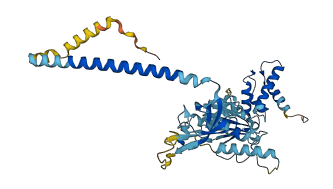
Descriptions
The autoinhibited protein was predicted that may have potential autoinhibitory elements via cis-regPred.
Autoinhibitory domains (AIDs)
Target domain |
|
Relief mechanism |
|
Assay |
cis-regPred |
Accessory elements
No accessory elements
Autoinhibited structure

Activated structure
5 structures for Q63569
| Entry ID | Method | Resolution | Chain | Position | Source |
|---|---|---|---|---|---|
| 6EPC | EM | 1230 A | M | 1-439 | PDB |
| 6EPD | EM | 1540 A | M | 1-439 | PDB |
| 6EPE | EM | 1280 A | M | 1-439 | PDB |
| 6EPF | EM | 1180 A | M | 1-439 | PDB |
| AF-Q63569-F1 | Predicted | AlphaFoldDB |
No variants for Q63569
| Variant ID(s) | Position | Change | Description | Diseaes Association | Provenance |
|---|---|---|---|---|---|
| No variants for Q63569 | |||||
No associated diseases with Q63569
5 regional properties for Q63569
| Type | Name | Position | InterPro Accession |
|---|---|---|---|
| domain | AAA+ ATPase domain | 219 - 358 | IPR003593 |
| domain | ATPase, AAA-type, core | 223 - 355 | IPR003959 |
| conserved_site | ATPase, AAA-type, conserved site | 326 - 344 | IPR003960 |
| domain | Proteasomal ATPase OB C-terminal domain | 90 - 165 | IPR032501 |
| domain | AAA ATPase, AAA+ lid domain | 378 - 419 | IPR041569 |
7 GO annotations of cellular component
| Name | Definition |
|---|---|
| cytoplasm | The contents of a cell excluding the plasma membrane and nucleus, but including other subcellular structures. |
| nucleus | A membrane-bounded organelle of eukaryotic cells in which chromosomes are housed and replicated. In most cells, the nucleus contains all of the cell's chromosomes except the organellar chromosomes, and is the site of RNA synthesis and processing. In some species, or in specialized cell types, RNA metabolism or DNA replication may be absent. |
| P-body | A focus in the cytoplasm where mRNAs may become inactivated by decapping or some other mechanism. Protein and RNA localized to these foci are involved in mRNA degradation, nonsense-mediated mRNA decay (NMD), translational repression, and RNA-mediated gene silencing. |
| perinuclear region of cytoplasm | Cytoplasm situated near, or occurring around, the nucleus. |
| proteasome accessory complex | A protein complex, that caps one or both ends of the proteasome core complex and regulates entry into, or exit from, the proteasome core complex. |
| proteasome complex | A large multisubunit complex which catalyzes protein degradation, found in eukaryotes, archaea and some bacteria. In eukaryotes, this complex consists of the barrel shaped proteasome core complex and one or two associated proteins or complexes that act in regulating entry into or exit from the core. |
| proteasome regulatory particle, base subcomplex | The subcomplex of the proteasome regulatory particle that directly associates with the proteasome core complex. |
4 GO annotations of molecular function
| Name | Definition |
|---|---|
| ATP binding | Binding to ATP, adenosine 5'-triphosphate, a universally important coenzyme and enzyme regulator. |
| ATP hydrolysis activity | Catalysis of the reaction: ATP + H2O = ADP + H+ phosphate. ATP hydrolysis is used in some reactions as an energy source, for example to catalyze a reaction or drive transport against a concentration gradient. |
| identical protein binding | Binding to an identical protein or proteins. |
| proteasome-activating activity | Catalysis of the reaction: ATP + H2O = ADP + phosphate, which promotes unfolding of protein substrates, and channel opening of the core proteasome. |
4 GO annotations of biological process
| Name | Definition |
|---|---|
| blastocyst development | The process whose specific outcome is the progression of the blastocyst over time, from its formation to the mature structure. The mammalian blastocyst is a hollow ball of cells containing two cell types, the inner cell mass and the trophectoderm. |
| modulation by host of viral transcription | Any process in which a host organism modulates the frequency, rate or extent of viral transcription. |
| positive regulation of transcription by RNA polymerase II | Any process that activates or increases the frequency, rate or extent of transcription from an RNA polymerase II promoter. |
| proteasome-mediated ubiquitin-dependent protein catabolic process | The chemical reactions and pathways resulting in the breakdown of a protein or peptide by hydrolysis of its peptide bonds, initiated by the covalent attachment of ubiquitin, and mediated by the proteasome. |
7 homologous proteins in AiPD
| UniProt AC | Gene Name | Protein Name | Species | Evidence Code |
|---|---|---|---|---|
| P17980 | PSMC3 | 26S proteasome regulatory subunit 6A | Homo sapiens (Human) | PR |
| O88685 | Psmc3 | 26S proteasome regulatory subunit 6A | Mus musculus (Mouse) | PR |
| Q63347 | Psmc2 | 26S proteasome regulatory subunit 7 | Rattus norvegicus (Rat) | PR |
| P62198 | Psmc5 | 26S proteasome regulatory subunit 8 | Rattus norvegicus (Rat) | PR |
| P46465 | TBP1 | 26S proteasome regulatory subunit 6A homolog | Oryza sativa subsp japonica (Rice) | PR |
| Q9SEI2 | RPT5A | 26S proteasome regulatory subunit 6A homolog A | Arabidopsis thaliana (Mouse-ear cress) | PR |
| P54776 | TBP1 | 26S proteasome regulatory subunit 6A homolog | Solanum lycopersicum (Tomato) (Lycopersicon esculentum) | PR |
| 10 | 20 | 30 | 40 | 50 | 60 |
| MNLLPTPESP | VTRQEKMATV | WDEAEQDGIG | EEVLKMSTEE | IVQRTRLLDS | EIKIMKSEVL |
| 70 | 80 | 90 | 100 | 110 | 120 |
| RVTHELQAMK | DKIKENSEKI | KVNKTLPYLV | SNVIELLDVD | PNDQEEDGAN | IDLDSQRKGK |
| 130 | 140 | 150 | 160 | 170 | 180 |
| CAVIKTSTRQ | TYFLPVIGLV | DAEKLKPGDL | VGVNKDSYLI | LETLPTEYDS | RVKAMEVDER |
| 190 | 200 | 210 | 220 | 230 | 240 |
| PTEQYSDIGG | LDKQIQELVE | AIVLPMNHKE | KFENLGIQPP | KGVLMYGPPG | TGKTLLARAC |
| 250 | 260 | 270 | 280 | 290 | 300 |
| AAQTKATFLK | LAGPQLVQMF | IGDGAKLVRD | AFALAKEKAP | SIIFIDELDA | IGTKRFDSEK |
| 310 | 320 | 330 | 340 | 350 | 360 |
| AGDREVQRTM | LELLNQLDGF | QPNTQVKVIA | ATNRVDILDP | ALLRSGRLDR | KIEFPMPNEE |
| 370 | 380 | 390 | 400 | 410 | 420 |
| ARARIMQIHS | RKMNVSPDVN | YEELARCTDD | FNGAQCKAVC | VEAGMIALRR | GATELTHEDY |
| 430 | |||||
| MEGILEVQAK | KKANLQYYA |