P62198
Gene name |
Psmc5 (Sug1) |
Protein name |
26S proteasome regulatory subunit 8 |
Names |
26S proteasome AAA-ATPase subunit RPT6, Proteasome 26S subunit ATPase 5, Proteasome subunit p45, Thyroid hormone receptor-interacting protein 1, TRIP1, p45/SUG |
Species |
Rattus norvegicus (Rat) |
KEGG Pathway |
rno:81827 |
EC number |
|
Protein Class |
|
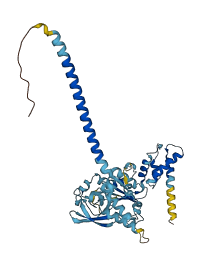
Descriptions
The autoinhibited protein was predicted that may have potential autoinhibitory elements via cis-regPred.
Autoinhibitory domains (AIDs)
Target domain |
|
Relief mechanism |
|
Assay |
cis-regPred |
Accessory elements
No accessory elements
Autoinhibited structure

Activated structure
5 structures for P62198
| Entry ID | Method | Resolution | Chain | Position | Source |
|---|---|---|---|---|---|
| 6EPC | EM | 1230 A | J | 1-406 | PDB |
| 6EPD | EM | 1540 A | J | 1-406 | PDB |
| 6EPE | EM | 1280 A | J | 1-406 | PDB |
| 6EPF | EM | 1180 A | J | 1-406 | PDB |
| AF-P62198-F1 | Predicted | AlphaFoldDB |
No variants for P62198
| Variant ID(s) | Position | Change | Description | Diseaes Association | Provenance |
|---|---|---|---|---|---|
| No variants for P62198 | |||||
No associated diseases with P62198
5 regional properties for P62198
| Type | Name | Position | InterPro Accession |
|---|---|---|---|
| domain | AAA+ ATPase domain | 182 - 321 | IPR003593 |
| domain | ATPase, AAA-type, core | 186 - 318 | IPR003959 |
| conserved_site | ATPase, AAA-type, conserved site | 289 - 307 | IPR003960 |
| domain | Proteasomal ATPase OB C-terminal domain | 73 - 128 | IPR032501 |
| domain | AAA ATPase, AAA+ lid domain | 342 - 384 | IPR041569 |
11 GO annotations of cellular component
| Name | Definition |
|---|---|
| cytoplasm | The contents of a cell excluding the plasma membrane and nucleus, but including other subcellular structures. |
| cytoplasmic vesicle | A vesicle found in the cytoplasm of a cell. |
| cytosolic proteasome complex | A proteasome complex found in the cytosol of a cell. |
| inclusion body | A discrete intracellular part formed of aggregated molecules such as proteins or other biopolymers. |
| nuclear proteasome complex | A proteasome found in the nucleus of a cell. |
| nucleus | A membrane-bounded organelle of eukaryotic cells in which chromosomes are housed and replicated. In most cells, the nucleus contains all of the cell's chromosomes except the organellar chromosomes, and is the site of RNA synthesis and processing. In some species, or in specialized cell types, RNA metabolism or DNA replication may be absent. |
| postsynapse | The part of a synapse that is part of the post-synaptic cell. |
| proteasome accessory complex | A protein complex, that caps one or both ends of the proteasome core complex and regulates entry into, or exit from, the proteasome core complex. |
| proteasome complex | A large multisubunit complex which catalyzes protein degradation, found in eukaryotes, archaea and some bacteria. In eukaryotes, this complex consists of the barrel shaped proteasome core complex and one or two associated proteins or complexes that act in regulating entry into or exit from the core. |
| proteasome regulatory particle | A multisubunit complex, which caps one or both ends of the proteasome core complex. This complex recognizes and unfolds ubiquitinated proteins, and translocates them to the proteasome core complex. |
| proteasome regulatory particle, base subcomplex | The subcomplex of the proteasome regulatory particle that directly associates with the proteasome core complex. |
8 GO annotations of molecular function
| Name | Definition |
|---|---|
| ATP binding | Binding to ATP, adenosine 5'-triphosphate, a universally important coenzyme and enzyme regulator. |
| ATP hydrolysis activity | Catalysis of the reaction: ATP + H2O = ADP + H+ phosphate. ATP hydrolysis is used in some reactions as an energy source, for example to catalyze a reaction or drive transport against a concentration gradient. |
| DNA-binding transcription factor binding | Binding to a DNA-binding transcription factor, a protein that interacts with a specific DNA sequence (sometimes referred to as a motif) within the regulatory region of a gene to modulate transcription. |
| general transcription initiation factor binding | Binding to a general transcription initiation factor, a protein that contributes to transcription start site selection and transcription initiation. |
| proteasome-activating activity | Catalysis of the reaction: ATP + H2O = ADP + phosphate, which promotes unfolding of protein substrates, and channel opening of the core proteasome. |
| signaling receptor binding | Binding to one or more specific sites on a receptor molecule, a macromolecule that undergoes combination with a hormone, neurotransmitter, drug or intracellular messenger to initiate a change in cell function. |
| TBP-class protein binding | Binding to a member of the class of TATA-binding proteins (TBP), including any of the TBP-related factors (TRFs). |
| thyrotropin-releasing hormone receptor binding | Binding to a receptor for thyrotropin-releasing hormone, a tripeptide hormone that is produced by the hypothalamus and stimulates the release of thyroid-stimulating hormone (TSH) and prolactin by the anterior pituitary. |
6 GO annotations of biological process
| Name | Definition |
|---|---|
| modulation of chemical synaptic transmission | Any process that modulates the frequency or amplitude of synaptic transmission, the process of communication from a neuron to a target (neuron, muscle, or secretory cell) across a synapse. Amplitude, in this case, refers to the change in postsynaptic membrane potential due to a single instance of synaptic transmission. |
| negative regulation of DNA-templated transcription | Any process that stops, prevents, or reduces the frequency, rate or extent of cellular DNA-templated transcription. |
| positive regulation of inclusion body assembly | Any process that increases the rate, frequency, or extent of inclusion body assembly. Inclusion body assembly is the aggregation, arrangement and bonding together of a set of components to form an inclusion body. |
| proteasome-mediated ubiquitin-dependent protein catabolic process | The chemical reactions and pathways resulting in the breakdown of a protein or peptide by hydrolysis of its peptide bonds, initiated by the covalent attachment of ubiquitin, and mediated by the proteasome. |
| regulation of protein catabolic process at postsynapse, modulating synaptic transmission | Any process that modulates synaptic transmission by regulating a catabolic process occurring at a postsynapse. |
| regulation of transcription by RNA polymerase II | Any process that modulates the frequency, rate or extent of transcription mediated by RNA polymerase II. |
8 homologous proteins in AiPD
| UniProt AC | Gene Name | Protein Name | Species | Evidence Code |
|---|---|---|---|---|
| Q01939 | RPT6 | 26S proteasome regulatory subunit 8 homolog | Saccharomyces cerevisiae (strain ATCC 204508 / S288c) (Baker's yeast) | PR |
| P62194 | PSMC5 | 26S proteasome regulatory subunit 8 | Bos taurus (Bovine) | PR |
| O18413 | Rpt6 | 26S proteasome regulatory subunit 8 | Drosophila melanogaster (Fruit fly) | PR |
| P62195 | PSMC5 | 26S proteasome regulatory subunit 8 | Homo sapiens (Human) | PR |
| P62196 | Psmc5 | 26S proteasome regulatory subunit 8 | Mus musculus (Mouse) | PR |
| P62197 | PSMC5 | 26S proteasome regulatory subunit 8 | Sus scrofa (Pig) | PR |
| Q63569 | Psmc3 | 26S proteasome regulatory subunit 6A | Rattus norvegicus (Rat) | PR |
| Q63347 | Psmc2 | 26S proteasome regulatory subunit 7 | Rattus norvegicus (Rat) | PR |
| 10 | 20 | 30 | 40 | 50 | 60 |
| MALDGPEQME | LEEGKAGSGL | RQYYLSKIEE | LQLIVNDKSQ | NLRRLQAQRN | ELNAKVRLLR |
| 70 | 80 | 90 | 100 | 110 | 120 |
| EELQLLQEQG | SYVGEVVRAM | DKKKVLVKVH | PEGKFVVDVD | KNIDINDVTP | NCRVALRNDS |
| 130 | 140 | 150 | 160 | 170 | 180 |
| YTLHKILPNK | VDPLVSLMMV | EKVPDSTYEM | IGGLDKQIKE | IKEVIELPVK | HPELFEALGI |
| 190 | 200 | 210 | 220 | 230 | 240 |
| AQPKGVLLYG | PPGTGKTLLA | RAVAHHTDCT | FIRVSGSELV | QKFIGEGARM | VRELFVMARE |
| 250 | 260 | 270 | 280 | 290 | 300 |
| HAPSIIFMDE | IDSIGSSRLE | GGSGGDSEVQ | RTMLELLNQL | DGFEATKNIK | VIMATNRIDI |
| 310 | 320 | 330 | 340 | 350 | 360 |
| LDSALLRPGR | IDRKIEFPPP | NEEARLDILK | IHSRKMNLTR | GINLRKIAEL | MPGASGAEVK |
| 370 | 380 | 390 | 400 | ||
| GVCTEAGMYA | LRERRVHVTQ | EDFEMAVAKV | MQKDSEKNMS | IKKLWK |