Q9M271
Gene name |
MTPA1 (MTP2, At3g61940, F21F14.110) |
Protein name |
Metal tolerance protein A1 |
Names |
AtMTP2, AtMTPa1 |
Species |
Arabidopsis thaliana (Mouse-ear cress) |
KEGG Pathway |
ath:AT3G61940 |
EC number |
|
Protein Class |
|
Descriptions
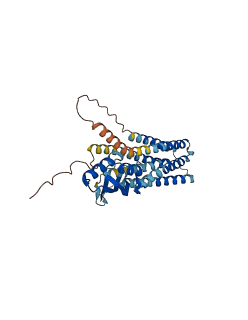
The autoinhibited protein was predicted that may have potential autoinhibitory elements via cis-regPred.
Autoinhibitory domains (AIDs)
Target domain |
|
Relief mechanism |
|
Assay |
cis-regPred |
Accessory elements
No accessory elements
Autoinhibited structure

Activated structure
1 structures for Q9M271
| Entry ID | Method | Resolution | Chain | Position | Source |
|---|---|---|---|---|---|
| AF-Q9M271-F1 | Predicted | AlphaFoldDB |
48 variants for Q9M271
| Variant ID(s) | Position | Change | Description | Diseaes Association | Provenance |
|---|---|---|---|---|---|
| ENSVATH12877858 | 8 | V>I | No | 1000Genomes | |
| ENSVATH12877859 | 9 | C>F | No | 1000Genomes | |
| ENSVATH12877860 | 9 | C>W | No | 1000Genomes | |
| ENSVATH00431647 | 12 | T>I | No | 1000Genomes | |
| ENSVATH00431647 | 12 | T>R | No | 1000Genomes | |
| ENSVATH00431648 | 27 | A>P | No | 1000Genomes | |
| ENSVATH06358370 | 30 | M>V | No | 1000Genomes | |
| ENSVATH06358371 | 36 | V>F | No | 1000Genomes | |
| ENSVATH06358371 | 36 | V>L | No | 1000Genomes | |
| ENSVATH12877861 | 51 | G>D | No | 1000Genomes | |
| ENSVATH14467925 | 84 | S>F | No | 1000Genomes | |
| ENSVATH02535810 | 85 | W>R | No | 1000Genomes | |
| tmp_3_22937736_A_T | 98 | I>L | No | 1000Genomes | |
| ENSVATH06358374 | 107 | I>V | No | 1000Genomes | |
| ENSVATH06358376 | 114 | T>N | No | 1000Genomes | |
| ENSVATH06358377 | 128 | E>G | No | 1000Genomes | |
| ENSVATH14467926 | 129 | T>S | No | 1000Genomes | |
| ENSVATH12877875 | 131 | D>A | No | 1000Genomes | |
| tmp_3_22937841_G_A | 133 | V>I | No | 1000Genomes | |
| ENSVATH12877876 | 134 | D>E | No | 1000Genomes | |
| ENSVATH14467927 | 136 | F>L | No | 1000Genomes | |
| ENSVATH06358381 | 173 | G>V | No | 1000Genomes | |
| ENSVATH06358382 | 178 | E>K | No | 1000Genomes | |
| ENSVATH00431649 | 194 | N>S | No | 1000Genomes | |
| tmp_3_22938033_G_C | 197 | G>R | No | 1000Genomes | |
| tmp_3_22938051_C_A | 203 | L>I | No | 1000Genomes | |
| ENSVATH14467928 | 216 | G>E | No | 1000Genomes | |
| ENSVATH14467929 | 217 | G>R | No | 1000Genomes | |
| tmp_3_22938107_T_A | 221 | Y>* | No | 1000Genomes | |
| tmp_3_22938109_A_G | 222 | N>S | No | 1000Genomes | |
| ENSVATH06358383 | 223 | P>H | No | 1000Genomes | |
| ENSVATH00431650 | 226 | K>T | No | 1000Genomes | |
| tmp_3_22938138_T_A | 232 | C>S | No | 1000Genomes | |
| ENSVATH00431651 | 235 | F>L | No | 1000Genomes | |
| tmp_3_22938194_C_A | 250 | S>R | No | 1000Genomes | |
| ENSVATH14467930 | 255 | L>P | No | 1000Genomes | |
| ENSVATH06358385 | 264 | D>A | No | 1000Genomes | |
| ENSVATH00431652 | 270 | K>* | Number of days following stratification to opening of first flower. the experiment was stopped at 200 d and accessions that had not flowered at that point were assigned a value of 200 [18c and 16 hrs daylight] Plants were checked bi-weekly for presence of first buds and the average flowering time of 4 plants of the same accession were collected [16c and 16 hrs daylight] Plants were checked bi-weekly for presence of first buds and the average flowering time of 4 plants of the same accession were collected [22c and 16 hrs daylight] Plants were checked bi-weekly for presence of first buds and the average leaf number at flowering time of 4 plants of the same accession were collected [16c and 16 hrs daylight] Flowering time was scored as the number of days for the bolt to reach 5cm [20-22c and natural light from the middle of october 2002 till march 2003] Plants were checked bi-weekly for presence of first buds and the average leaf number at flowering time of 4 plants of the same accession were collected [22c and 16 hrs daylight] [EnsemblGenome] | No | 1000Genomes |
| tmp_3_22938267_A_T | 275 | I>F | No | 1000Genomes | |
| tmp_3_22938289_A_T | 282 | H>L | No | 1000Genomes | |
| tmp_3_22938297_C_T | 285 | H>Y | No | 1000Genomes | |
| tmp_3_22938310_T_C | 289 | I>T | No | 1000Genomes | |
| ENSVATH00431653 | 294 | A>G | No | 1000Genomes | |
| tmp_3_22938332_T_G | 296 | F>L | No | 1000Genomes | |
| ENSVATH06358386 | 302 | V>A | No | 1000Genomes | |
| ENSVATH06358387 | 303 | R>T | No | 1000Genomes | |
| ENSVATH12877879 | 322 | E>* | No | 1000Genomes | |
| ENSVATH12877880 | 322 | E>V | No | 1000Genomes |
No associated diseases with Q9M271
No regional properties for Q9M271
| Type | Name | Position | InterPro Accession |
|---|---|---|---|
| No domain, repeats, and functional sites for Q9M271 | |||
5 GO annotations of cellular component
| Name | Definition |
|---|---|
| endoplasmic reticulum membrane | The lipid bilayer surrounding the endoplasmic reticulum. |
| integral component of membrane | The component of a membrane consisting of the gene products and protein complexes having at least some part of their peptide sequence embedded in the hydrophobic region of the membrane. |
| plasma membrane | The membrane surrounding a cell that separates the cell from its external environment. It consists of a phospholipid bilayer and associated proteins. |
| vacuolar membrane | The lipid bilayer surrounding the vacuole and separating its contents from the cytoplasm of the cell. |
| vacuole | A closed structure, found only in eukaryotic cells, that is completely surrounded by unit membrane and contains liquid material. Cells contain one or several vacuoles, that may have different functions from each other. Vacuoles have a diverse array of functions. They can act as a storage organelle for nutrients or waste products, as a degradative compartment, as a cost-effective way of increasing cell size, and as a homeostatic regulator controlling both turgor pressure and pH of the cytosol. |
2 GO annotations of molecular function
| Name | Definition |
|---|---|
| metal ion binding | Binding to a metal ion. |
| zinc ion transmembrane transporter activity | Enables the transfer of zinc (Zn) ions from one side of a membrane to the other. |
3 GO annotations of biological process
| Name | Definition |
|---|---|
| metal ion transport | The directed movement of metal ions, any metal ion with an electric charge, into, out of or within a cell, or between cells, by means of some agent such as a transporter or pore. |
| zinc ion transmembrane transport | A process in which a zinc II ion is transported from one side of a membrane to the other by means of some agent such as a transporter or pore. |
| zinc ion transport | The directed movement of zinc (Zn II) ions into, out of or within a cell, or between cells, by means of some agent such as a transporter or pore. |
5 homologous proteins in AiPD
| UniProt AC | Gene Name | Protein Name | Species | Evidence Code |
|---|---|---|---|---|
| P97441 | Slc30a3 | Zinc transporter 3 | Mus musculus (Mouse) | PR |
| Q2HJ10 | Slc30a2 | Zinc transporter 2 | Mus musculus (Mouse) | PR |
| P0CE46 | Slc30a8 | Zinc transporter 8 | Rattus norvegicus (Rat) | PR |
| Q9MAP1 | At1g33020 | Putative F-box protein At1g33020 | Arabidopsis thaliana (Mouse-ear cress) | PR |
| Q6DBM8 | MTPB | Metal tolerance protein B | Arabidopsis thaliana (Mouse-ear cress) | PR |
| 10 | 20 | 30 | 40 | 50 | 60 |
| MDSRRSKVCG | ETACGFSTSS | SDAKKRAASM | RKLCFVVVLC | LLFMSIEVVC | GIKANSLAIL |
| 70 | 80 | 90 | 100 | 110 | 120 |
| ADAAHLLTDV | GAFAISMLSL | WASSWEANPR | QSYGFFRIEI | LGTLVSIQLI | WLLTGILVYE |
| 130 | 140 | 150 | 160 | 170 | 180 |
| AVTRLVQETN | DDVDGFFMVL | VAAFGLVVNI | IMIVVLGHDH | GHGHDHGHSH | DHGHSYGERA |
| 190 | 200 | 210 | 220 | 230 | 240 |
| EQLLEKSKEI | RNINVQGAYL | HVLGDLIQSI | GVMIGGGMIW | YNPKWKVIDL | ICTLFFSVIV |
| 250 | 260 | 270 | 280 | 290 | 300 |
| LGTTIKMLRS | ILEVLMESTP | REIDARQLEK | GLMEIEEVVD | VHELHIWAIT | VGKALFSCHV |
| 310 | 320 | 330 | |||
| KVRPEAGDEM | VLNKVIDYIW | REYRISHVTI | QIER |