Q9JMI1
Gene name |
Aacs |
Protein name |
Acetoacetyl-CoA synthetase |
Names |
|
Species |
Rattus norvegicus (Rat) |
KEGG Pathway |
rno:65984 |
EC number |
6.2.1.16: Acid--thiol ligases |
Protein Class |
|
Descriptions
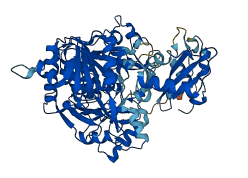
The autoinhibited protein was predicted that may have potential autoinhibitory elements via cis-regPred.
Autoinhibitory domains (AIDs)
Target domain |
|
Relief mechanism |
|
Assay |
cis-regPred |
Accessory elements
No accessory elements
Autoinhibited structure

Activated structure
1 structures for Q9JMI1
| Entry ID | Method | Resolution | Chain | Position | Source |
|---|---|---|---|---|---|
| AF-Q9JMI1-F1 | Predicted | AlphaFoldDB |
No variants for Q9JMI1
| Variant ID(s) | Position | Change | Description | Diseaes Association | Provenance |
|---|---|---|---|---|---|
| No variants for Q9JMI1 | |||||
No associated diseases with Q9JMI1
Functions
| Description | ||
|---|---|---|
| EC Number | 6.2.1.16 | Acid--thiol ligases |
| Subcellular Localization |
|
|
| PANTHER Family | ||
| PANTHER Subfamily | ||
| PANTHER Protein Class | ||
| PANTHER Pathway Category | No pathway information available | |
1 GO annotations of cellular component
| Name | Definition |
|---|---|
| cytosol | The part of the cytoplasm that does not contain organelles but which does contain other particulate matter, such as protein complexes. |
3 GO annotations of molecular function
| Name | Definition |
|---|---|
| acetoacetate-CoA ligase activity | Catalysis of the reaction: acetoacetate + ATP + CoA = acetoacetyl-CoA + AMP + diphosphate + H(+). |
| ATP binding | Binding to ATP, adenosine 5'-triphosphate, a universally important coenzyme and enzyme regulator. |
| butyrate-CoA ligase activity | Catalysis of the reaction: ATP + an acid + CoA = AMP + diphosphate + an acyl-CoA. |
16 GO annotations of biological process
| Name | Definition |
|---|---|
| adipose tissue development | The process whose specific outcome is the progression of adipose tissue over time, from its formation to the mature structure. Adipose tissue is specialized tissue that is used to store fat. |
| cellular response to cholesterol | Any process that results in a change in state or activity of a cell (in terms of movement, secretion, enzyme production, gene expression, etc.) as a result of a cholesterol stimulus. |
| cellular response to glucose stimulus | Any process that results in a change in state or activity of a cell (in terms of movement, secretion, enzyme production, gene expression, etc.) as a result of a glucose stimulus. |
| cellular response to testosterone stimulus | Any process that results in a change in state or activity of a cell (in terms of movement, secretion, enzyme production, gene expression, etc.) as a result of a testosterone stimulus. |
| fatty acid metabolic process | The chemical reactions and pathways involving fatty acids, aliphatic monocarboxylic acids liberated from naturally occurring fats and oils by hydrolysis. |
| liver development | The process whose specific outcome is the progression of the liver over time, from its formation to the mature structure. The liver is an exocrine gland which secretes bile and functions in metabolism of protein and carbohydrate and fat, synthesizes substances involved in the clotting of the blood, synthesizes vitamin A, detoxifies poisonous substances, stores glycogen, and breaks down worn-out erythrocytes. |
| positive regulation of insulin secretion | Any process that activates or increases the frequency, rate or extent of the regulated release of insulin. |
| response to ethanol | Any process that results in a change in state or activity of a cell or an organism (in terms of movement, secretion, enzyme production, gene expression, etc.) as a result of an ethanol stimulus. |
| response to nutrient | Any process that results in a change in state or activity of a cell or an organism (in terms of movement, secretion, enzyme production, gene expression, etc.) as a result of a nutrient stimulus. |
| response to oleic acid | Any process that results in a change in state or activity of a cell or an organism (in terms of movement, secretion, enzyme production, gene expression, etc.) as a result of an oleic acid stimulus. |
| response to organic cyclic compound | Any process that results in a change in state or activity of a cell or an organism (in terms of movement, secretion, enzyme production, gene expression, etc.) as a result of an organic cyclic compound stimulus. |
| response to organonitrogen compound | Any process that results in a change in state or activity of a cell or an organism (in terms of movement, secretion, enzyme production, gene expression, etc.) as a result of an organonitrogen stimulus. An organonitrogen compound is formally a compound containing at least one carbon-nitrogen bond. |
| response to purine-containing compound | Any process that results in a change in state or activity of a cell or an organism (in terms of movement, secretion, enzyme production, gene expression, etc.) as a result of a purine-containing compound stimulus. |
| response to starvation | Any process that results in a change in state or activity of a cell or an organism (in terms of movement, secretion, enzyme production, gene expression, etc.) as a result of a starvation stimulus, deprivation of nourishment. |
| response to xenobiotic stimulus | Any process that results in a change in state or activity of a cell or an organism (in terms of movement, secretion, enzyme production, gene expression, etc.) as a result of a stimulus from a xenobiotic, a compound foreign to the organim exposed to it. It may be synthesized by another organism (like ampicilin) or it can be a synthetic chemical. |
| white fat cell differentiation | The process in which a relatively unspecialized cell acquires specialized features of a white adipocyte, an animal connective tissue cell involved in energy storage. White adipocytes have cytoplasmic lipids arranged in a unique vacuole. |
8 homologous proteins in AiPD
| UniProt AC | Gene Name | Protein Name | Species | Evidence Code |
|---|---|---|---|---|
| Q9NR19 | ACSS2 | Acetyl-coenzyme A synthetase, cytoplasmic | Homo sapiens (Human) | PR |
| Q68CK6 | ACSM2B | Acyl-coenzyme A synthetase ACSM2B, mitochondrial | Homo sapiens (Human) | PR |
| Q08AH3 | ACSM2A | Acyl-coenzyme A synthetase ACSM2A, mitochondrial | Homo sapiens (Human) | PR |
| Q9QXG4 | Acss2 | Acetyl-coenzyme A synthetase, cytoplasmic | Mus musculus (Mouse) | PR |
| Q8K0L3 | Acsm2 | Acyl-coenzyme A synthetase ACSM2, mitochondrial | Mus musculus (Mouse) | PR |
| Q9D2R0 | Aacs | Acetoacetyl-CoA synthetase | Mus musculus (Mouse) | PR |
| O70490 | Acsm2 | Acyl-coenzyme A synthetase ACSM2, mitochondrial | Rattus norvegicus (Rat) | PR |
| Q84P17 | AAE18 | Probable acyl-activating enzyme 18, peroxisomal | Arabidopsis thaliana (Mouse-ear cress) | PR |
| 10 | 20 | 30 | 40 | 50 | 60 |
| MSKLARLERE | EIMECQVMWE | PDSKKDTQMD | RFRAAVGTAC | GLALGNYDDL | YHWSVRSYSD |
| 70 | 80 | 90 | 100 | 110 | 120 |
| FWAEFWKFSG | IVCSRMYDEV | VDTSKGIADV | PEWFRGSRLN | YAENLLRHKE | NDRVALYVAR |
| 130 | 140 | 150 | 160 | 170 | 180 |
| EGREEIAKVT | FEELRQQVAL | FAAAMRKMGV | KKGDRVVGYL | PNSAHAVEAM | LAAASIGAIW |
| 190 | 200 | 210 | 220 | 230 | 240 |
| SSTSPDFGVN | GVLDRFSQIQ | PKLIFSVEAV | VYNGKEHGHL | EKLQRVVKGL | PDLQRVVLIP |
| 250 | 260 | 270 | 280 | 290 | 300 |
| YVLPREKIDI | SKIPNSMFLD | DFLASGTGAQ | APQLEFEQLP | FSHPLFIMFS | SGTTGAPKCM |
| 310 | 320 | 330 | 340 | 350 | 360 |
| VHSAGGTLIQ | HLKEHVLHGN | MTSSDILLYY | TTVGWMMWNW | MVSALATGAS | LVLYDGSPLV |
| 370 | 380 | 390 | 400 | 410 | 420 |
| PTPNVLWDLV | DRIGITILGT | GAKWLSVLEE | KDMKPMETHN | LHTLHTILST | GSPLKAQSYE |
| 430 | 440 | 450 | 460 | 470 | 480 |
| YVYRCIKSTV | LLGSISGGTD | IISCFMGQNS | SIPVYKGEIQ | ARNLGMAVEA | WDEEGKTVWG |
| 490 | 500 | 510 | 520 | 530 | 540 |
| ASGELVCTKP | IPCQPTHFWN | DENGSKYRKA | YFSKYPGVWA | HGDYCRINPK | TGGIVMLGRS |
| 550 | 560 | 570 | 580 | 590 | 600 |
| DGTLNPNGVR | FGSSEIYNIV | EAFDEVEDSL | CVPQYNRDGE | ERVVLFLKMA | SGHTFQPDLV |
| 610 | 620 | 630 | 640 | 650 | 660 |
| KHIRDAIRLG | LSARHVPSLI | LETQGIPYTI | NGKKVEVAVK | QVIAGKTVEH | RGAFSNPESL |
| 670 | |||||
| DLYRDIPELQ | DF |