Q9ERM3
Gene name |
Dgat1 |
Protein name |
Diacylglycerol O-acyltransferase 1 |
Names |
ICAM-4, Acyl-CoA retinol O-fatty-acyltransferase, ARAT, Retinol O-fatty-acyltransferase, Diglyceride acyltransferase |
Species |
Rattus norvegicus (Rat) |
KEGG Pathway |
rno:84497 |
EC number |
2.3.1.20: Transferring groups other than amino-acyl groups |
Protein Class |
|
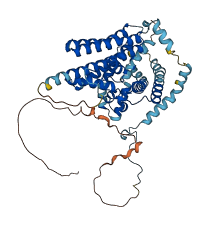
Descriptions
The autoinhibited protein was predicted that may have potential autoinhibitory elements via cis-regPred.
Autoinhibitory domains (AIDs)
Target domain |
|
Relief mechanism |
|
Assay |
cis-regPred |
Accessory elements
No accessory elements
Autoinhibited structure

Activated structure
1 structures for Q9ERM3
| Entry ID | Method | Resolution | Chain | Position | Source |
|---|---|---|---|---|---|
| AF-Q9ERM3-F1 | Predicted | AlphaFoldDB |
No variants for Q9ERM3
| Variant ID(s) | Position | Change | Description | Diseaes Association | Provenance |
|---|---|---|---|---|---|
| No variants for Q9ERM3 | |||||
No associated diseases with Q9ERM3
6 regional properties for Q9ERM3
| Type | Name | Position | InterPro Accession |
|---|---|---|---|
| domain | Coagulation factor 5/8 C-terminal domain | 272 - 422 | IPR000421-1 |
| domain | Coagulation factor 5/8 C-terminal domain | 428 - 581 | IPR000421-2 |
| domain | CUB domain | 25 - 139 | IPR000859-1 |
| domain | CUB domain | 145 - 263 | IPR000859-2 |
| domain | MAM domain | 639 - 811 | IPR000998 |
| domain | Neuropilin, C-terminal | 847 - 923 | IPR022579 |
Functions
| Description | ||
|---|---|---|
| EC Number | 2.3.1.20 | Transferring groups other than amino-acyl groups |
| Subcellular Localization |
|
|
| PANTHER Family | ||
| PANTHER Subfamily | ||
| PANTHER Protein Class | ||
| PANTHER Pathway Category | No pathway information available | |
5 GO annotations of cellular component
| Name | Definition |
|---|---|
| endoplasmic reticulum membrane | The lipid bilayer surrounding the endoplasmic reticulum. |
| integral component of membrane | The component of a membrane consisting of the gene products and protein complexes having at least some part of their peptide sequence embedded in the hydrophobic region of the membrane. |
| intracellular membrane-bounded organelle | Organized structure of distinctive morphology and function, bounded by a single or double lipid bilayer membrane and occurring within the cell. Includes the nucleus, mitochondria, plastids, vacuoles, and vesicles. Excludes the plasma membrane. |
| membrane | A lipid bilayer along with all the proteins and protein complexes embedded in it an attached to it. |
| plasma membrane | The membrane surrounding a cell that separates the cell from its external environment. It consists of a phospholipid bilayer and associated proteins. |
8 GO annotations of molecular function
| Name | Definition |
|---|---|
| 2-acylglycerol O-acyltransferase activity | Catalysis of the reaction: acyl-CoA + 2-acylglycerol = CoA + diacylglycerol. |
| acyltransferase activity | Catalysis of the transfer of an acyl group from one compound (donor) to another (acceptor). |
| diacylglycerol binding | Binding to a diacylglycerol, a diester of glycerol and two fatty acids. |
| diacylglycerol O-acyltransferase activity | Catalysis of the reaction: acyl-CoA + 1,2-diacylglycerol = CoA + triacylglycerol. |
| fatty acid binding | Binding to a fatty acid, an aliphatic monocarboxylic acids liberated from naturally occurring fats and oils by hydrolysis. |
| identical protein binding | Binding to an identical protein or proteins. |
| O-acyltransferase activity | Catalysis of the transfer of an acyl group to an oxygen atom on the acceptor molecule. |
| retinol O-fatty-acyltransferase activity | Catalysis of the reaction: acyl-CoA + retinol = CoA + retinyl ester. |
17 GO annotations of biological process
| Name | Definition |
|---|---|
| diacylglycerol metabolic process | The chemical reactions and pathways involving diacylglycerol, a glyceride in which any two of the R groups (positions not specified) are acyl groups while the remaining R group can be either H or an alkyl group. |
| fatty acid homeostasis | Any process involved in the maintenance of an internal steady state of fatty acid within an organism or cell. |
| glycerolipid metabolic process | The chemical reactions and pathways involving glycerolipids, any lipid with a glycerol backbone. Diacylglycerol and phosphatidate are key lipid intermediates of glycerolipid biosynthesis. |
| insulin secretion | The regulated release of proinsulin from secretory granules accompanied by cleavage of proinsulin to form mature insulin. In vertebrates, insulin is secreted from B granules in the B cells of the vertebrate pancreas and from insulin-producing cells in insects. |
| ketone body metabolic process | The chemical reactions and pathways involving ketone body. |
| lipid storage | The accumulation and maintenance in cells or tissues of lipids, compounds soluble in organic solvents but insoluble or sparingly soluble in aqueous solvents. Lipid reserves can be accumulated during early developmental stages for mobilization and utilization at later stages of development. |
| long-chain fatty-acyl-CoA metabolic process | The chemical reactions and pathways involving long-chain fatty-acyl-CoAs, any derivative of coenzyme A in which the sulfhydryl group is in a thioester linkage with a long-chain fatty-acyl group. Long-chain fatty-acyl-CoAs have chain lengths of C13 or more. |
| monoacylglycerol biosynthetic process | The chemical reactions and pathways resulting in the formation of monoacylglycerol, any ester of glycerol in which any one of its hydroxyl groups has been acylated with a fatty acid, the other being non-esterified. |
| positive regulation of fatty acid oxidation | Any process that activates or increases the frequency, rate or extent of fatty acid oxidation. |
| positive regulation of hepatic stellate cell activation | Any process that activates or increases the frequency, rate or extent of hepatic stellate cell activation. |
| positive regulation of triglyceride biosynthetic process | Any process that increases the rate, frequency, or extent of triglyceride biosynthesis. Triglyceride biosynthesis is the collection of chemical reactions and pathways resulting in the formation of triglyceride, any triester of glycerol. |
| regulation of eating behavior | Any process that modulates the frequency, rate or extent of eating behavior. |
| regulation of intestinal lipid absorption | Any process that modulates the frequency, rate or extent of intestinal lipid absorption. |
| regulation of vitamin A metabolic process | Any process that modulates the frequency, rate or extent of vitamin A metabolic process. |
| response to human chorionic gonadotropin | Any process that results in a change in state or activity of a cell or organism (in terms of movement, secretion, enzyme production, gene expression, etc.) as a result of a human chorionic gonadotropin stimulus. |
| triglyceride biosynthetic process | The chemical reactions and pathways resulting in the formation of a triglyceride, any triester of glycerol. |
| very-low-density lipoprotein particle assembly | The non-covalent aggregation and arrangement of proteins and lipids in the liver to form a very-low-density lipoprotein particle. |
6 homologous proteins in AiPD
| UniProt AC | Gene Name | Protein Name | Species | Evidence Code |
|---|---|---|---|---|
| Q8MK44 | DGAT1 | Diacylglycerol O-acyltransferase 1 | Bos taurus (Bovine) | PR |
| P35610 | SOAT1 | Sterol O-acyltransferase 1 | Homo sapiens (Human) | PR |
| O75907 | DGAT1 | Diacylglycerol O-acyltransferase 1 | Homo sapiens (Human) | PR |
| O88908 | Soat2 | Sterol O-acyltransferase 2 | Mus musculus (Mouse) | PR |
| Q9Z2A7 | Dgat1 | Diacylglycerol O-acyltransferase 1 | Mus musculus (Mouse) | PR |
| Q9SLD2 | DGAT1 | Diacylglycerol O-acyltransferase 1 | Arabidopsis thaliana (Mouse-ear cress) | PR |
| 10 | 20 | 30 | 40 | 50 | 60 |
| MGDRGGAGSS | RRRRTGSRVS | VQGGSGPKVE | EDEVREAAVS | PDLGAGGDAP | APAPAPAHTR |
| 70 | 80 | 90 | 100 | 110 | 120 |
| DKDRQTSVGD | GHWELRCHRL | QDSLFSSDSG | FSNYRGILNW | CVVMLILSNA | RLSLENLIKY |
| 130 | 140 | 150 | 160 | 170 | 180 |
| GILVDPIQVV | SLFLKDPYSW | PAPCLIIASN | IFIVATFQIE | KRLSVGALTE | QMGLLLHVVN |
| 190 | 200 | 210 | 220 | 230 | 240 |
| LATIICFPAA | VALLVESITP | VGSLFALASY | SIIFLKLSSY | RDVNLWCRQR | RVKAKAVSAG |
| 250 | 260 | 270 | 280 | 290 | 300 |
| KKVSGAAAQN | TVSYPDNLTY | RDLYYFIFAP | TLCYELNFPR | SPRIRKRFLL | RRVLEMLFFT |
| 310 | 320 | 330 | 340 | 350 | 360 |
| QLQVGLIQQW | MVPTIQNSMK | PFKDMDYSRI | IERLLKLAVP | NHLIWLIFFY | WLFHSCLNAV |
| 370 | 380 | 390 | 400 | 410 | 420 |
| AELLQFGDRE | FYRDWWNAES | VTYFWQNWNI | PVHKWCIRHF | YKPMLRLGSN | KWMARTGVFW |
| 430 | 440 | 450 | 460 | 470 | 480 |
| ASAFFHEYLV | SIPLRMFRLW | AFTAMMAQVP | LAWIVNRFFQ | GNYGNAAVWV | TLIIGQPVAV |
| 490 | |||||
| LMYVHDYYVL | NYDAPVGA |