Q96242
Gene name |
CYP74A (AOS, At5g42650, MJB21.2) |
Protein name |
Allene oxide synthase, chloroplastic |
Names |
Cytochrome P450 74A, Hydroperoxide dehydrase |
Species |
Arabidopsis thaliana (Mouse-ear cress) |
KEGG Pathway |
ath:AT5G42650 |
EC number |
4.2.1.92: Hydro-lyases |
Protein Class |
|
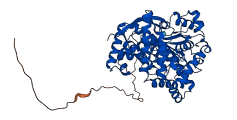
Descriptions
The autoinhibited protein was predicted that may have potential autoinhibitory elements via cis-regPred.
Autoinhibitory domains (AIDs)
Target domain |
|
Relief mechanism |
|
Assay |
cis-regPred |
Accessory elements
No accessory elements
Autoinhibited structure

Activated structure
8 structures for Q96242
| Entry ID | Method | Resolution | Chain | Position | Source |
|---|---|---|---|---|---|
| 2RCH | X-ray | 185 A | A/B | 34-518 | PDB |
| 2RCL | X-ray | 241 A | A/B | 34-518 | PDB |
| 2RCM | X-ray | 173 A | A/B | 34-518 | PDB |
| 3CLI | X-ray | 180 A | A/B | 34-518 | PDB |
| 3DSI | X-ray | 160 A | A/B | 34-518 | PDB |
| 3DSJ | X-ray | 160 A | A/B | 34-518 | PDB |
| 3DSK | X-ray | 155 A | A/B | 34-518 | PDB |
| AF-Q96242-F1 | Predicted | AlphaFoldDB |
24 variants for Q96242
| Variant ID(s) | Position | Change | Description | Diseaes Association | Provenance |
|---|---|---|---|---|---|
| ENSVATH07305984 | 3 | S>C | No | 1000Genomes | |
| ENSVATH00697324 | 7 | P>H | No | 1000Genomes | |
| tmp_5_17099338_A_G | 8 | F>L | No | 1000Genomes | |
| ENSVATH12393105 | 26 | V>F | No | 1000Genomes | |
| ENSVATH14570350 | 26 | V>G | No | 1000Genomes | |
| tmp_5_17099217_C_T | 48 | G>E | No | 1000Genomes | |
| ENSVATH12393034 | 60 | N>K | No | 1000Genomes | |
| tmp_5_17098784_C_A | 192 | E>D | No | 1000Genomes | |
| tmp_5_17098634_C_G | 242 | L>F | No | 1000Genomes | |
| ENSVATH00697310 | 295 | E>D | No | 1000Genomes | |
| tmp_5_17098441_G_C | 307 | R>G | No | 1000Genomes | |
| tmp_5_17098399_T_G | 321 | N>H | No | 1000Genomes | |
| ENSVATH12393029 | 356 | I>M | No | 1000Genomes | |
| tmp_5_17098065_C_T | 432 | R>Q | No | 1000Genomes | |
| ENSVATH14570345 | 433 | A>P | No | 1000Genomes | |
| ENSVATH00697304 | 463 | T>A | No | 1000Genomes | |
|
ENSVATH14570344 ENSVATH00697304 |
463 | T>S | No | 1000Genomes | |
| ENSVATH12393026 | 467 | G>R | No | 1000Genomes | |
| tmp_5_17097923_C_A | 479 | L>F | No | 1000Genomes | |
| ENSVATH12393025 | 484 | F>L | No | 1000Genomes | |
| tmp_5_17097871_T_C | 497 | I>V | No | 1000Genomes | |
| ENSVATH12392994 | 498 | E>Q | No | 1000Genomes | |
| ENSVATH12392993 | 517 | S>R | No | 1000Genomes | |
| ENSVATH12392992 | 518 | F>I | No | 1000Genomes |
No associated diseases with Q96242
No regional properties for Q96242
| Type | Name | Position | InterPro Accession |
|---|---|---|---|
| No domain, repeats, and functional sites for Q96242 | |||
Functions
| Description | ||
|---|---|---|
| EC Number | 4.2.1.92 | Hydro-lyases |
| Subcellular Localization |
|
|
| PANTHER Family | ||
| PANTHER Subfamily | ||
| PANTHER Protein Class | ||
| PANTHER Pathway Category | No pathway information available | |
8 GO annotations of cellular component
| Name | Definition |
|---|---|
| chloroplast | A chlorophyll-containing plastid with thylakoids organized into grana and frets, or stroma thylakoids, and embedded in a stroma. |
| chloroplast envelope | The double lipid bilayer enclosing the chloroplast and separating its contents from the rest of the cytoplasm; includes the intermembrane space. |
| chloroplast thylakoid | Sac-like membranous structures (cisternae) in a chloroplast combined into stacks (grana) and present singly in the stroma (stroma thylakoids or frets) as interconnections between grana. An example of this component is found in Arabidopsis thaliana. |
| chloroplast thylakoid membrane | The pigmented membrane of a chloroplast thylakoid. An example of this component is found in Arabidopsis thaliana. |
| mitochondrion | A semiautonomous, self replicating organelle that occurs in varying numbers, shapes, and sizes in the cytoplasm of virtually all eukaryotic cells. It is notably the site of tissue respiration. |
| plastid | Any member of a family of organelles found in the cytoplasm of plants and some protists, which are membrane-bounded and contain DNA. Plant plastids develop from a common type, the proplastid. |
| plastoglobule | A lipoprotein particle present in chloroplasts. They are rich in non-polar lipids (triglycerides, esters) as well as in prenylquinones, plastoquinone and tocopherols. Plastoglobules are often associated with thylakoid membranes, suggesting an exchange of lipids with thylakoids. |
| thylakoid | A membranous cellular structure that bears the photosynthetic pigments in plants, algae, and cyanobacteria. In cyanobacteria thylakoids are of various shapes and are attached to, or continuous with, the plasma membrane. In eukaryotes they are flattened, membrane-bounded disk-like structures located in the chloroplasts; in the chloroplasts of higher plants the thylakoids form dense stacks called grana. Isolated thylakoid preparations can carry out photosynthetic electron transport and the associated phosphorylation. |
7 GO annotations of molecular function
| Name | Definition |
|---|---|
| allene oxide synthase activity | Catalysis of the reaction: 13(S)-hydroperoxylinolenate = 12,13(S)-epoxylinolenate + H2O. |
| heme binding | Binding to a heme, a compound composed of iron complexed in a porphyrin (tetrapyrrole) ring. |
| iron ion binding | Binding to an iron (Fe) ion. |
| monooxygenase activity | Catalysis of the incorporation of one atom from molecular oxygen into a compound and the reduction of the other atom of oxygen to water. |
| oxidoreductase activity | Catalysis of an oxidation-reduction (redox) reaction, a reversible chemical reaction in which the oxidation state of an atom or atoms within a molecule is altered. One substrate acts as a hydrogen or electron donor and becomes oxidized, while the other acts as hydrogen or electron acceptor and becomes reduced. |
| oxidoreductase activity, acting on paired donors, with incorporation or reduction of molecular oxygen | Catalysis of an oxidation-reduction (redox) reaction in which hydrogen or electrons are transferred from each of two donors, and molecular oxygen is reduced or incorporated into a donor. |
| oxygen binding | Binding to oxygen (O2). |
11 GO annotations of biological process
| Name | Definition |
|---|---|
| defense response | Reactions, triggered in response to the presence of a foreign body or the occurrence of an injury, which result in restriction of damage to the organism attacked or prevention/recovery from the infection caused by the attack. |
| defense response to fungus | Reactions triggered in response to the presence of a fungus that act to protect the cell or organism. |
| epoxygenase P450 pathway | The chemical reactions and pathways by which arachidonic acid is converted to other compounds including epoxyeicosatrienoic acids and dihydroxyeicosatrienoic acids. |
| fatty acid biosynthetic process | The chemical reactions and pathways resulting in the formation of a fatty acid, any of the aliphatic monocarboxylic acids that can be liberated by hydrolysis from naturally occurring fats and oils. Fatty acids are predominantly straight-chain acids of 4 to 24 carbon atoms, which may be saturated or unsaturated; branched fatty acids and hydroxy fatty acids also occur, and very long chain acids of over 30 carbons are found in waxes. |
| jasmonic acid biosynthetic process | The chemical reactions and pathways resulting in the formation of jasmonic acid, a fatty acid derivative. |
| oxylipin biosynthetic process | The chemical reactions and pathways resulting in the formation of any oxylipin, any of a group of biologically active compounds formed by oxidative metabolism of polyunsaturated fatty acids. |
| oxylipin metabolic process | The chemical reactions and pathways involving any oxylipin, any of a group of biologically active compounds formed by oxidative metabolism of polyunsaturated fatty acids. |
| response to fungus | Any process that results in a change in state or activity of a cell or an organism (in terms of movement, secretion, enzyme production, gene expression, etc.) as a result of a stimulus from a fungus. |
| response to jasmonic acid | Any process that results in a change in state or activity of a cell or an organism (in terms of movement, secretion, enzyme production, gene expression, etc.) as a result of a jasmonic acid stimulus. |
| response to wounding | Any process that results in a change in state or activity of a cell or an organism (in terms of movement, secretion, enzyme production, gene expression, etc.) as a result of a stimulus indicating damage to the organism. |
| sterol metabolic process | The chemical reactions and pathways involving sterols, steroids with one or more hydroxyl groups and a hydrocarbon side-chain in the molecule. |
5 homologous proteins in AiPD
| UniProt AC | Gene Name | Protein Name | Species | Evidence Code |
|---|---|---|---|---|
| O64698 | CYP710A2 | Cytochrome P450 710A2 | Arabidopsis thaliana (Mouse-ear cress) | PR |
| O64697 | CYP710A1 | Cytochrome P450 710A1 | Arabidopsis thaliana (Mouse-ear cress) | PR |
| Q9SAA9 | CYP51G1 | Sterol 14-demethylase | Arabidopsis thaliana (Mouse-ear cress) | PR |
| O81077 | CYP707A2 | Abscisic acid 8'-hydroxylase 2 | Arabidopsis thaliana (Mouse-ear cress) | PR |
| Q94IA6 | CYP90D1 | 3-epi-6-deoxocathasterone 23-monooxygenase CYP90D1 | Arabidopsis thaliana (Mouse-ear cress) | PR |
| 10 | 20 | 30 | 40 | 50 | 60 |
| MASISTPFPI | SLHPKTVRSK | PLKFRVLTRP | IKASGSETPD | LTVATRTGSK | DLPIRNIPGN |
| 70 | 80 | 90 | 100 | 110 | 120 |
| YGLPIVGPIK | DRWDYFYDQG | AEEFFKSRIR | KYNSTVYRVN | MPPGAFIAEN | PQVVALLDGK |
| 130 | 140 | 150 | 160 | 170 | 180 |
| SFPVLFDVDK | VEKKDLFTGT | YMPSTELTGG | YRILSYLDPS | EPKHEKLKNL | LFFLLKSSRN |
| 190 | 200 | 210 | 220 | 230 | 240 |
| RIFPEFQATY | SELFDSLEKE | LSLKGKADFG | GSSDGTAFNF | LARAFYGTNP | ADTKLKADAP |
| 250 | 260 | 270 | 280 | 290 | 300 |
| GLITKWVLFN | LHPLLSIGLP | RVIEEPLIHT | FSLPPALVKS | DYQRLYEFFL | ESAGEILVEA |
| 310 | 320 | 330 | 340 | 350 | 360 |
| DKLGISREEA | THNLLFATCF | NTWGGMKILF | PNMVKRIGRA | GHQVHNRLAE | EIRSVIKSNG |
| 370 | 380 | 390 | 400 | 410 | 420 |
| GELTMGAIEK | MELTKSVVYE | CLRFEPPVTA | QYGRAKKDLV | IESHDAAFKV | KAGEMLYGYQ |
| 430 | 440 | 450 | 460 | 470 | 480 |
| PLATRDPKIF | DRADEFVPER | FVGEEGEKLL | RHVLWSNGPE | TETPTVGNKQ | CAGKDFVVLV |
| 490 | 500 | 510 | |||
| ARLFVIEIFR | RYDSFDIEVG | TSPLGSSVNF | SSLRKASF |