Q921E6
Gene name |
Eed |
Protein name |
Polycomb protein EED |
Names |
|
Species |
Mus musculus (Mouse) |
KEGG Pathway |
mmu:13626 |
EC number |
|
Protein Class |
|
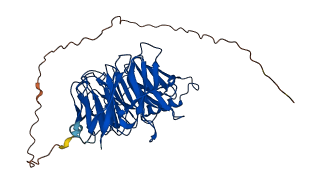
Descriptions
The autoinhibited protein was predicted that may have potential autoinhibitory elements via cis-regPred.
Autoinhibitory domains (AIDs)
Target domain |
|
Relief mechanism |
|
Assay |
cis-regPred |
Accessory elements
No accessory elements
Autoinhibited structure

Activated structure
2 structures for Q921E6
| Entry ID | Method | Resolution | Chain | Position | Source |
|---|---|---|---|---|---|
| 2QXV | X-ray | 182 A | A | 81-441 | PDB |
| AF-Q921E6-F1 | Predicted | AlphaFoldDB |
16 variants for Q921E6
| Variant ID(s) | Position | Change | Description | Diseaes Association | Provenance |
|---|---|---|---|---|---|
| rs13465525 | 78 | C>Y | No | EVA | |
| rs3388922116 | 97 | F>* | No | EVA | |
| rs3388912181 | 116 | V>M | No | EVA | |
| rs3398292397 | 148 | Y>* | No | EVA | |
| rs3388919514 | 152 | W>C | No | EVA | |
| rs3388919505 | 159 | S>N | No | EVA | |
| rs3388925425 | 162 | L>I | No | EVA | |
| rs3388884394 | 184 | K>M | No | EVA | |
| rs3388924824 | 195 | E>V | No | EVA | |
| rs3388928992 | 214 | A>T | No | EVA | |
| rs3388928060 | 252 | M>I | No | EVA | |
| rs3388925383 | 287 | R>S | No | EVA | |
| rs3388897827 | 355 | R>G | No | EVA | |
| rs3388923317 | 406 | H>L | No | EVA | |
| rs3388925637 | 406 | H>N | No | EVA | |
| rs3388917532 | 413 | I>V | No | EVA |
No associated diseases with Q921E6
6 regional properties for Q921E6
| Type | Name | Position | InterPro Accession |
|---|---|---|---|
| repeat | WD40 repeat | 81 - 125 | IPR001680-1 |
| repeat | WD40 repeat | 131 - 176 | IPR001680-2 |
| repeat | WD40 repeat | 179 - 273 | IPR001680-3 |
| repeat | WD40 repeat | 295 - 332 | IPR001680-4 |
| repeat | WD40 repeat | 397 - 438 | IPR001680-5 |
| conserved_site | WD40 repeat, conserved site | 206 - 220 | IPR019775 |
Functions
7 GO annotations of cellular component
| Name | Definition |
|---|---|
| chromatin silencing complex | Any protein complex that mediates changes in chromatin structure that result in transcriptional silencing. |
| cytosol | The part of the cytoplasm that does not contain organelles but which does contain other particulate matter, such as protein complexes. |
| ESC/E(Z) complex | A multimeric protein complex that can methylate lysine-27 and lysine-9 residues of histone H3. In Drosophila the core subunits of the complex include ESC, E(Z), CAF1 (NURF-55) and SU(Z)12. In mammals the core subunits of the complex include EED, EZH2, SUZ12 and RBBP4. |
| nucleoplasm | That part of the nuclear content other than the chromosomes or the nucleolus. |
| nucleus | A membrane-bounded organelle of eukaryotic cells in which chromosomes are housed and replicated. In most cells, the nucleus contains all of the cell's chromosomes except the organellar chromosomes, and is the site of RNA synthesis and processing. In some species, or in specialized cell types, RNA metabolism or DNA replication may be absent. |
| pronucleus | The nucleus of either the ovum or the spermatozoon following fertilization. Thus, in the fertilized ovum, there are two pronuclei, one originating from the ovum, the other from the spermatozoon that brought about fertilization; they approach each other, but do not fuse until just before the first cleavage, when each pronucleus loses its membrane to release its contents. |
| sex chromatin | Chromatin that is part of a sex chromosome. |
6 GO annotations of molecular function
| Name | Definition |
|---|---|
| chromatin binding | Binding to chromatin, the network of fibers of DNA, protein, and sometimes RNA, that make up the chromosomes of the eukaryotic nucleus during interphase. |
| enzyme activator activity | Binds to and increases the activity of an enzyme. |
| histone methyltransferase activity | Catalysis of the reaction: S-adenosyl-L-methionine + histone = S-adenosyl-L-homocysteine + methyl-histone. Histone methylation generally occurs on either an arginine or lysine residue. |
| identical protein binding | Binding to an identical protein or proteins. |
| RNA polymerase II cis-regulatory region sequence-specific DNA binding | Binding to a specific upstream regulatory DNA sequence (transcription factor recognition sequence or binding site) located in cis relative to the transcription start site (i.e., on the same strand of DNA) of a gene transcribed by RNA polymerase II. |
| transcription corepressor binding | Binding to a transcription corepressor, a protein involved in negative regulation of transcription via protein-protein interactions with transcription factors and other proteins that negatively regulate transcription. Transcription corepressors do not bind DNA directly, but rather mediate protein-protein interactions between repressing transcription factors and the basal transcription machinery. |
7 GO annotations of biological process
| Name | Definition |
|---|---|
| cellular response to leukemia inhibitory factor | Any process that results in a change in state or activity of a cell (in terms of movement, secretion, enzyme production, gene expression, etc.) as a result of a leukemia inhibitory factor stimulus. |
| histone methylation | The modification of histones by addition of methyl groups. |
| negative regulation of transcription by RNA polymerase II | Any process that stops, prevents, or reduces the frequency, rate or extent of transcription mediated by RNA polymerase II. |
| oligodendrocyte differentiation | The process in which a relatively unspecialized cell acquires the specialized features of an oligodendrocyte. An oligodendrocyte is a type of glial cell involved in myelinating the axons of neurons in the central nervous system. |
| positive regulation of histone H3-K27 methylation | Any process that increases the rate, frequency, or extent of histone H3-K27 methylation. Histone H3-K27 methylation is the modification of histone H3 by addition of a methyl group to lysine at position 27 of the histone. |
| regulation of adaxial/abaxial pattern formation | Any process that modulates the frequency, rate or extent of adaxial/abaxial pattern formation. |
| regulation of gene expression by genomic imprinting | An epigenetic mechanism of regulation of gene expression in which epigenetic modifications (imprints) are established during gametogenesis. For a given gene to show parentally biased expression, the imprint are established exclusively in one of the two parental genomes, thus generating an asymmetry between the maternal and paternal alleles. |
5 homologous proteins in AiPD
| UniProt AC | Gene Name | Protein Name | Species | Evidence Code |
|---|---|---|---|---|
| Q3SZ25 | EED | Polycomb protein EED | Bos taurus (Bovine) | PR |
| Q5ZKH3 | EED | Polycomb protein EED | Gallus gallus (Chicken) | PR |
| O75530 | EED | Polycomb protein EED | Homo sapiens (Human) | PR |
| Q28DT7 | eed | Polycomb protein eed | Xenopus tropicalis (Western clawed frog) (Silurana tropicalis) | PR |
| Q566T0 | eed | Polycomb protein eed | Danio rerio (Zebrafish) (Brachydanio rerio) | PR |
| 10 | 20 | 30 | 40 | 50 | 60 |
| MSEREVSTAP | AGTDMPAAKK | QKLSSDENSN | PDLSGDENDD | AVSIESGTNT | ERPDTPTNTP |
| 70 | 80 | 90 | 100 | 110 | 120 |
| NAPGRKSWGK | GKWKSKKCKY | SFKCVNSLKE | DHNQPLFGVQ | FNWHSKEGDP | LVFATVGSNR |
| 130 | 140 | 150 | 160 | 170 | 180 |
| VTLYECHSQG | EIRLLQSYVD | ADADENFYTC | AWTYDSNTSH | PLLAVAGSRG | IIRIINPITM |
| 190 | 200 | 210 | 220 | 230 | 240 |
| QCIKHYVGHG | NAINELKFHP | RDPNLLLSVS | KDHALRLWNI | QTDTLVAIFG | GVEGHRDEVL |
| 250 | 260 | 270 | 280 | 290 | 300 |
| SADYDLLGEK | IMSCGMDHSL | KLWRINSKRM | MNAIKESYDY | NPNKTNRPFI | SQKIHFPDFS |
| 310 | 320 | 330 | 340 | 350 | 360 |
| TRDIHRNYVD | CVRWLGDLIL | SKSCENAIVC | WKPGKMEDDI | DKIKPSESNV | TILGRFDYSQ |
| 370 | 380 | 390 | 400 | 410 | 420 |
| CDIWYMRFSM | DFWQKMLALG | NQVGKLYVWD | LEVEDPHKAK | CTTLTHHKCG | AAIRQTSFSR |
| 430 | 440 | ||||
| DSSILIAVCD | DASIWRWDRL | R |