Descriptions
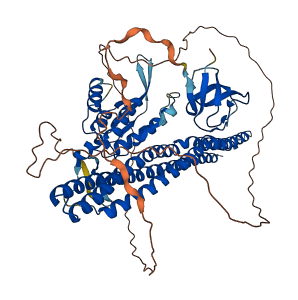
The autoinhibited protein was predicted that may have potential autoinhibitory elements via cis-regPred.
Autoinhibitory domains (AIDs)
Target domain |
|
Relief mechanism |
|
Assay |
cis-regPred |
Accessory elements
No accessory elements
Autoinhibited structure

Activated structure
1 structures for Q91ZR2
| Entry ID | Method | Resolution | Chain | Position | Source |
|---|---|---|---|---|---|
| AF-Q91ZR2-F1 | Predicted | AlphaFoldDB |
No variants for Q91ZR2
| Variant ID(s) | Position | Change | Description | Diseaes Association | Provenance |
|---|---|---|---|---|---|
| No variants for Q91ZR2 | |||||
No associated diseases with Q91ZR2
1 regional properties for Q91ZR2
| Type | Name | Position | InterPro Accession |
|---|---|---|---|
| conserved_site | S-adenosylmethionine decarboxylase, conserved site | 81 - 91 | IPR018166 |
Functions
8 GO annotations of cellular component
| Name | Definition |
|---|---|
| clathrin-coated vesicle | A vesicle with a coat formed of clathrin connected to the membrane via one of the clathrin adaptor complexes. |
| cytoplasmic vesicle | A vesicle found in the cytoplasm of a cell. |
| extracellular exosome | A vesicle that is released into the extracellular region by fusion of the limiting endosomal membrane of a multivesicular body with the plasma membrane. Extracellular exosomes, also simply called exosomes, have a diameter of about 40-100 nm. |
| extrinsic component of cytoplasmic side of plasma membrane | The component of a plasma membrane consisting of gene products and protein complexes that are loosely bound to its cytoplasmic surface, but not integrated into the hydrophobic region. |
| growth cone | The migrating motile tip of a growing neuron projection, where actin accumulates, and the actin cytoskeleton is the most dynamic. |
| neuronal cell body | The portion of a neuron that includes the nucleus, but excludes cell projections such as axons and dendrites. |
| plasma membrane | The membrane surrounding a cell that separates the cell from its external environment. It consists of a phospholipid bilayer and associated proteins. |
| recycling endosome membrane | The lipid bilayer surrounding a recycling endosome. |
2 GO annotations of molecular function
| Name | Definition |
|---|---|
| phosphatidylinositol binding | Binding to an inositol-containing glycerophospholipid, i.e. phosphatidylinositol (PtdIns) and its phosphorylated derivatives. |
| phosphatidylinositol-4,5-bisphosphate binding | Binding to phosphatidylinositol-4,5-bisphosphate, a derivative of phosphatidylinositol in which the inositol ring is phosphorylated at the 4' and 5' positions. |
8 GO annotations of biological process
| Name | Definition |
|---|---|
| cleavage furrow formation | Generation of the cleavage furrow, a shallow groove in the cell surface near the old metaphase plate that marks the site of cytokinesis. This process includes the recruitment and localized activation of signals such as RhoA at the site of the future furrow to ensure that furrowing initiates at the correct site in the cell. |
| endocytosis | A vesicle-mediated transport process in which cells take up external materials or membrane constituents by the invagination of a small region of the plasma membrane to form a new membrane-bounded vesicle. |
| endosomal transport | The directed movement of substances mediated by an endosome, a membrane-bounded organelle that carries materials enclosed in the lumen or located in the endosomal membrane. |
| mitotic cytokinesis | A cell cycle process that results in the division of the cytoplasm of a cell after mitosis, resulting in the separation of the original cell into two daughter cells. |
| plasma membrane tubulation | A membrane tubulation process occurring in a plasma membrane. |
| positive regulation of autophagosome assembly | Any process that activates or increases the frequency, rate or extent of autophagic vacuole assembly. |
| positive regulation of GTPase activity | Any process that activates or increases the activity of a GTPase. |
| protein transport | The directed movement of proteins into, out of or within a cell, or between cells, by means of some agent such as a transporter or pore. |
5 homologous proteins in AiPD
| UniProt AC | Gene Name | Protein Name | Species | Evidence Code |
|---|---|---|---|---|
| Q8WV41 | SNX33 | Sorting nexin-33 | Homo sapiens (Human) | PR |
| Q9Y5X1 | SNX9 | Sorting nexin-9 | Homo sapiens (Human) | PR |
| Q96RF0 | SNX18 | Sorting nexin-18 | Homo sapiens (Human) | PR |
| Q91VH2 | Snx9 | Sorting nexin-9 | Mus musculus (Mouse) | PR |
| Q28GP7 | snx33 | Sorting nexin-33 | Xenopus tropicalis (Western clawed frog) (Silurana tropicalis) | PR |
| 10 | 20 | 30 | 40 | 50 | 60 |
| MALRARALYD | FKSENPGEIS | LREHEVLSLC | SEQDIEGWLE | GINSRGDRGL | FPASYVQVIR |
| 70 | 80 | 90 | 100 | 110 | 120 |
| APEPGPPADG | GPGAPARYAN | VPPGGFEPLP | AAPPAAFPPL | LQPQASPGSF | QPPGAGFPYG |
| 130 | 140 | 150 | 160 | 170 | 180 |
| GGALQPSPQQ | LYGGYQASLG | SDDDWDDEWD | DSSTVADEPG | ALGSGAYPDL | DGSSSAGGGA |
| 190 | 200 | 210 | 220 | 230 | 240 |
| AGRYRLSTRS | DLSLGSRGVS | APPAPSVWSQ | ELGHGEPQPQ | SLLHLRQVGR | GGLRAGRGVR |
| 250 | 260 | 270 | 280 | 290 | 300 |
| LREGWGQAVR | GAGSYGPEWQ | ENPYPFQCTI | DDPTKQTKFK | GMKSYISYKL | VPTHTQVPVH |
| 310 | 320 | 330 | 340 | 350 | 360 |
| RRYKHFDWLY | ARLAEKFPVI | SVPHLPEKQA | TGRFEEDFIS | KRRKGLIWWM | NHMASHPVLA |
| 370 | 380 | 390 | 400 | 410 | 420 |
| QCDVFQHFLT | CPSSTDEKAW | KQGKRKAEKD | EMVGANFFLT | LSTPPAAALD | LQEVESKIDG |
| 430 | 440 | 450 | 460 | 470 | 480 |
| FKCFTKKMDD | SALQLNHTAN | EFARKQVTGF | KKEYQKVGQS | FRGLSQAFEL | DQQAFSVGLN |
| 490 | 500 | 510 | 520 | 530 | 540 |
| QAIAFTGDAY | DAIGELFAEQ | PRQDLDPVMD | LLALYQGHLA | NFPDIIHVQK | GALTKVKESR |
| 550 | 560 | 570 | 580 | 590 | 600 |
| RHVEEGKMEV | QKADGIQDRC | NTISFATLAE | IHHFHQIRVR | DFKSQMQHFL | QQQIIFFQKV |
| 610 | |||||
| TQKLEEALHK | YDSV |