Q8VEE4
Gene name |
Rpa1 |
Protein name |
Replication protein A 70 kDa DNA-binding subunit |
Names |
RP-A p70, Replication factor A protein 1, RF-A protein 1 |
Species |
Mus musculus (Mouse) |
KEGG Pathway |
mmu:68275 |
EC number |
|
Protein Class |
|
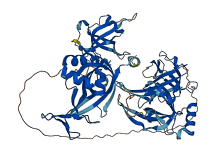
Descriptions
The autoinhibited protein was predicted that may have potential autoinhibitory elements via cis-regPred.
Autoinhibitory domains (AIDs)
Target domain |
|
Relief mechanism |
|
Assay |
cis-regPred |
Accessory elements
No accessory elements
Autoinhibited structure

Activated structure
1 structures for Q8VEE4
| Entry ID | Method | Resolution | Chain | Position | Source |
|---|---|---|---|---|---|
| AF-Q8VEE4-F1 | Predicted | AlphaFoldDB |
43 variants for Q8VEE4
| Variant ID(s) | Position | Change | Description | Diseaes Association | Provenance |
|---|---|---|---|---|---|
| rs3389188490 | 23 | P>H | No | EVA | |
| rs3389149941 | 35 | T>S | No | EVA | |
| rs3401227966 | 63 | N>H | No | EVA | |
| rs3389182625 | 117 | P>H | No | EVA | |
| rs3389117812 | 127 | Q>H | No | EVA | |
| 134 | Q>del | No | |||
| rs3389182576 | 136 | A>E | No | EVA | |
| rs3389142795 | 209 | C>S | No | EVA | |
| rs3389149889 | 212 | V>I | No | EVA | |
| rs3389177532 | 220 | T>E | No | EVA | |
| rs3389174656 | 222 | S>C | No | EVA | |
| rs3389174656 | 222 | S>G | No | EVA | |
| rs3389179952 | 227 | E>K | No | EVA | |
| rs3389154634 | 230 | L>P | No | EVA | |
| rs3389192893 | 244 | A>V | No | EVA | |
| rs3389174084 | 252 | D>N | No | EVA | |
| rs3389154612 | 262 | K>N | No | EVA | |
| rs250007288 | 270 | A>T | No | EVA | |
| rs3402073256 | 320 | K>N | No | EVA | |
| rs3401845344 | 321 | A>P | No | EVA | |
| rs3401228044 | 322 | K>E | No | EVA | |
| rs3402338673 | 326 | V>L | No | EVA | |
| rs3389149923 | 328 | I>N | No | EVA | |
| rs3389180012 | 340 | K>* | No | EVA | |
| rs3389154614 | 348 | R>I | No | EVA | |
| rs3412866950 | 359 | D>E | No | EVA | |
| rs3389192930 | 360 | M>V | No | EVA | |
| rs3402443328 | 384 | V>L | No | EVA | |
| rs3389182560 | 411 | N>I | No | EVA | |
| rs3389179586 | 414 | I>M | No | EVA | |
| rs3389182630 | 427 | E>D | No | EVA | |
| rs3402073241 | 432 | D>V | No | EVA | |
| rs3389174660 | 437 | S>Y | No | EVA | |
| rs3401226117 | 438 | D>G | No | EVA | |
| rs3389189183 | 443 | G>R | No | EVA | |
| rs3389117817 | 484 | N>Y | No | EVA | |
| rs3389189192 | 490 | C>Y | No | EVA | |
| rs3389182621 | 529 | I>S | No | EVA | |
| rs3389180013 | 531 | D>E | No | EVA | |
| rs3389174126 | 537 | W>* | No | EVA | |
| rs3389186321 | 539 | T>R | No | EVA | |
| rs3389192883 | 605 | P>R | No | EVA | |
| rs3389174077 | 615 | L>Q | No | EVA |
No associated diseases with Q8VEE4
5 regional properties for Q8VEE4
| Type | Name | Position | InterPro Accession |
|---|---|---|---|
| domain | OB-fold nucleic acid binding domain, AA-tRNA synthetase-type | 206 - 289 | IPR004365 |
| domain | Replication factor-A protein 1, N-terminal | 5 - 104 | IPR007199 |
| domain | Replication factor A, C-terminal | 470 - 615 | IPR013955 |
| domain | Replication protein A, OB domain | 314 - 411 | IPR031657 |
| domain | Replication factor A, C-terminal, eukaryotes | 454 - 621 | IPR047192 |
9 GO annotations of cellular component
| Name | Definition |
|---|---|
| condensed chromosome | A highly compacted molecule of DNA and associated proteins resulting in a cytologically distinct structure. |
| condensed nuclear chromosome | A highly compacted molecule of DNA and associated proteins resulting in a cytologically distinct nuclear chromosome. |
| DNA replication factor A complex | A conserved heterotrimeric complex that binds nonspecifically to single-stranded DNA and is required for multiple processes in eukaryotic DNA metabolism, including DNA replication, DNA repair, and recombination. In all eukaryotic organisms examined the complex is composed of subunits of approximately 70, 30, and 14 kDa. |
| lateral element | A proteinaceous core found between sister chromatids during meiotic prophase. |
| male germ cell nucleus | The nucleus of a male germ cell, a reproductive cell in males. |
| nucleoplasm | That part of the nuclear content other than the chromosomes or the nucleolus. |
| nucleus | A membrane-bounded organelle of eukaryotic cells in which chromosomes are housed and replicated. In most cells, the nucleus contains all of the cell's chromosomes except the organellar chromosomes, and is the site of RNA synthesis and processing. In some species, or in specialized cell types, RNA metabolism or DNA replication may be absent. |
| PML body | A class of nuclear body; they react against SP100 auto-antibodies (PML, promyelocytic leukemia); cells typically contain 10-30 PML bodies per nucleus; alterations in the localization of PML bodies occurs after viral infection. |
| site of DNA damage | A region of a chromosome at which DNA damage has occurred. DNA damage signaling and repair proteins accumulate at the lesion to respond to the damage and repair the DNA to form a continuous DNA helix. |
6 GO annotations of molecular function
| Name | Definition |
|---|---|
| chromatin binding | Binding to chromatin, the network of fibers of DNA, protein, and sometimes RNA, that make up the chromosomes of the eukaryotic nucleus during interphase. |
| damaged DNA binding | Binding to damaged DNA. |
| G-rich strand telomeric DNA binding | Binding to G-rich, single-stranded, telomere-associated DNA. |
| metal ion binding | Binding to a metal ion. |
| single-stranded DNA binding | Binding to single-stranded DNA. |
| single-stranded telomeric DNA binding | Binding to single-stranded telomere-associated DNA. |
17 GO annotations of biological process
| Name | Definition |
|---|---|
| base-excision repair | In base excision repair, an altered base is removed by a DNA glycosylase enzyme, followed by excision of the resulting sugar phosphate. The small gap left in the DNA helix is filled in by the sequential action of DNA polymerase and DNA ligase. |
| cellular response to DNA damage stimulus | Any process that results in a change in state or activity of a cell (in terms of movement, secretion, enzyme production, gene expression, etc.) as a result of a stimulus indicating damage to its DNA from environmental insults or errors during metabolism. |
| chromosome organization | A process that is carried out at the cellular level that results in the assembly, arrangement of constituent parts, or disassembly of chromosomes, structures composed of a very long molecule of DNA and associated proteins that carries hereditary information. This term covers covalent modifications at the molecular level as well as spatial relationships among the major components of a chromosome. |
| DNA repair | The process of restoring DNA after damage. Genomes are subject to damage by chemical and physical agents in the environment (e.g. UV and ionizing radiations, chemical mutagens, fungal and bacterial toxins, etc.) and by free radicals or alkylating agents endogenously generated in metabolism. DNA is also damaged because of errors during its replication. A variety of different DNA repair pathways have been reported that include direct reversal, base excision repair, nucleotide excision repair, photoreactivation, bypass, double-strand break repair pathway, and mismatch repair pathway. |
| DNA replication | The cellular metabolic process in which a cell duplicates one or more molecules of DNA. DNA replication begins when specific sequences, known as origins of replication, are recognized and bound by initiation proteins, and ends when the original DNA molecule has been completely duplicated and the copies topologically separated. The unit of replication usually corresponds to the genome of the cell, an organelle, or a virus. The template for replication can either be an existing DNA molecule or RNA. |
| DNA unwinding involved in DNA replication | The process in which interchain hydrogen bonds between two strands of DNA are broken or 'melted', generating unpaired template strands for DNA replication. |
| double-strand break repair via homologous recombination | The error-free repair of a double-strand break in DNA in which the broken DNA molecule is repaired using homologous sequences. A strand in the broken DNA searches for a homologous region in an intact chromosome to serve as the template for DNA synthesis. The restoration of two intact DNA molecules results in the exchange, reciprocal or nonreciprocal, of genetic material between the intact DNA molecule and the broken DNA molecule. |
| hemopoiesis | The process whose specific outcome is the progression of the myeloid and lymphoid derived organ/tissue systems of the blood and other parts of the body over time, from formation to the mature structure. The site of hemopoiesis is variable during development, but occurs primarily in bone marrow or kidney in many adult vertebrates. |
| homeostasis of number of cells within a tissue | Any biological process involved in the maintenance of the steady-state number of cells within a population of cells in a tissue. |
| in utero embryonic development | The process whose specific outcome is the progression of the embryo in the uterus over time, from formation of the zygote in the oviduct, to birth. An example of this process is found in Mus musculus. |
| meiotic cell cycle | Progression through the phases of the meiotic cell cycle, in which canonically a cell replicates to produce four offspring with half the chromosomal content of the progenitor cell via two nuclear divisions. |
| mismatch repair | A system for the correction of errors in which an incorrect base, which cannot form hydrogen bonds with the corresponding base in the parent strand, is incorporated into the daughter strand. The mismatch repair system promotes genomic fidelity by repairing base-base mismatches, insertion-deletion loops and heterologies generated during DNA replication and recombination. |
| nucleotide-excision repair | A DNA repair process in which a small region of the strand surrounding the damage is removed from the DNA helix as an oligonucleotide. The small gap left in the DNA helix is filled in by the sequential action of DNA polymerase and DNA ligase. Nucleotide excision repair recognizes a wide range of substrates, including damage caused by UV irradiation (pyrimidine dimers and 6-4 photoproducts) and chemicals (intrastrand cross-links and bulky adducts). |
| positive regulation of cell population proliferation | Any process that activates or increases the rate or extent of cell proliferation. |
| protein localization to chromosome | Any process in which a protein is transported to, or maintained at, a specific location on a chromosome. |
| telomere maintenance | Any process that contributes to the maintenance of proper telomeric length and structure by affecting and monitoring the activity of telomeric proteins, the length of telomeric DNA and the replication and repair of the DNA. These processes includes those that shorten, lengthen, replicate and repair the telomeric DNA sequences. |
| telomere maintenance via telomerase | The maintenance of proper telomeric length by the addition of telomeric repeats by telomerase. |
9 homologous proteins in AiPD
| UniProt AC | Gene Name | Protein Name | Species | Evidence Code |
|---|---|---|---|---|
| P22336 | RFA1 | Replication factor A protein 1 | Saccharomyces cerevisiae (strain ATCC 204508 / S288c) (Baker's yeast) | PR |
| Q5ZJJ2 | RPA1 | Replication protein A 70 kDa DNA-binding subunit | Gallus gallus (Chicken) | PR |
| Q24492 | RpA-70 | Replication protein A 70 kDa DNA-binding subunit | Drosophila melanogaster (Fruit fly) | PR |
| P27694 | RPA1 | Replication protein A 70 kDa DNA-binding subunit | Homo sapiens (Human) | PR |
| Q10Q08 | RPA1B | Replication protein A 70 kDa DNA-binding subunit B | Oryza sativa subsp japonica (Rice) | PR |
| Q19537 | rpa-1 | Probable replication factor A 73 kDa subunit | Caenorhabditis elegans | PR |
| F4JSG3 | RPA1E | Replication protein A 70 kDa DNA-binding subunit E | Arabidopsis thaliana (Mouse-ear cress) | PR |
| Q9SKI4 | RPA1A | Replication protein A 70 kDa DNA-binding subunit A | Arabidopsis thaliana (Mouse-ear cress) | PR |
| Q5FW17 | rpa1 | Replication protein A 70 kDa DNA-binding subunit | Xenopus tropicalis (Western clawed frog) (Silurana tropicalis) | PR |
| 10 | 20 | 30 | 40 | 50 | 60 |
| MVGHLSEGAI | EVMIQQENTS | IKPILQVINI | RPISTGNRSP | RYRLLMSDGL | NTLSSFMLAT |
| 70 | 80 | 90 | 100 | 110 | 120 |
| QLNTLVEGGQ | LASNCVCQVH | KFIVNTLKDG | RKVVVLMDLE | VMKSAEDVGL | KIGNPVPYNE |
| 130 | 140 | 150 | 160 | 170 | 180 |
| GYGQQQQQQQ | QQQQQAVPSP | ASAATPPASK | PQPQNGSLGM | GSTAAKAYGA | SKPFGKPAGT |
| 190 | 200 | 210 | 220 | 230 | 240 |
| GLLQPSGGTQ | SKVVPIASLT | PYQSKWTICA | RVTNKSQIRT | WSNSRGEGKL | FSLELVDESG |
| 250 | 260 | 270 | 280 | 290 | 300 |
| EIRATAFNEQ | VDKFFPLIEV | NKVYYFSKGA | LKIANKQFSA | VKNDYEMTFN | NETSVLPCED |
| 310 | 320 | 330 | 340 | 350 | 360 |
| GHHLPTVQFD | FTGIGDLESK | AKDALVDIIG | ICKSYEDSIK | ITVKSNNREV | AKRNIYLMDM |
| 370 | 380 | 390 | 400 | 410 | 420 |
| SGKVVTTTLW | GEDADKFDGS | RQPVMAIKGA | RVSDFGGRSL | SVLSSSTVIV | NPDIPEAYKL |
| 430 | 440 | 450 | 460 | 470 | 480 |
| RGWFDSEGQA | LDGVSISDHR | SGGAGGGNTN | WKTLHEAKSE | NLGQGDKADY | FSTVAAVVFL |
| 490 | 500 | 510 | 520 | 530 | 540 |
| RKENCMYQAC | PTQDCNKKVI | DQQNGLYRCE | KCDREFPNFK | YRMILSANIA | DFQENQWVTC |
| 550 | 560 | 570 | 580 | 590 | 600 |
| FQESAEAILG | QNTMYLGELK | EKNEQAFEEV | FQNANFRSFT | FRIRVKLETY | NDESRIKATV |
| 610 | 620 | ||||
| MDVKPVDFRD | YGRRLIANIR | KNM |