Q8LF21
Gene name |
DRP1C |
Protein name |
Phragmoplastin DRP1C |
Names |
Dynamin-like protein 1C, Dynamin-like protein 5, Dynamin-like protein DLP1, Dynamin-related protein 1C, AtDRP1C |
Species |
Arabidopsis thaliana (Mouse-ear cress) |
KEGG Pathway |
ath:AT1G14830 |
EC number |
|
Protein Class |
|
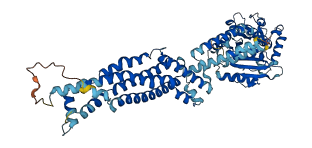
Descriptions
The autoinhibited protein was predicted that may have potential autoinhibitory elements via cis-regPred.
Autoinhibitory domains (AIDs)
Target domain |
|
Relief mechanism |
|
Assay |
cis-regPred |
Accessory elements
No accessory elements
Autoinhibited structure

Activated structure
1 structures for Q8LF21
| Entry ID | Method | Resolution | Chain | Position | Source |
|---|---|---|---|---|---|
| AF-Q8LF21-F1 | Predicted | AlphaFoldDB |
8 variants for Q8LF21
| Variant ID(s) | Position | Change | Description | Diseaes Association | Provenance |
|---|---|---|---|---|---|
| ENSVATH11232680 | 312 | D>N | No | 1000Genomes | |
| ENSVATH04578356 | 320 | R>K | No | 1000Genomes | |
| ENSVATH04578348 | 360 | R>Q | No | 1000Genomes | |
| tmp_1_5108344_T_C | 458 | I>V | No | 1000Genomes | |
| tmp_1_5108308_T_C | 470 | R>G | No | 1000Genomes | |
| ENSVATH01052309 | 516 | D>E | No | 1000Genomes | |
| tmp_1_5108055_G_A | 528 | S>F | No | 1000Genomes | |
| tmp_1_5107823_T_C | 574 | K>R | No | 1000Genomes |
No associated diseases with Q8LF21
Functions
10 GO annotations of cellular component
| Name | Definition |
|---|---|
| cell cortex | The region of a cell that lies just beneath the plasma membrane and often, but not always, contains a network of actin filaments and associated proteins. |
| cell plate | The nascent cell membrane and cell wall structure that forms between two daughter nuclei near the center of a dividing plant cell. It develops at the equitorial region of the phragmoplast. It grows outwards to join with the lateral walls and form two daughter cells. |
| clathrin-coated vesicle | A vesicle with a coat formed of clathrin connected to the membrane via one of the clathrin adaptor complexes. |
| cytoplasm | The contents of a cell excluding the plasma membrane and nucleus, but including other subcellular structures. |
| extracellular region | The space external to the outermost structure of a cell. For cells without external protective or external encapsulating structures this refers to space outside of the plasma membrane. This term covers the host cell environment outside an intracellular parasite. |
| membrane | A lipid bilayer along with all the proteins and protein complexes embedded in it an attached to it. |
| microtubule | Any of the long, generally straight, hollow tubes of internal diameter 12-15 nm and external diameter 24 nm found in a wide variety of eukaryotic cells; each consists (usually) of 13 protofilaments of polymeric tubulin, staggered in such a manner that the tubulin monomers are arranged in a helical pattern on the microtubular surface, and with the alpha/beta axes of the tubulin subunits parallel to the long axis of the tubule; exist in equilibrium with pool of tubulin monomers and can be rapidly assembled or disassembled in response to physiological stimuli; concerned with force generation, e.g. in the spindle. |
| phragmoplast | Fibrous structure (light microscope view) that arises between the daughter nuclei at telophase and within which the initial partition (cell plate), dividing the mother cell in two (cytokinesis), is formed. Appears at first as a spindle connected to the two nuclei, but later spreads laterally in the form of a ring. Consists of microtubules. |
| plasma membrane | The membrane surrounding a cell that separates the cell from its external environment. It consists of a phospholipid bilayer and associated proteins. |
| plasmodesma | A fine cytoplasmic channel, found in all higher plants, that connects the cytoplasm of one cell to that of an adjacent cell. |
3 GO annotations of molecular function
| Name | Definition |
|---|---|
| GTP binding | Binding to GTP, guanosine triphosphate. |
| GTPase activity | Catalysis of the reaction: GTP + H2O = GDP + H+ + phosphate. |
| microtubule binding | Binding to a microtubule, a filament composed of tubulin monomers. |
5 GO annotations of biological process
| Name | Definition |
|---|---|
| cell cycle | The progression of biochemical and morphological phases and events that occur in a cell during successive cell replication or nuclear replication events. Canonically, the cell cycle comprises the replication and segregation of genetic material followed by the division of the cell, but in endocycles or syncytial cells nuclear replication or nuclear division may not be followed by cell division. |
| cell division | The process resulting in division and partitioning of components of a cell to form more cells; may or may not be accompanied by the physical separation of a cell into distinct, individually membrane-bounded daughter cells. |
| mitochondrial fission | The division of a mitochondrion within a cell to form two or more separate mitochondrial compartments. |
| mitochondrion organization | A process that is carried out at the cellular level which results in the assembly, arrangement of constituent parts, or disassembly of a mitochondrion; includes mitochondrial morphogenesis and distribution, and replication of the mitochondrial genome as well as synthesis of new mitochondrial components. |
| pollen maturation | The final stages of microgametogenesis after the trinucleate stage has been reached resulting in viable pollen grains. |
10 homologous proteins in AiPD
| UniProt AC | Gene Name | Protein Name | Species | Evidence Code |
|---|---|---|---|---|
| Q05193 | DNM1 | Dynamin-1 | Homo sapiens (Human) | PR |
| Q9UQ16 | DNM3 | Dynamin-3 | Homo sapiens (Human) | PR |
| O00429 | DNM1L | Dynamin-1-like protein | Homo sapiens (Human) | PR |
| P39053 | Dnm1 | Dynamin-1 | Mus musculus (Mouse) | PR |
| Q8BZ98 | Dnm3 | Dynamin-3 | Mus musculus (Mouse) | PR |
| Q8K1M6 | Dnm1l | Dynamin-1-like protein | Mus musculus (Mouse) | PR |
| P21575 | Dnm1 | Dynamin-1 | Rattus norvegicus (Rat) | PR |
| Q08877 | Dnm3 | Dynamin-3 | Rattus norvegicus (Rat) | PR |
| O35303 | Dnm1l | Dynamin-1-like protein | Rattus norvegicus (Rat) | PR |
| Q8S3C9 | DRP1D | Phragmoplastin DRP1D | Arabidopsis thaliana (Mouse-ear cress) | PR |
| 10 | 20 | 30 | 40 | 50 | 60 |
| MATMKSLIGL | INKIQRACTV | LGDHGGEGMS | LWEALPTVAV | VGGQSSGKSS | VLESVVGRDF |
| 70 | 80 | 90 | 100 | 110 | 120 |
| LPRGSGIVTR | RPLVLQLHKT | EDGTTEYAEF | LHAPKKRFAD | FAAVRKEIED | ETDRITGKSK |
| 130 | 140 | 150 | 160 | 170 | 180 |
| QISNIPIQLS | IYSPNVVNLT | LIDLPGLTKV | AVDGQPESIV | QDIENMVRSY | VEKPNCIILA |
| 190 | 200 | 210 | 220 | 230 | 240 |
| ISPANQDIAT | SDAIKLAREV | DPTGERTFGV | ATKLDIMDKG | TDCLDVLEGR | SYRLQHPWVG |
| 250 | 260 | 270 | 280 | 290 | 300 |
| IVNRSQADIN | KRVDMIAARR | KEQEYFETSP | EYGHLASRMG | SEYLAKLLSQ | HLETVIRQKI |
| 310 | 320 | 330 | 340 | 350 | 360 |
| PSIVALINKS | IDEINAELDR | IGRPIAVDSG | AQLYTILELC | RAFDRVFKEH | LDGGRPGGDR |
| 370 | 380 | 390 | 400 | 410 | 420 |
| IYGVFDHQLP | AALKKLPFDR | HLSTKNVQKV | VSEADGYQPH | LIAPEQGYRR | LIDGSISYFK |
| 430 | 440 | 450 | 460 | 470 | 480 |
| GPAEATVDAV | HFVLKELVRK | SISETEELKR | FPTLASDIAA | AANEALERFR | DESRKTVLRL |
| 490 | 500 | 510 | 520 | 530 | 540 |
| VDMESSYLTV | EFFRKLHLEP | EKEKPNPRNA | PAPNADPYSD | NHFRKIGSNV | SAYINMVCDT |
| 550 | 560 | 570 | 580 | 590 | 600 |
| LRNSLPKAVV | YCQVREAKRS | LLNFFYAQVG | RKEKEKLGAM | LDEDPQLMER | RGTLAKRLEL |
| 610 | |||||
| YKQARDDIDA | VAWK |