Q8BZ98
Gene name |
Dnm3 (Kiaa0820) |
Protein name |
Dynamin-3 |
Names |
|
Species |
Mus musculus (Mouse) |
KEGG Pathway |
mmu:103967 |
EC number |
3.6.5.5: Acting on GTP; involved in cellular and subcellular movement |
Protein Class |
|
Descriptions
The autoinhibited protein was predicted that may have potential autoinhibitory elements via cis-regPred.
Autoinhibitory domains (AIDs)
Target domain |
|
Relief mechanism |
|
Assay |
cis-regPred |
Accessory elements
No accessory elements
Autoinhibited structure

Activated structure
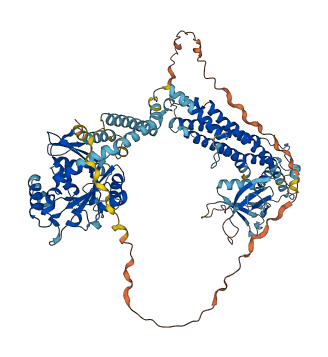
1 structures for Q8BZ98
| Entry ID | Method | Resolution | Chain | Position | Source |
|---|---|---|---|---|---|
| AF-Q8BZ98-F1 | Predicted | AlphaFoldDB |
No variants for Q8BZ98
| Variant ID(s) | Position | Change | Description | Diseaes Association | Provenance |
|---|---|---|---|---|---|
| No variants for Q8BZ98 | |||||
No associated diseases with Q8BZ98
14 regional properties for Q8BZ98
| Type | Name | Position | InterPro Accession |
|---|---|---|---|
| domain | CUB domain | 574 - 683 | IPR000859-1 |
| domain | CUB domain | 711 - 820 | IPR000859-2 |
| domain | CUB domain | 966 - 1075 | IPR000859-3 |
| domain | SRCR domain | 70 - 97 | IPR001190-1 |
| domain | SRCR domain | 105 - 205 | IPR001190-2 |
| domain | SRCR domain | 273 - 373 | IPR001190-3 |
| domain | SRCR domain | 420 - 520 | IPR001190-4 |
| domain | SRCR domain | 844 - 944 | IPR001190-5 |
| domain | Zona pellucida domain | 1084 - 1332 | IPR001507 |
| domain | SRCR-like domain | 105 - 205 | IPR017448-1 |
| domain | SRCR-like domain | 273 - 373 | IPR017448-2 |
| domain | SRCR-like domain | 420 - 520 | IPR017448-3 |
| domain | SRCR-like domain | 844 - 944 | IPR017448-4 |
| conserved_site | Zona pellucida domain, conserved site | 1234 - 1274 | IPR017977 |
Functions
| Description | ||
|---|---|---|
| EC Number | 3.6.5.5 | Acting on GTP; involved in cellular and subcellular movement |
| Subcellular Localization |
|
|
| PANTHER Family | ||
| PANTHER Subfamily | ||
| PANTHER Protein Class | ||
| PANTHER Pathway Category | No pathway information available | |
19 GO annotations of cellular component
| Name | Definition |
|---|---|
| apical tubulobulbar complex | Actin-based structures involved in establishing close contact between mature spermatids and Sertoli cells at the luminal end of the Sertoli cell. |
| axon | The long process of a neuron that conducts nerve impulses, usually away from the cell body to the terminals and varicosities, which are sites of storage and release of neurotransmitter. |
| basal tubulobulbar complex | Actin-based structures involved in establishing the blood-testis barrier of the Sertoli cell. |
| cytoplasm | The contents of a cell excluding the plasma membrane and nucleus, but including other subcellular structures. |
| dendritic spine | A small, membranous protrusion from a dendrite that forms a postsynaptic compartment, typically receiving input from a single presynapse. They function as partially isolated biochemical and an electrical compartments. Spine morphology is variable:they can be thin, stubby, mushroom, or branched, with a continuum of intermediate morphologies. They typically terminate in a bulb shape, linked to the dendritic shaft by a restriction. Spine remodeling is though to be involved in synaptic plasticity. |
| dendritic spine head | Distal part of the dendritic spine, that carries the post-synaptic density. |
| glutamatergic synapse | A synapse that uses glutamate as a neurotransmitter. |
| Golgi apparatus | A membrane-bound cytoplasmic organelle of the endomembrane system that further processes the core oligosaccharides (e.g. N-glycans) added to proteins in the endoplasmic reticulum and packages them into membrane-bound vesicles. The Golgi apparatus operates at the intersection of the secretory, lysosomal, and endocytic pathways. |
| membrane | A lipid bilayer along with all the proteins and protein complexes embedded in it an attached to it. |
| microtubule | Any of the long, generally straight, hollow tubes of internal diameter 12-15 nm and external diameter 24 nm found in a wide variety of eukaryotic cells; each consists (usually) of 13 protofilaments of polymeric tubulin, staggered in such a manner that the tubulin monomers are arranged in a helical pattern on the microtubular surface, and with the alpha/beta axes of the tubulin subunits parallel to the long axis of the tubule; exist in equilibrium with pool of tubulin monomers and can be rapidly assembled or disassembled in response to physiological stimuli; concerned with force generation, e.g. in the spindle. |
| mitochondrion | A semiautonomous, self replicating organelle that occurs in varying numbers, shapes, and sizes in the cytoplasm of virtually all eukaryotic cells. It is notably the site of tissue respiration. |
| perinuclear region of cytoplasm | Cytoplasm situated near, or occurring around, the nucleus. |
| photoreceptor inner segment | The inner segment of a vertebrate photoreceptor containing mitochondria, ribosomes and membranes where opsin molecules are assembled and passed to be part of the outer segment discs. |
| plasma membrane | The membrane surrounding a cell that separates the cell from its external environment. It consists of a phospholipid bilayer and associated proteins. |
| postsynaptic density | An electron dense network of proteins within and adjacent to the postsynaptic membrane of an asymmetric, neuron-neuron synapse. Its major components include neurotransmitter receptors and the proteins that spatially and functionally organize them such as anchoring and scaffolding molecules, signaling enzymes and cytoskeletal components. |
| postsynaptic endocytic zone membrane | The region of the postsynaptic membrane that is part of the postsynaptic endocytic zone. This region of membrane is associated with stable clathrin puncta. |
| presynapse | The part of a synapse that is part of the presynaptic cell. |
| synapse | The junction between an axon of one neuron and a dendrite of another neuron, a muscle fiber or a glial cell. As the axon approaches the synapse it enlarges into a specialized structure, the presynaptic terminal bouton, which contains mitochondria and synaptic vesicles. At the tip of the terminal bouton is the presynaptic membrane; facing it, and separated from it by a minute cleft (the synaptic cleft) is a specialized area of membrane on the receiving cell, known as the postsynaptic membrane. In response to the arrival of nerve impulses, the presynaptic terminal bouton secretes molecules of neurotransmitters into the synaptic cleft. These diffuse across the cleft and transmit the signal to the postsynaptic membrane. |
| synaptic cleft | The narrow gap that separates the presynaptic and postsynaptic membranes, into which neurotransmitter is released. |
8 GO annotations of molecular function
| Name | Definition |
|---|---|
| GTP binding | Binding to GTP, guanosine triphosphate. |
| GTPase activity | Catalysis of the reaction: GTP + H2O = GDP + H+ + phosphate. |
| identical protein binding | Binding to an identical protein or proteins. |
| microtubule binding | Binding to a microtubule, a filament composed of tubulin monomers. |
| nitric-oxide synthase binding | Binding to nitric-oxide synthase. |
| structural constituent of postsynapse | The action of a molecule that contributes to the structural integrity of a postsynapse. |
| type 1 metabotropic glutamate receptor binding | Binding to a type 1 metabotropic glutamate receptor. |
| type 5 metabotropic glutamate receptor binding | Binding to a type 5 metabotropic glutamate receptor. |
11 GO annotations of biological process
| Name | Definition |
|---|---|
| endocytosis | A vesicle-mediated transport process in which cells take up external materials or membrane constituents by the invagination of a small region of the plasma membrane to form a new membrane-bounded vesicle. |
| filopodium assembly | The assembly of a filopodium, a thin, stiff protrusion extended by the leading edge of a motile cell such as a crawling fibroblast or amoeba, or an axonal growth cone. |
| negative regulation of dendritic spine morphogenesis | Any process that decreases the rate, frequency, or extent of dendritic spine morphogenesis, the process in which the anatomical structures of a dendritic spine are generated and organized. A dendritic spine is a protrusion from a dendrite and a specialized subcellular compartment involved in synaptic transmission. |
| positive regulation of filopodium assembly | Any process that activates or increases the frequency, rate or extent of the assembly of a filopodium, a thin, stiff protrusion extended by the leading edge of a motile cell such as a crawling fibroblast or amoeba, or an axonal growth cone. |
| positive regulation of synaptic vesicle recycling | Any process that activates or increases the frequency, rate or extent of synaptic vesicle recycling. |
| postsynaptic neurotransmitter receptor internalization | A receptor-mediated endocytosis process that results in the internalization of a neurotransmitter receptor from the postsynaptic membrane endocytic zone into an endocytic vesicle. |
| receptor internalization | A receptor-mediated endocytosis process that results in the movement of receptors from the plasma membrane to the inside of the cell. The process begins when cell surface receptors are monoubiquitinated following ligand-induced activation. Receptors are subsequently taken up into endocytic vesicles from where they are either targeted to the lysosome or vacuole for degradation or recycled back to the plasma membrane. |
| regulation of dendritic spine morphogenesis | Any process that modulates the rate, frequency, or extent of dendritic spine morphogenesis, the process in which the anatomical structures of a dendritic spine are generated and organized. A dendritic spine is a protrusion from a dendrite and a specialized subcellular compartment involved in synaptic transmission. |
| synapse assembly | The aggregation, arrangement and bonding together of a set of components to form a synapse. This process ends when the synapse is mature (functional). |
| synaptic vesicle budding from presynaptic endocytic zone membrane | Evagination of the presynaptic membrane, resulting in the formation of a new synaptic vesicle. |
| synaptic vesicle endocytosis | A vesicle-mediated transport process, in which the synaptic vesicle membrane constituents are retrieved from the presynaptic membrane on the axon terminal after neurotransmitter secretion by exocytosis. Synaptic vesicle endocytosis can occur via clathrin-dependent and clathrin-independent mechanisms. |
10 homologous proteins in AiPD
| UniProt AC | Gene Name | Protein Name | Species | Evidence Code |
|---|---|---|---|---|
| O00429 | DNM1L | Dynamin-1-like protein | Homo sapiens (Human) | PR |
| Q05193 | DNM1 | Dynamin-1 | Homo sapiens (Human) | PR |
| Q9UQ16 | DNM3 | Dynamin-3 | Homo sapiens (Human) | PR |
| Q8K1M6 | Dnm1l | Dynamin-1-like protein | Mus musculus (Mouse) | PR |
| P39053 | Dnm1 | Dynamin-1 | Mus musculus (Mouse) | PR |
| O35303 | Dnm1l | Dynamin-1-like protein | Rattus norvegicus (Rat) | PR |
| P21575 | Dnm1 | Dynamin-1 | Rattus norvegicus (Rat) | PR |
| Q08877 | Dnm3 | Dynamin-3 | Rattus norvegicus (Rat) | PR |
| Q8LF21 | DRP1C | Phragmoplastin DRP1C | Arabidopsis thaliana (Mouse-ear cress) | PR |
| Q8S3C9 | DRP1D | Phragmoplastin DRP1D | Arabidopsis thaliana (Mouse-ear cress) | PR |
| 10 | 20 | 30 | 40 | 50 | 60 |
| MGNREMEELI | PLVNRLQDAF | SALGQSCLLE | LPQIAVVGGQ | SAGKSSVLEN | FVGRDFLPRG |
| 70 | 80 | 90 | 100 | 110 | 120 |
| SGIVTRRPLV | LQLVTSKAEY | AEFLHCKGKK | FTDFDEVRHE | IEAETDRVTG | MNKGISSIPI |
| 130 | 140 | 150 | 160 | 170 | 180 |
| NLRVYSPHVL | NLTLIDLPGI | TKVPVGDQPP | DIEYQIRDMI | MQFITRENCL | ILAVTPANTD |
| 190 | 200 | 210 | 220 | 230 | 240 |
| LANSDALKLA | KEVDPQGLRT | IGVITKLDLM | DEGTDARDVL | ENKLLPLRRG | YVGVVNRSQK |
| 250 | 260 | 270 | 280 | 290 | 300 |
| DIDGKKDIKA | AMLAERKFFL | SHPAYRHIAD | RMGTPHLQKV | LNQQLTNHIR | DTLPNFRNKL |
| 310 | 320 | 330 | 340 | 350 | 360 |
| QGQLLSIEHE | VEAFKNFKPE | DPTRKTKALL | QMVQQFAVDF | EKRIEGSGDQ | VDTLELSGGA |
| 370 | 380 | 390 | 400 | 410 | 420 |
| KINRIFHERF | PFEIVKMEFN | EKELRREISY | AIKNIHGIRT | GLFTPDMAFE | AIVKKQIVKL |
| 430 | 440 | 450 | 460 | 470 | 480 |
| KGPSLKSVDL | VMQELINTVK | KCTKRLANFP | RLCEETERIV | ANHIREREGK | TKDQVLLLID |
| 490 | 500 | 510 | 520 | 530 | 540 |
| IQVSYINTNH | EDFIGFANAQ | QRSSQVHKKS | TIGNQVIRKG | WLTVSNIGIM | KGGSKGYWFV |
| 550 | 560 | 570 | 580 | 590 | 600 |
| LTAESLSWYK | DDEEKEKKYM | LPLDNLKVRD | VEKGFMSSKH | VFALFNTEQR | NVYKDYRFLE |
| 610 | 620 | 630 | 640 | 650 | 660 |
| LACDSQEDVD | SWKASLLRAG | VYPDKSVGSN | KTENDENGQA | ENFSMDPQLE | RQVETIRNLV |
| 670 | 680 | 690 | 700 | 710 | 720 |
| DSYMSIINKC | IRDLIPKTIM | HLMINNVKDF | INSELLAQLY | SSEDQNTLME | ESAEQAQRRD |
| 730 | 740 | 750 | 760 | 770 | 780 |
| EMLRMYQALK | EALAIIGDIN | TATVSTPAPP | PVDDSWLQHS | RRSPPPSPTT | QRRLTISAPL |
| 790 | 800 | 810 | 820 | 830 | 840 |
| PRPTSGRGPA | PAIPSPGPHS | GAPPVPFRPG | PLPPFPNSSD | SFGAPPQVPS | RPTRAPPSVP |
| 850 | 860 | ||||
| SRRPPPSPTR | PTIIRPLESS | LLD |