Q8K1M6
Gene name |
Dnm1l (Drp1) |
Protein name |
Dynamin-1-like protein |
Names |
Dynamin family member proline-rich carboxyl-terminal domain less, Dymple, Dynamin-related protein 1 |
Species |
Mus musculus (Mouse) |
KEGG Pathway |
mmu:74006 |
EC number |
3.6.5.5: Acting on GTP; involved in cellular and subcellular movement |
Protein Class |
|
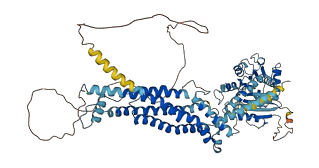
Descriptions
The autoinhibited protein was predicted that may have potential autoinhibitory elements via cis-regPred.
Autoinhibitory domains (AIDs)
Target domain |
|
Relief mechanism |
|
Assay |
cis-regPred |
Accessory elements
No accessory elements
Autoinhibited structure

Activated structure
1 structures for Q8K1M6
| Entry ID | Method | Resolution | Chain | Position | Source |
|---|---|---|---|---|---|
| AF-Q8K1M6-F1 | Predicted | AlphaFoldDB |
No variants for Q8K1M6
| Variant ID(s) | Position | Change | Description | Diseaes Association | Provenance |
|---|---|---|---|---|---|
| No variants for Q8K1M6 | |||||
1 associated diseases with Q8K1M6
[MIM: 618254]: Ciliary dyskinesia, primary, 39 (CILD39)
A form of primary ciliary dyskinesia, a disorder characterized by abnormalities of motile cilia. Respiratory infections leading to chronic inflammation and bronchiectasis are recurrent, due to defects in the respiratory cilia. Some patients exhibit randomization of left-right body asymmetry and situs inversus. Primary ciliary dyskinesia associated with situs inversus is referred to as Kartagener syndrome. CILD39 inheritance is autosomal recessive. {ECO:0000269|PubMed:30388400}. Note=The disease is caused by variants affecting the gene represented in this entry.
Without disease ID
- A form of primary ciliary dyskinesia, a disorder characterized by abnormalities of motile cilia. Respiratory infections leading to chronic inflammation and bronchiectasis are recurrent, due to defects in the respiratory cilia. Some patients exhibit randomization of left-right body asymmetry and situs inversus. Primary ciliary dyskinesia associated with situs inversus is referred to as Kartagener syndrome. CILD39 inheritance is autosomal recessive. {ECO:0000269|PubMed:30388400}. Note=The disease is caused by variants affecting the gene represented in this entry.
4 regional properties for Q8K1M6
| Type | Name | Position | InterPro Accession |
|---|---|---|---|
| domain | Oxoglutarate/iron-dependent dioxygenase | 165 - 275 | IPR005123 |
| domain | Prolyl 4-hydroxylase, alpha subunit | 78 - 274 | IPR006620 |
| domain | Oxoglutarate/iron-dependent oxygenase, C-terminal degradation domain | 304 - 535 | IPR019601 |
| domain | Prolyl 3,4-dihydroxylase TPA1/OFD1, N-terminal domain | 172 - 274 | IPR039558 |
Functions
| Description | ||
|---|---|---|
| EC Number | 3.6.5.5 | Acting on GTP; involved in cellular and subcellular movement |
| Subcellular Localization |
|
|
| PANTHER Family | ||
| PANTHER Subfamily | ||
| PANTHER Protein Class | ||
| PANTHER Pathway Category | No pathway information available | |
21 GO annotations of cellular component
| Name | Definition |
|---|---|
| anchoring junction | A cell junction that mechanically attaches a cell (and its cytoskeleton) to neighboring cells or to the extracellular matrix. |
| brush border | The dense covering of microvilli on the apical surface of an epithelial cell in tissues such as the intestine, kidney, and choroid plexus; the microvilli aid absorption by increasing the surface area of the cell. |
| clathrin-coated pit | A part of the endomembrane system in the form of an invagination of a membrane upon which a clathrin coat forms, and that can be converted by vesicle budding into a clathrin-coated vesicle. Coated pits form on the plasma membrane, where they are involved in receptor-mediated selective transport of many proteins and other macromolecules across the cell membrane, in the trans-Golgi network, and on some endosomes. |
| cytoplasm | The contents of a cell excluding the plasma membrane and nucleus, but including other subcellular structures. |
| cytosol | The part of the cytoplasm that does not contain organelles but which does contain other particulate matter, such as protein complexes. |
| endoplasmic reticulum | The irregular network of unit membranes, visible only by electron microscopy, that occurs in the cytoplasm of many eukaryotic cells. The membranes form a complex meshwork of tubular channels, which are often expanded into slitlike cavities called cisternae. The ER takes two forms, rough (or granular), with ribosomes adhering to the outer surface, and smooth (with no ribosomes attached). |
| Golgi apparatus | A membrane-bound cytoplasmic organelle of the endomembrane system that further processes the core oligosaccharides (e.g. N-glycans) added to proteins in the endoplasmic reticulum and packages them into membrane-bound vesicles. The Golgi apparatus operates at the intersection of the secretory, lysosomal, and endocytic pathways. |
| Golgi membrane | The lipid bilayer surrounding any of the compartments of the Golgi apparatus. |
| intracellular membrane-bounded organelle | Organized structure of distinctive morphology and function, bounded by a single or double lipid bilayer membrane and occurring within the cell. Includes the nucleus, mitochondria, plastids, vacuoles, and vesicles. Excludes the plasma membrane. |
| membrane | A lipid bilayer along with all the proteins and protein complexes embedded in it an attached to it. |
| microtubule | Any of the long, generally straight, hollow tubes of internal diameter 12-15 nm and external diameter 24 nm found in a wide variety of eukaryotic cells; each consists (usually) of 13 protofilaments of polymeric tubulin, staggered in such a manner that the tubulin monomers are arranged in a helical pattern on the microtubular surface, and with the alpha/beta axes of the tubulin subunits parallel to the long axis of the tubule; exist in equilibrium with pool of tubulin monomers and can be rapidly assembled or disassembled in response to physiological stimuli; concerned with force generation, e.g. in the spindle. |
| mitochondrial membrane | Either of the lipid bilayers that surround the mitochondrion and form the mitochondrial envelope. |
| mitochondrial outer membrane | The outer, i.e. cytoplasm-facing, lipid bilayer of the mitochondrial envelope. |
| mitochondrion | A semiautonomous, self replicating organelle that occurs in varying numbers, shapes, and sizes in the cytoplasm of virtually all eukaryotic cells. It is notably the site of tissue respiration. |
| mitochondrion-derived vesicle | A vesicle derived via budding from a mitochondrion. These vesicles often contain inner membrane and, much more rarely, cristae. |
| perinuclear region of cytoplasm | Cytoplasm situated near, or occurring around, the nucleus. |
| peroxisome | A small organelle enclosed by a single membrane, and found in most eukaryotic cells. Contains peroxidases and other enzymes involved in a variety of metabolic processes including free radical detoxification, lipid catabolism and biosynthesis, and hydrogen peroxide metabolism. |
| presynaptic endocytic zone membrane | The region of the presynaptic membrane that is part of the presynaptic endocytic zone - where synaptic vesicles are endocytosed and recycled following release. |
| protein-containing complex | A stable assembly of two or more macromolecules, i.e. proteins, nucleic acids, carbohydrates or lipids, in which at least one component is a protein and the constituent parts function together. |
| secretory vesicle | A cytoplasmic, membrane bound vesicle that is capable of fusing to the plasma membrane to release its contents into the extracellular space. |
| synaptic vesicle membrane | The lipid bilayer surrounding a synaptic vesicle. |
12 GO annotations of molecular function
| Name | Definition |
|---|---|
| BH2 domain binding | Binding to a BH2 protein domain, present in Bcl-2 family members. Proteins that act as inhibitors of apoptosis harbour at least three BH domains: BH1, BH2 and BH3; the BH1 and BH2 domains are found in all death antagonists of the Bcl-2 family but only in one class of death agonists. |
| clathrin binding | Binding to a clathrin heavy or light chain, the main components of the coat of coated vesicles and coated pits, and which also occurs in synaptic vesicles. |
| GTP binding | Binding to GTP, guanosine triphosphate. |
| GTP-dependent protein binding | Binding to a protein or protein complex when at least one of the interacting partners is in the GTP-bound state. |
| GTPase activity | Catalysis of the reaction: GTP + H2O = GDP + H+ + phosphate. |
| identical protein binding | Binding to an identical protein or proteins. |
| lipid binding | Binding to a lipid. |
| microtubule binding | Binding to a microtubule, a filament composed of tubulin monomers. |
| protein homodimerization activity | Binding to an identical protein to form a homodimer. |
| protein-containing complex binding | Binding to a macromolecular complex. |
| small GTPase binding | Binding to a small monomeric GTPase. |
| ubiquitin protein ligase binding | Binding to a ubiquitin protein ligase enzyme, any of the E3 proteins. |
39 GO annotations of biological process
| Name | Definition |
|---|---|
| calcium ion transport | The directed movement of calcium (Ca) ions into, out of or within a cell, or between cells, by means of some agent such as a transporter or pore. |
| cellular response to oxygen-glucose deprivation | Any process that results in a change in state or activity of a cell (in terms of movement, secretion, enzyme production, gene expression, etc.) as a result of the deprivation of oxygen and glucose. |
| cellular response to thapsigargin | OBSOLETE. Any process that results in a change in state or activity of a cell (in terms of movement, secretion, enzyme production, gene expression, etc.) as a result of a thapsigargin stimulus. |
| dynamin family protein polymerization involved in mitochondrial fission | The process of creating dynamin protein family polymers, compounds composed of a large number of dynamin family monomers around a lipid tube of a dividing mitochondrion. Dynamin polymers form around lipid tubes and contribute to membrane fission. |
| heart contraction | The multicellular organismal process in which the heart decreases in volume in a characteristic way to propel blood through the body. |
| intracellular distribution of mitochondria | Any process that establishes the spatial arrangement of mitochondria within the cell. |
| membrane fusion | The membrane organization process that joins two lipid bilayers to form a single membrane. |
| mitochondrial fission | The division of a mitochondrion within a cell to form two or more separate mitochondrial compartments. |
| mitochondrial fragmentation involved in apoptotic process | The change in the morphology of the mitochondria in an apoptotic cell from a highly branched network to a fragmented vesicular form. |
| mitochondrial membrane fission | A process that is carried out at the cellular level which results in the separation of a single continuous mitochondrial membrane into two membranes and contributes to mitochondrial fission. |
| mitochondrion morphogenesis | The process in which the anatomical structures of a mitochondrion are generated and organized. |
| mitochondrion organization | A process that is carried out at the cellular level which results in the assembly, arrangement of constituent parts, or disassembly of a mitochondrion; includes mitochondrial morphogenesis and distribution, and replication of the mitochondrial genome as well as synthesis of new mitochondrial components. |
| necroptotic process | A programmed necrotic cell death process which begins when a cell receives a signal (e.g. a ligand binding to a death receptor or to a Toll-like receptor), and proceeds through a series of biochemical events (signaling pathways), characterized by activation of receptor-interacting serine/threonine-protein kinase 1 and/or 3 (RIPK1/3, also called RIP1/3) and by critical dependence on mixed lineage kinase domain-like (MLKL), and which typically lead to common morphological features of necrotic cell death. The process ends when the cell has died. The process is divided into a signaling phase, and an execution phase, which is triggered by the former. |
| negative regulation of mitochondrial fusion | Any process that decreases the frequency, rate or extent of merging of two or more mitochondria within a cell to form a single compartment. |
| peroxisome fission | The division of a mature peroxisome within a cell to form two or more separate peroxisome compartments. |
| positive regulation of apoptotic process | Any process that activates or increases the frequency, rate or extent of cell death by apoptotic process. |
| positive regulation of dendritic spine morphogenesis | Any process that increases the rate, frequency, or extent of dendritic spine morphogenesis, the process in which the anatomical structures of a dendritic spine are generated and organized. A dendritic spine is a protrusion from a dendrite and a specialized subcellular compartment involved in synaptic transmission. |
| positive regulation of intrinsic apoptotic signaling pathway | Any process that activates or increases the frequency, rate or extent of intrinsic apoptotic signaling pathway. |
| positive regulation of mitochondrial fission | Any process that increases the rate, frequency or extent of mitochondrial fission. Mitochondrial fission is the division of a mitochondrion within a cell to form two or more separate mitochondrial compartments. |
| positive regulation of neutrophil chemotaxis | Any process that increases the frequency, rate, or extent of neutrophil chemotaxis. Neutrophil chemotaxis is the directed movement of a neutrophil cell, the most numerous polymorphonuclear leukocyte found in the blood, in response to an external stimulus, usually an infection or wounding. |
| positive regulation of protein secretion | Any process that activates or increases the frequency, rate or extent of the controlled release of a protein from a cell. |
| positive regulation of release of cytochrome c from mitochondria | Any process that increases the rate, frequency or extent of release of cytochrome c from mitochondria, the process in which cytochrome c is enabled to move from the mitochondrial intermembrane space into the cytosol, which is an early step in apoptosis and leads to caspase activation. |
| positive regulation of synaptic vesicle endocytosis | Any process that activates or increases the frequency, rate or extent of synaptic vesicle endocytosis. |
| positive regulation of synaptic vesicle exocytosis | Any process that activates or increases the frequency, rate or extent of synaptic vesicle exocytosis. |
| protein complex oligomerization | The process of creating protein oligomers, compounds composed of a small number, usually between three and ten, of component monomers; protein oligomers may be composed of different or identical monomers. Oligomers may be formed by the polymerization of a number of monomers or the depolymerization of a large protein polymer. |
| protein localization to mitochondrion | A process in which a protein is transported to, or maintained in, a location within the mitochondrion. |
| protein-containing complex assembly | The aggregation, arrangement and bonding together of a set of macromolecules to form a protein-containing complex. |
| regulation of ATP metabolic process | Any process that modulates the frequency, rate or extent of ATP metabolic process. |
| regulation of autophagy of mitochondrion | Any process that modulates the frequency, rate or extent of mitochondrion degradation by an autophagic process. |
| regulation of gene expression | Any process that modulates the frequency, rate or extent of gene expression. Gene expression is the process in which a gene's coding sequence is converted into a mature gene product (protein or RNA). |
| regulation of mitochondrion organization | Any process that modulates the frequency, rate or extent of a process involved in the formation, arrangement of constituent parts, or disassembly of a mitochondrion. |
| regulation of peroxisome organization | Any process that modulates the frequency, rate or extent of peroxisome organization. |
| regulation of ubiquitin protein ligase activity | Any process that modulates the frequency, rate or extent of ubiquitin protein ligase activity. |
| release of cytochrome c from mitochondria | The process that results in the movement of cytochrome c from the mitochondrial intermembrane space into the cytosol, which is part of the apoptotic signaling pathway and leads to caspase activation. |
| response to flavonoid | Any process that results in a change in state or activity of a cell or an organism (in terms of movement, secretion, enzyme production, gene expression, etc.) as a result of a flavonoid stimulus. |
| response to hypobaric hypoxia | Any process that results in a change in state or activity of a cell or an organism (in terms of movement, secretion, enzyme production, gene expression, etc.) as a result of a stimulus indicating lowered oxygen tension combined with low atmospheric pressure. Hypoxia is defined as a decline in O2 levels below normoxic levels of 20.8 - 20.95% and hypobaric is defined as atmospheric pressure below 0.74 atm (greater than 2,500 m above sea level). |
| rhythmic process | Any process pertinent to the generation and maintenance of rhythms in the physiology of an organism. |
| synaptic vesicle endocytosis | A vesicle-mediated transport process, in which the synaptic vesicle membrane constituents are retrieved from the presynaptic membrane on the axon terminal after neurotransmitter secretion by exocytosis. Synaptic vesicle endocytosis can occur via clathrin-dependent and clathrin-independent mechanisms. |
| synaptic vesicle recycling via endosome | Synaptic vesicle recycling where vesicles endocytosed via clathrin-coated pits re-acidify and refill with neurotransmitters after passing through an endosomal intermediate. |
10 homologous proteins in AiPD
| UniProt AC | Gene Name | Protein Name | Species | Evidence Code |
|---|---|---|---|---|
| Q9UQ16 | DNM3 | Dynamin-3 | Homo sapiens (Human) | PR |
| Q05193 | DNM1 | Dynamin-1 | Homo sapiens (Human) | PR |
| O00429 | DNM1L | Dynamin-1-like protein | Homo sapiens (Human) | PR |
| Q8BZ98 | Dnm3 | Dynamin-3 | Mus musculus (Mouse) | PR |
| P39053 | Dnm1 | Dynamin-1 | Mus musculus (Mouse) | PR |
| P21575 | Dnm1 | Dynamin-1 | Rattus norvegicus (Rat) | PR |
| Q08877 | Dnm3 | Dynamin-3 | Rattus norvegicus (Rat) | PR |
| O35303 | Dnm1l | Dynamin-1-like protein | Rattus norvegicus (Rat) | PR |
| Q8LF21 | DRP1C | Phragmoplastin DRP1C | Arabidopsis thaliana (Mouse-ear cress) | PR |
| Q8S3C9 | DRP1D | Phragmoplastin DRP1D | Arabidopsis thaliana (Mouse-ear cress) | PR |
| 10 | 20 | 30 | 40 | 50 | 60 |
| MEALIPVINK | LQDVFNTVGA | DIIQLPQIVV | VGTQSSGKSS | VLESLVGRDL | LPRGTGVVTR |
| 70 | 80 | 90 | 100 | 110 | 120 |
| RPLILQLVHV | SPEDKRKTTG | EENGKFQSWR | VEAEEWGKFL | HTKNKLYTDF | DEIRQEIENE |
| 130 | 140 | 150 | 160 | 170 | 180 |
| TERISGNNKG | VSPEPIHLKV | FSPNVVNLTL | VDLPGMTKVP | VGDQPKDIEL | QIRELILRFI |
| 190 | 200 | 210 | 220 | 230 | 240 |
| SNPNSIILAV | TAANTDMATS | EALKISREVD | PDGRRTLAVI | TKLDLMDAGT | DAMDVLMGRV |
| 250 | 260 | 270 | 280 | 290 | 300 |
| IPVKLGIIGV | VNRSQLDINN | KKSVTDSIRD | EYAFLQKKYP | SLANRNGTKY | LARTLNRLLM |
| 310 | 320 | 330 | 340 | 350 | 360 |
| HHIRDCLPEL | KTRINVLAAQ | YQSLLNSYGE | PVDDKSATLL | QLITKFATEY | CNTIEGTAKY |
| 370 | 380 | 390 | 400 | 410 | 420 |
| IETSELCGGA | RICYIFHETF | GRTLESVDPL | GGLNTIDILT | AIRNATGPRP | ALFVPEVSFE |
| 430 | 440 | 450 | 460 | 470 | 480 |
| LLVKRQIKRL | EEPSLRCVEL | VHEEMQRIIQ | HCSNYSTQEL | LRFPKLHDAI | VEVVTCLLRK |
| 490 | 500 | 510 | 520 | 530 | 540 |
| RLPVTNEMVH | NLVAIELAYI | NTKHPDFADA | CGLMNNNIEE | QRRNRLAREL | PSAGSRDKSS |
| 550 | 560 | 570 | 580 | 590 | 600 |
| KVPSALAPAS | QEPPPAASAE | ADGKLIQDNR | RETKNVPSAG | GGIGDGGQEP | TTGNWRGMLK |
| 610 | 620 | 630 | 640 | 650 | 660 |
| TSKAEELLAE | EKSKPIPIMP | ASPQKGHAVN | LLDVPVPVAR | KLSAREQRDC | EVIERLIKSY |
| 670 | 680 | 690 | 700 | 710 | 720 |
| FLIVRKNIQD | SVPKAVMHFL | VNHVKDTLQS | ELVGQLYKSS | LLDDLLTESE | DMAQRRKEAA |
| 730 | 740 | ||||
| DMLKALQGAS | QIIAEIRETH | LW |