P21575
Gene name |
Dnm1 (Dnm) |
Protein name |
Dynamin-1 |
Names |
B-dynamin, D100, Dynamin, brain |
Species |
Rattus norvegicus (Rat) |
KEGG Pathway |
rno:140694 |
EC number |
3.6.5.5: Acting on GTP; involved in cellular and subcellular movement |
Protein Class |
|
Descriptions
The autoinhibited protein was predicted that may have potential autoinhibitory elements via cis-regPred.
Autoinhibitory domains (AIDs)
Target domain |
|
Relief mechanism |
|
Assay |
cis-regPred |
Accessory elements
No accessory elements
Autoinhibited structure

Activated structure
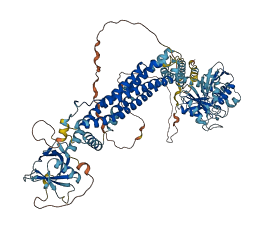
3 structures for P21575
| Entry ID | Method | Resolution | Chain | Position | Source |
|---|---|---|---|---|---|
| 2AKA | X-ray | 190 A | B | 6-304 | PDB |
| 3ZVR | X-ray | 310 A | A | 1-752 | PDB |
| AF-P21575-F1 | Predicted | AlphaFoldDB |
No variants for P21575
| Variant ID(s) | Position | Change | Description | Diseaes Association | Provenance |
|---|---|---|---|---|---|
| No variants for P21575 | |||||
No associated diseases with P21575
8 regional properties for P21575
| Type | Name | Position | InterPro Accession |
|---|---|---|---|
| domain | Dynamin stalk domain | 215 - 501 | IPR000375 |
| domain | Dynamin, GTPase domain | 6 - 294 | IPR001401 |
| domain | Pleckstrin homology domain | 519 - 627 | IPR001849 |
| domain | Dynamin GTPase effector | 654 - 745 | IPR003130 |
| conserved_site | Dynamin, GTPase region, conserved site | 57 - 66 | IPR019762 |
| domain | GTPase effector domain | 659 - 750 | IPR020850 |
| domain | Dynamin-type guanine nucleotide-binding (G) domain | 28 - 294 | IPR030381 |
| domain | Dynamin, N-terminal | 34 - 206 | IPR045063 |
Functions
| Description | ||
|---|---|---|
| EC Number | 3.6.5.5 | Acting on GTP; involved in cellular and subcellular movement |
| Subcellular Localization |
|
|
| PANTHER Family | ||
| PANTHER Subfamily | ||
| PANTHER Protein Class | ||
| PANTHER Pathway Category | No pathway information available | |
14 GO annotations of cellular component
| Name | Definition |
|---|---|
| cytoplasm | The contents of a cell excluding the plasma membrane and nucleus, but including other subcellular structures. |
| glutamatergic synapse | A synapse that uses glutamate as a neurotransmitter. |
| Golgi apparatus | A membrane-bound cytoplasmic organelle of the endomembrane system that further processes the core oligosaccharides (e.g. N-glycans) added to proteins in the endoplasmic reticulum and packages them into membrane-bound vesicles. The Golgi apparatus operates at the intersection of the secretory, lysosomal, and endocytic pathways. |
| membrane | A lipid bilayer along with all the proteins and protein complexes embedded in it an attached to it. |
| membrane coat | Any of several different proteinaceous coats that can associate with membranes. Membrane coats include those formed by clathrin plus an adaptor complex, the COPI and COPII complexes, and possibly others. They are found associated with membranes on many vesicles as well as other membrane features such as pits and perhaps tubules. |
| microtubule | Any of the long, generally straight, hollow tubes of internal diameter 12-15 nm and external diameter 24 nm found in a wide variety of eukaryotic cells; each consists (usually) of 13 protofilaments of polymeric tubulin, staggered in such a manner that the tubulin monomers are arranged in a helical pattern on the microtubular surface, and with the alpha/beta axes of the tubulin subunits parallel to the long axis of the tubule; exist in equilibrium with pool of tubulin monomers and can be rapidly assembled or disassembled in response to physiological stimuli; concerned with force generation, e.g. in the spindle. |
| photoreceptor inner segment | The inner segment of a vertebrate photoreceptor containing mitochondria, ribosomes and membranes where opsin molecules are assembled and passed to be part of the outer segment discs. |
| photoreceptor ribbon synapse | A ribbon synapse between a retinal photoreceptor cell (rod or cone) and a retinal bipolar cell. These contain a plate-like synaptic ribbon. |
| plasma membrane | The membrane surrounding a cell that separates the cell from its external environment. It consists of a phospholipid bilayer and associated proteins. |
| presynaptic endocytic zone membrane | The region of the presynaptic membrane that is part of the presynaptic endocytic zone - where synaptic vesicles are endocytosed and recycled following release. |
| protein-containing complex | A stable assembly of two or more macromolecules, i.e. proteins, nucleic acids, carbohydrates or lipids, in which at least one component is a protein and the constituent parts function together. |
| synapse | The junction between an axon of one neuron and a dendrite of another neuron, a muscle fiber or a glial cell. As the axon approaches the synapse it enlarges into a specialized structure, the presynaptic terminal bouton, which contains mitochondria and synaptic vesicles. At the tip of the terminal bouton is the presynaptic membrane; facing it, and separated from it by a minute cleft (the synaptic cleft) is a specialized area of membrane on the receiving cell, known as the postsynaptic membrane. In response to the arrival of nerve impulses, the presynaptic terminal bouton secretes molecules of neurotransmitters into the synaptic cleft. These diffuse across the cleft and transmit the signal to the postsynaptic membrane. |
| synaptic vesicle | A secretory organelle, typically 50 nm in diameter, of presynaptic nerve terminals; accumulates in high concentrations of neurotransmitters and secretes these into the synaptic cleft by fusion with the 'active zone' of the presynaptic plasma membrane. |
| varicosity | Non-terminal inflated portion of the axon, containing the specialized apparatus necessary to release neurotransmitters. |
10 GO annotations of molecular function
| Name | Definition |
|---|---|
| D2 dopamine receptor binding | Binding to a D2 dopamine receptor. |
| GTP binding | Binding to GTP, guanosine triphosphate. |
| GTPase activity | Catalysis of the reaction: GTP + H2O = GDP + H+ + phosphate. |
| identical protein binding | Binding to an identical protein or proteins. |
| microtubule binding | Binding to a microtubule, a filament composed of tubulin monomers. |
| nitric-oxide synthase binding | Binding to nitric-oxide synthase. |
| protein C-terminus binding | Binding to a protein C-terminus, the end of a peptide chain at which the 1-carboxyl function of a constituent amino acid is not attached in peptide linkage to another amino-acid residue. |
| protein kinase binding | Binding to a protein kinase, any enzyme that catalyzes the transfer of a phosphate group, usually from ATP, to a protein substrate. |
| protein-containing complex binding | Binding to a macromolecular complex. |
| SH3 domain binding | Binding to a SH3 domain (Src homology 3) of a protein, small protein modules containing approximately 50 amino acid residues found in a great variety of intracellular or membrane-associated proteins. |
13 GO annotations of biological process
| Name | Definition |
|---|---|
| endocytosis | A vesicle-mediated transport process in which cells take up external materials or membrane constituents by the invagination of a small region of the plasma membrane to form a new membrane-bounded vesicle. |
| endosome organization | A process that is carried out at the cellular level which results in the assembly, arrangement of constituent parts, or disassembly of endosomes. |
| G protein-coupled receptor internalization | The process that results in the uptake of a G protein-coupled receptor into an endocytic vesicle. |
| modulation of chemical synaptic transmission | Any process that modulates the frequency or amplitude of synaptic transmission, the process of communication from a neuron to a target (neuron, muscle, or secretory cell) across a synapse. Amplitude, in this case, refers to the change in postsynaptic membrane potential due to a single instance of synaptic transmission. |
| positive regulation of synaptic vesicle endocytosis | Any process that activates or increases the frequency, rate or extent of synaptic vesicle endocytosis. |
| positive regulation of synaptic vesicle recycling | Any process that activates or increases the frequency, rate or extent of synaptic vesicle recycling. |
| receptor internalization | A receptor-mediated endocytosis process that results in the movement of receptors from the plasma membrane to the inside of the cell. The process begins when cell surface receptors are monoubiquitinated following ligand-induced activation. Receptors are subsequently taken up into endocytic vesicles from where they are either targeted to the lysosome or vacuole for degradation or recycled back to the plasma membrane. |
| receptor-mediated endocytosis | An endocytosis process in which cell surface receptors ensure specificity of transport. A specific receptor on the cell surface binds tightly to the extracellular macromolecule (the ligand) that it recognizes; the plasma-membrane region containing the receptor-ligand complex then undergoes endocytosis, forming a transport vesicle containing the receptor-ligand complex and excluding most other plasma-membrane proteins. Receptor-mediated endocytosis generally occurs via clathrin-coated pits and vesicles. |
| regulation of synaptic vesicle endocytosis | Any process that modulates the frequency, rate or extent of synaptic vesicle endocytosis. |
| response to amyloid-beta | Any process that results in a change in state or activity of a cell or an organism (in terms of movement, secretion, enzyme production, gene expression, etc.) as a result of a amyloid-beta stimulus. |
| synaptic vesicle budding from presynaptic endocytic zone membrane | Evagination of the presynaptic membrane, resulting in the formation of a new synaptic vesicle. |
| synaptic vesicle endocytosis | A vesicle-mediated transport process, in which the synaptic vesicle membrane constituents are retrieved from the presynaptic membrane on the axon terminal after neurotransmitter secretion by exocytosis. Synaptic vesicle endocytosis can occur via clathrin-dependent and clathrin-independent mechanisms. |
| toxin transport | The directed movement of a toxin into, out of or within a cell, or between cells, by means of some agent such as a transporter or pore. |
10 homologous proteins in AiPD
| UniProt AC | Gene Name | Protein Name | Species | Evidence Code |
|---|---|---|---|---|
| Q9UQ16 | DNM3 | Dynamin-3 | Homo sapiens (Human) | PR |
| O00429 | DNM1L | Dynamin-1-like protein | Homo sapiens (Human) | PR |
| Q05193 | DNM1 | Dynamin-1 | Homo sapiens (Human) | PR |
| Q8BZ98 | Dnm3 | Dynamin-3 | Mus musculus (Mouse) | PR |
| Q8K1M6 | Dnm1l | Dynamin-1-like protein | Mus musculus (Mouse) | PR |
| P39053 | Dnm1 | Dynamin-1 | Mus musculus (Mouse) | PR |
| O35303 | Dnm1l | Dynamin-1-like protein | Rattus norvegicus (Rat) | PR |
| Q08877 | Dnm3 | Dynamin-3 | Rattus norvegicus (Rat) | PR |
| Q8LF21 | DRP1C | Phragmoplastin DRP1C | Arabidopsis thaliana (Mouse-ear cress) | PR |
| Q8S3C9 | DRP1D | Phragmoplastin DRP1D | Arabidopsis thaliana (Mouse-ear cress) | PR |
| 10 | 20 | 30 | 40 | 50 | 60 |
| MGNRGMEDLI | PLVNRLQDAF | SAIGQNADLD | LPQIAVVGGQ | SAGKSSVLEN | FVGRDFLPRG |
| 70 | 80 | 90 | 100 | 110 | 120 |
| SGIVTRRPLV | LQLVNSTTEY | AEFLHCKGKK | FTDFEEVRLE | IEAETDRVTG | TNKGISPVPI |
| 130 | 140 | 150 | 160 | 170 | 180 |
| NLRVYSPHVL | NLTLVDLPGM | TKVPVGDQPP | DIEFQIRDML | MQFVTKENCL | ILAVSPANSD |
| 190 | 200 | 210 | 220 | 230 | 240 |
| LANSDALKIA | KEVDPQGQRT | IGVITKLDLM | DEGTDARDVL | ENKLLPLRRG | YIGVVNRSQK |
| 250 | 260 | 270 | 280 | 290 | 300 |
| DIDGKKDITA | ALAAERKFFL | SHPSYRHLAD | RMGTPYLQKV | LNQQLTNHIR | DTLPGLRNKL |
| 310 | 320 | 330 | 340 | 350 | 360 |
| QSQLLSIEKE | VDEYKNFRPD | DPARKTKALL | QMVQQFAVDF | EKRIEGSGDQ | IDTYELSGGA |
| 370 | 380 | 390 | 400 | 410 | 420 |
| RINRIFHERF | PFELVKMEFD | EKELRREISY | AIKNIHGIRT | GLFTPDLAFE | ATVKKQVQKL |
| 430 | 440 | 450 | 460 | 470 | 480 |
| KEPSIKCVDM | VVSELTSTIR | KCSEKLQQYP | RLREEMERIV | TTHIREREGR | TKEQVMLLID |
| 490 | 500 | 510 | 520 | 530 | 540 |
| IELAYMNTNH | EDFIGFANAQ | QRSNQMNKKK | TSGNQDEILV | IRKGWLTINN | IGIMKGGSKE |
| 550 | 560 | 570 | 580 | 590 | 600 |
| YWFVLTAENL | SWYKDDEEKE | KKYMLSVDNL | KLRDVEKGFM | SSKHIFALFN | TEQRNVYKDY |
| 610 | 620 | 630 | 640 | 650 | 660 |
| RQLELACETQ | EEVDSWKASF | LRAGVYPERV | GDKEKASETE | ENGSDSFMHS | MDPQLERQVE |
| 670 | 680 | 690 | 700 | 710 | 720 |
| TIRNLVDSYM | AIVNKTVRDL | MPKTIMHLMI | NNTKEFIFSE | LLANLYSCGD | QNTLMEESAE |
| 730 | 740 | 750 | 760 | 770 | 780 |
| QAQRRDEMLR | MYHALKEALS | IIGDINTTTV | STPMPPPVDD | SWLQVQSVPA | GRRSPTSSPT |
| 790 | 800 | 810 | 820 | 830 | 840 |
| PQRRAPAVPP | ARPGSRGPAP | GPPPAGSALG | GAPPVPSRPG | ASPDPFGPPP | QVPSRPNRAP |
| 850 | 860 | ||||
| PGVPSRSGQA | SPSRPESPRP | PFDL |