Q8C6L5
Gene name |
Cgas |
Protein name |
Cyclic GMP-AMP synthase |
Names |
cGAMP synthase, cGAS, m-cGAS, 2'3'-cGAMP synthase, Mab-21 domain-containing protein 1 |
Species |
Mus musculus (Mouse) |
KEGG Pathway |
mmu:214763 |
EC number |
2.7.7.86: Nucleotidyltransferases |
Protein Class |
|
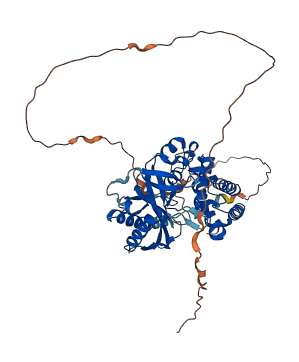
Descriptions
The autoinhibited protein was predicted that may have potential autoinhibitory elements via cis-regPred.
Autoinhibitory domains (AIDs)
Target domain |
|
Relief mechanism |
|
Assay |
cis-regPred |
Accessory elements
No accessory elements
Autoinhibited structure

Activated structure
36 structures for Q8C6L5
| Entry ID | Method | Resolution | Chain | Position | Source |
|---|---|---|---|---|---|
| 4K8V | X-ray | 200 A | A/B/C/D | 147-507 | PDB |
| 4K96 | X-ray | 208 A | A/B | 147-507 | PDB |
| 4K97 | X-ray | 241 A | A | 147-507 | PDB |
| 4K98 | X-ray | 194 A | A | 147-507 | PDB |
| 4K99 | X-ray | 195 A | A | 147-507 | PDB |
| 4K9A | X-ray | 226 A | A | 147-507 | PDB |
| 4K9B | X-ray | 226 A | A | 147-507 | PDB |
| 4LEY | X-ray | 250 A | A/B/C/D | 142-507 | PDB |
| 4LEZ | X-ray | 236 A | A/C | 142-507 | PDB |
| 4O6A | X-ray | 186 A | A/B | 147-507 | PDB |
| 5N6I | X-ray | 360 A | A/B/C/D/E/F | 139-507 | PDB |
| 5XZB | X-ray | 213 A | A | 149-505 | PDB |
| 5XZE | X-ray | 218 A | A | 147-507 | PDB |
| 5XZG | X-ray | 183 A | A | 147-507 | PDB |
| 6X59 | EM | 298 A | K | 142-507 | PDB |
| 6X5A | EM | 436 A | K | 142-507 | PDB |
| 6XJD | EM | 680 A | K/L | 142-507 | PDB |
| 7A08 | EM | 311 A | a | 139-507 | PDB |
| 7BUJ | X-ray | 213 A | A/B | 61-507 | PDB |
| 7BUM | X-ray | 305 A | A/B | 1-507 | PDB |
| 7BUQ | X-ray | 309 A | A/B | 1-507 | PDB |
| 7JO9 | EM | 330 A | K | 142-507 | PDB |
| 7JOA | EM | 330 A | K | 142-507 | PDB |
| 7KXS | X-ray | 260 A | A/B | 147-507 | PDB |
| 7UTT | X-ray | 204 A | A/C | 147-507 | PDB |
| 7UUX | X-ray | 226 A | A/C | 147-507 | PDB |
| 7UXW | X-ray | 257 A | A/C | 147-507 | PDB |
| 7UYQ | X-ray | 257 A | A/C | 147-507 | PDB |
| 7UYZ | X-ray | 249 A | A/C | 147-507 | PDB |
| 7UZR | X-ray | 270 A | A/C | 147-507 | PDB |
| 7V0C | X-ray | 257 A | A/C | 147-507 | PDB |
| 7V0R | X-ray | 251 A | A/C | 147-507 | PDB |
| 7V0W | X-ray | 266 A | A/C | 147-507 | PDB |
| 8EAE | X-ray | 256 A | A/C | 147-507 | PDB |
| 8ECC | X-ray | 244 A | A/C | 147-507 | PDB |
| AF-Q8C6L5-F1 | Predicted | AlphaFoldDB |
16 variants for Q8C6L5
| Variant ID(s) | Position | Change | Description | Diseaes Association | Provenance |
|---|---|---|---|---|---|
| rs233690332 | 9 | T>A | No | EVA | |
| rs241013452 | 64 | H>R | No | EVA | |
| rs220987275 | 92 | R>P | No | EVA | |
| rs3399820834 | 125 | P>L | No | EVA | |
| rs243131043 | 163 | D>A | No | EVA | |
| rs3389068006 | 245 | G>* | No | EVA | |
| rs3389053770 | 283 | S>DG* | No | EVA | |
| rs3399820810 | 349 | P>H | No | EVA | |
| rs3389067957 | 421 | Y>N | No | EVA | |
| rs3389062773 | 422 | H>L | No | EVA | |
| rs3400185560 | 425 | T>A | No | EVA | |
| rs3400378492 | 425 | T>N | No | EVA | |
| rs3400512748 | 426 | A>G | No | EVA | |
| rs3413070844 | 427 | I>S | No | EVA | |
| rs265245495 | 454 | A>V | No | EVA | |
| rs248304713 | 483 | R>Q | No | EVA |
No associated diseases with Q8C6L5
Functions
| Description | ||
|---|---|---|
| EC Number | 2.7.7.86 | Nucleotidyltransferases |
| Subcellular Localization |
|
|
| PANTHER Family | ||
| PANTHER Subfamily | ||
| PANTHER Protein Class | ||
| PANTHER Pathway Category | No pathway information available | |
5 GO annotations of cellular component
| Name | Definition |
|---|---|
| cytosol | The part of the cytoplasm that does not contain organelles but which does contain other particulate matter, such as protein complexes. |
| nucleoplasm | That part of the nuclear content other than the chromosomes or the nucleolus. |
| nucleus | A membrane-bounded organelle of eukaryotic cells in which chromosomes are housed and replicated. In most cells, the nucleus contains all of the cell's chromosomes except the organellar chromosomes, and is the site of RNA synthesis and processing. In some species, or in specialized cell types, RNA metabolism or DNA replication may be absent. |
| plasma membrane | The membrane surrounding a cell that separates the cell from its external environment. It consists of a phospholipid bilayer and associated proteins. |
| site of double-strand break | A region of a chromosome at which a DNA double-strand break has occurred. DNA damage signaling and repair proteins accumulate at the lesion to respond to the damage and repair the DNA to form a continuous DNA helix. |
12 GO annotations of molecular function
| Name | Definition |
|---|---|
| 2',3'-cyclic GMP-AMP synthase activity | Catalysis of the reaction: ATP + GTP = 2 diphosphate + cyclic G-P(2'-5')A-P(3'-5') (cyclic 2',3' GAMP). |
| ATP binding | Binding to ATP, adenosine 5'-triphosphate, a universally important coenzyme and enzyme regulator. |
| chromatin binding | Binding to chromatin, the network of fibers of DNA, protein, and sometimes RNA, that make up the chromosomes of the eukaryotic nucleus during interphase. |
| DNA binding | Any molecular function by which a gene product interacts selectively and non-covalently with DNA (deoxyribonucleic acid). |
| double-stranded DNA binding | Binding to double-stranded DNA. |
| GTP binding | Binding to GTP, guanosine triphosphate. |
| metal ion binding | Binding to a metal ion. |
| molecular condensate scaffold activity | Binding and bringing together two or more macromolecules in contact, permitting those molecules to organize as a molecular condensate. |
| nucleosome binding | Binding to a nucleosome, a complex comprised of DNA wound around a multisubunit core and associated proteins, which forms the primary packing unit of DNA into higher order structures. |
| phosphatidylinositol-4,5-bisphosphate binding | Binding to phosphatidylinositol-4,5-bisphosphate, a derivative of phosphatidylinositol in which the inositol ring is phosphorylated at the 4' and 5' positions. |
| poly-ADP-D-ribose modification-dependent protein binding | Binding to a protein upon poly-ADP-ribosylation of the target protein. |
| protein homodimerization activity | Binding to an identical protein to form a homodimer. |
18 GO annotations of biological process
| Name | Definition |
|---|---|
| activation of innate immune response | Any process that initiates an innate immune response. Innate immune responses are defense responses mediated by germline encoded components that directly recognize components of potential pathogens. Examples of this process include activation of the hypersensitive response of Arabidopsis thaliana and activation of any NOD or TLR signaling pathway in vertebrate species. |
| cAMP-mediated signaling | Any intracellular signal transduction in which the signal is passed on within the cell via cyclic AMP (cAMP). Includes production of cAMP, and downstream effectors that further transmit the signal within the cell. |
| cellular response to DNA damage stimulus | Any process that results in a change in state or activity of a cell (in terms of movement, secretion, enzyme production, gene expression, etc.) as a result of a stimulus indicating damage to its DNA from environmental insults or errors during metabolism. |
| cellular response to exogenous dsRNA | Any process that results in a change in state or activity of a cell (in terms of movement, secretion, enzyme production, gene expression, etc.) as a result of an exogenous double-stranded RNA stimulus. |
| cGMP-mediated signaling | Any intracellular signal transduction in which the signal is passed on within the cell via cyclic GMP (cGMP). Includes production of cGMP, and downstream effectors that further transmit the signal within the cell. |
| defense response to virus | Reactions triggered in response to the presence of a virus that act to protect the cell or organism. |
| determination of adult lifespan | The pathways that regulate the duration of the adult phase of the life-cycle of an animal. |
| DNA repair | The process of restoring DNA after damage. Genomes are subject to damage by chemical and physical agents in the environment (e.g. UV and ionizing radiations, chemical mutagens, fungal and bacterial toxins, etc.) and by free radicals or alkylating agents endogenously generated in metabolism. DNA is also damaged because of errors during its replication. A variety of different DNA repair pathways have been reported that include direct reversal, base excision repair, nucleotide excision repair, photoreactivation, bypass, double-strand break repair pathway, and mismatch repair pathway. |
| innate immune response | Innate immune responses are defense responses mediated by germline encoded components that directly recognize components of potential pathogens. |
| negative regulation of double-strand break repair via homologous recombination | Any process that stops, prevents, or reduces the frequency, rate or extent of double-strand break repair via homologous recombination. |
| paracrine signaling | The transfer of information from one cell to another, where the signal travels from the signal-producing cell to the receiving cell by passive diffusion or bulk flow in intercellular fluid. The signaling cell and the receiving cell are usually in the vicinity of each other. |
| positive regulation of cellular senescence | Any process that activates or increases the frequency, rate or extent of cellular senescence. |
| positive regulation of defense response to virus by host | Any host process that results in the promotion of antiviral immune response mechanisms, thereby limiting viral replication. |
| positive regulation of type I interferon production | Any process that activates or increases the frequency, rate, or extent of type I interferon production. Type I interferons include the interferon-alpha, beta, delta, episilon, zeta, kappa, tau, and omega gene families. |
| regulation of immune response | Any process that modulates the frequency, rate or extent of the immune response, the immunological reaction of an organism to an immunogenic stimulus. |
| regulation of immunoglobulin production | Any process that modulates the frequency, rate, or extent of immunoglobulin production. |
| regulation of T cell activation | Any process that modulates the frequency, rate or extent of T cell activation. |
| regulation of type I interferon production | Any process that modulates the frequency, rate, or extent of interferon type I production. Type I interferons include the interferon-alpha, beta, delta, episilon, zeta, kappa, tau, and omega gene families. |
4 homologous proteins in AiPD
| 10 | 20 | 30 | 40 | 50 | 60 |
| MEDPRRRTTA | PRAKKPSAKR | APTQPSRTRA | HAESCGPQRG | ARSRRAERDG | DTTEKPRAPG |
| 70 | 80 | 90 | 100 | 110 | 120 |
| PRVHPARATE | LTKDAQPSAM | DAAGATARPA | VRVPQQQAIL | DPELPAVREP | QPPADPEARK |
| 130 | 140 | 150 | 160 | 170 | 180 |
| VVRGPSHRRG | ARSTGQPRAP | RGSRKEPDKL | KKVLDKLRLK | RKDISEAAET | VNKVVERLLR |
| 190 | 200 | 210 | 220 | 230 | 240 |
| RMQKRESEFK | GVEQLNTGSY | YEHVKISAPN | EFDVMFKLEV | PRIELQEYYE | TGAFYLVKFK |
| 250 | 260 | 270 | 280 | 290 | 300 |
| RIPRGNPLSH | FLEGEVLSAT | KMLSKFRKII | KEEVKEIKDI | DVSVEKEKPG | SPAVTLLIRN |
| 310 | 320 | 330 | 340 | 350 | 360 |
| PEEISVDIIL | ALESKGSWPI | STKEGLPIQG | WLGTKVRTNL | RREPFYLVPK | NAKDGNSFQG |
| 370 | 380 | 390 | 400 | 410 | 420 |
| ETWRLSFSHT | EKYILNNHGI | EKTCCESSGA | KCCRKECLKL | MKYLLEQLKK | EFQELDAFCS |
| 430 | 440 | 450 | 460 | 470 | 480 |
| YHVKTAIFHM | WTQDPQDSQW | DPRNLSSCFD | KLLAFFLECL | RTEKLDHYFI | PKFNLFSQEL |
| 490 | 500 | ||||
| IDRKSKEFLS | KKIEYERNNG | FPIFDKL |