Q8C4V4
Gene name |
Fbxl3 (Afh, Fbl3a, Fbxl3a, Ovtm) |
Protein name |
F-box/LRR-repeat protein 3 |
Names |
F-box and leucine-rich repeat protein 3A, F-box/LRR-repeat protein 3A, Protein after-hours, Protein overtime |
Species |
Mus musculus (Mouse) |
KEGG Pathway |
mmu:50789 |
EC number |
|
Protein Class |
|
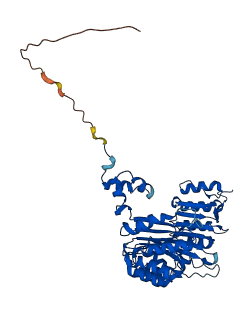
Descriptions
The autoinhibited protein was predicted that may have potential autoinhibitory elements via cis-regPred.
Autoinhibitory domains (AIDs)
Target domain |
|
Relief mechanism |
|
Assay |
cis-regPred |
Accessory elements
No accessory elements
Autoinhibited structure

Activated structure
1 structures for Q8C4V4
| Entry ID | Method | Resolution | Chain | Position | Source |
|---|---|---|---|---|---|
| AF-Q8C4V4-F1 | Predicted | AlphaFoldDB |
21 variants for Q8C4V4
| Variant ID(s) | Position | Change | Description | Diseaes Association | Provenance |
|---|---|---|---|---|---|
| rs232343829 | 30 | R>H | No | EVA | |
| rs213379933 | 31 | S>L | No | EVA | |
| rs3411270010 | 124 | A>V | No | EVA | |
| rs3405527437 | 125 | E>* | No | EVA | |
| rs3405527459 | 125 | E>A | No | EVA | |
| rs3405466973 | 127 | A>D | No | EVA | |
| rs3389349212 | 251 | R>H | No | EVA | |
| rs1132876753 | 314 | Y>H | No | EVA | |
| rs1132475258 | 317 | R>K | No | EVA | |
| rs1135399515 | 320 | S>N | No | EVA | |
| rs1132688748 | 323 | V>E | No | EVA | |
| rs1132353160 | 329 | M>T | No | EVA | |
| rs3389349395 | 364 | I>T | No | EVA | |
| rs3389310096 | 375 | A>D | No | EVA | |
| rs3389310111 | 376 | F>* | No | EVA | |
| rs3389310093 | 376 | F>L | No | EVA | |
| rs3389300303 | 379 | F>V | No | EVA | |
| rs3389316883 | 381 | K>E | No | EVA | |
| rs3389349469 | 384 | G>W | No | EVA | |
| rs3389341397 | 416 | L>P | No | EVA | |
| rs3389344129 | 426 | P>H | No | EVA |
No associated diseases with Q8C4V4
1 regional properties for Q8C4V4
| Type | Name | Position | InterPro Accession |
|---|---|---|---|
| domain | F-box domain | 39 - 79 | IPR001810 |
5 GO annotations of cellular component
| Name | Definition |
|---|---|
| cytosol | The part of the cytoplasm that does not contain organelles but which does contain other particulate matter, such as protein complexes. |
| nuclear body | Extra-nucleolar nuclear domains usually visualized by confocal microscopy and fluorescent antibodies to specific proteins. |
| nucleoplasm | That part of the nuclear content other than the chromosomes or the nucleolus. |
| nucleus | A membrane-bounded organelle of eukaryotic cells in which chromosomes are housed and replicated. In most cells, the nucleus contains all of the cell's chromosomes except the organellar chromosomes, and is the site of RNA synthesis and processing. In some species, or in specialized cell types, RNA metabolism or DNA replication may be absent. |
| SCF ubiquitin ligase complex | A ubiquitin ligase complex in which a cullin from the Cul1 subfamily and a RING domain protein form the catalytic core; substrate specificity is conferred by a Skp1 adaptor and an F-box protein. SCF complexes are involved in targeting proteins for degradation by the proteasome. The best characterized complexes are those from yeast and mammals (with core subunits named Cdc53/Cul1, Rbx1/Hrt1/Roc1). |
1 GO annotations of molecular function
| Name | Definition |
|---|---|
| ubiquitin-protein transferase activity | Catalysis of the transfer of ubiquitin from one protein to another via the reaction X-Ub + Y --> Y-Ub + X, where both X-Ub and Y-Ub are covalent linkages. |
9 GO annotations of biological process
| Name | Definition |
|---|---|
| entrainment of circadian clock by photoperiod | The synchronization of a circadian rhythm to photoperiod, the intermittent cycle of light (day) and dark (night). |
| G2/M transition of mitotic cell cycle | The mitotic cell cycle transition by which a cell in G2 commits to M phase. The process begins when the kinase activity of M cyclin/CDK complex reaches a threshold high enough for the cell cycle to proceed. This is accomplished by activating a positive feedback loop that results in the accumulation of unphosphorylated and active M cyclin/CDK complex. |
| proteasome-mediated ubiquitin-dependent protein catabolic process | The chemical reactions and pathways resulting in the breakdown of a protein or peptide by hydrolysis of its peptide bonds, initiated by the covalent attachment of ubiquitin, and mediated by the proteasome. |
| protein destabilization | Any process that decreases the stability of a protein, making it more vulnerable to degradative processes or aggregation. |
| protein ubiquitination | The process in which one or more ubiquitin groups are added to a protein. |
| regulation of cell cycle | Any process that modulates the rate or extent of progression through the cell cycle. |
| regulation of circadian rhythm | Any process that modulates the frequency, rate or extent of a circadian rhythm. A circadian rhythm is a biological process in an organism that recurs with a regularity of approximately 24 hours. |
| rhythmic process | Any process pertinent to the generation and maintenance of rhythms in the physiology of an organism. |
| SCF-dependent proteasomal ubiquitin-dependent protein catabolic process | The chemical reactions and pathways resulting in the breakdown of a protein or peptide by hydrolysis of its peptide bonds, initiated by the covalent attachment of ubiquitin, with ubiquitin-protein ligation catalyzed by an SCF (Skp1/Cul1/F-box protein) complex, and mediated by the proteasome. |
6 homologous proteins in AiPD
| UniProt AC | Gene Name | Protein Name | Species | Evidence Code |
|---|---|---|---|---|
| Q8N4B4 | FBXO39 | F-box only protein 39 | Homo sapiens (Human) | PR |
| Q8N461 | FBXL16 | F-box/LRR-repeat protein 16 | Homo sapiens (Human) | PR |
| Q9UKT7 | FBXL3 | F-box/LRR-repeat protein 3 | Homo sapiens (Human) | PR |
| Q8BH70 | Fbxl4 | F-box/LRR-repeat protein 4 | Mus musculus (Mouse) | PR |
| Q9LTX2 | At5g49980 | Transport inhibitor response 1-like protein | Arabidopsis thaliana (Mouse-ear cress) | PR |
| Q9ZR12 | GRH1 | GRR1-like protein 1 | Arabidopsis thaliana (Mouse-ear cress) | PR |
| 10 | 20 | 30 | 40 | 50 | 60 |
| MKRGGRDSDQ | DSAEEGTAEK | PKRPRTTQER | SQPCDWGNLL | QDIVLHVFKY | LPLLDRAHAS |
| 70 | 80 | 90 | 100 | 110 | 120 |
| QVCRNWNQVF | HMPDLWRCFE | FELNQPATSY | LKATHPELIK | QIIKRHSNHL | QYVSFKVDSS |
| 130 | 140 | 150 | 160 | 170 | 180 |
| KESAEAACDI | LSQLVNCSLK | TLGLISTARP | SFMDLPKSHF | ISALTVVFVN | SKSLSSLKID |
| 190 | 200 | 210 | 220 | 230 | 240 |
| DTPVDDPSLK | VLVANNSDTL | KLLKMSSCPH | VSPAGILCVA | DQCHGLRELA | LNYHLLSDEL |
| 250 | 260 | 270 | 280 | 290 | 300 |
| LLALSSEKHV | RLEHLRIDVV | SENPGQTHFH | TIQKSSWDAF | IKHSPKVNLV | MYFFLYEEEF |
| 310 | 320 | 330 | 340 | 350 | 360 |
| DPFFRYEIPA | THLYFGRSVS | KDVLGRVGMT | CPRLVELVVC | ANGLRPLDEE | LIRIAERCKN |
| 370 | 380 | 390 | 400 | 410 | 420 |
| LSAIGLGECE | VSCSAFVEFV | KMCGGRLSQL | SIMEEVLIPD | QKYSLEQIHW | EVSKHLGRVW |
| FPDMMPTW |