Q8C0J2
Gene name |
Atg16l1 |
Protein name |
Autophagy-related protein 16-1 |
Names |
APG16-like 1 |
Species |
Mus musculus (Mouse) |
KEGG Pathway |
mmu:77040 |
EC number |
|
Protein Class |
|
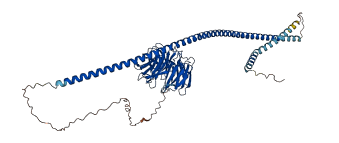
Descriptions
The autoinhibited protein was predicted that may have potential autoinhibitory elements via cis-regPred.
Autoinhibitory domains (AIDs)
Target domain |
|
Relief mechanism |
|
Assay |
cis-regPred |
Accessory elements
No accessory elements
Autoinhibited structure

Activated structure
4 structures for Q8C0J2
| Entry ID | Method | Resolution | Chain | Position | Source |
|---|---|---|---|---|---|
| 6SUR | X-ray | 347 A | I/J/K/L/M/N | 154-210 | PDB |
| 6Y09 | X-ray | 240 A | C/D | 141-265 | PDB |
| 6ZAY | X-ray | 240 A | C/D | 141-265 | PDB |
| AF-Q8C0J2-F1 | Predicted | AlphaFoldDB |
26 variants for Q8C0J2
| Variant ID(s) | Position | Change | Description | Diseaes Association | Provenance |
|---|---|---|---|---|---|
| rs13461819 | 83 | Q>H | No | EVA | |
| rs3388486499 | 105 | E>* | No | EVA | |
| rs3388484807 | 130 | K>* | No | EVA | |
| rs3390284076 | 189 | E>* | No | EVA | |
| rs3390239040 | 189 | E>D | No | EVA | |
| rs3390307422 | 189 | E>V | No | EVA | |
| rs3388485772 | 233 | P>L | No | EVA | |
| rs3388486705 | 312 | T>S | No | EVA | |
| rs47638532 | 315 | S>L | No | EVA | |
| rs3390297744 | 342 | M>L | No | EVA | |
| rs3388485487 | 354 | D>Y | No | EVA | |
| rs3388486221 | 367 | A>D | No | EVA | |
| rs3388487251 | 371 | S>N | No | EVA | |
| rs3388484737 | 374 | F>S | No | EVA | |
| rs3388484938 | 404 | L>F | No | EVA | |
| rs3388485717 | 449 | G>R | No | EVA | |
| rs3388484965 | 527 | S>R | No | EVA | |
| rs3388486447 | 533 | C>R | No | EVA | |
| rs3390293616 | 545 | D>A | No | EVA | |
| rs3390143259 | 546 | G>A | No | EVA | |
| rs3390289768 | 548 | Y>N | No | EVA | |
| rs3390255515 | 550 | A>P | No | EVA | |
| rs3390279665 | 551 | A>S | No | EVA | |
| rs3388484177 | 567 | K>N | No | EVA | |
| rs3388487127 | 605 | A>P | No | EVA | |
| rs3388487127 | 605 | A>T | No | EVA |
No associated diseases with Q8C0J2
4 regional properties for Q8C0J2
Functions
10 GO annotations of cellular component
| Name | Definition |
|---|---|
| Atg12-Atg5-Atg16 complex | A protein complex required for the expansion of the autophagosomal membrane. In budding yeast, this complex consists of Atg12p, Atg5p and Atg16p. |
| autophagosome | A double-membrane-bounded compartment that engulfs endogenous cellular material as well as invading microorganisms to target them to the lytic vacuole/lysosome for degradation as part of macroautophagy. |
| autophagosome membrane | The lipid bilayer surrounding an autophagosome, a double-membrane-bounded vesicle in which endogenous cellular material is sequestered. |
| axoneme | The bundle of microtubules and associated proteins that forms the core of cilia (also called flagella) in eukaryotic cells and is responsible for their movements. |
| cytoplasm | The contents of a cell excluding the plasma membrane and nucleus, but including other subcellular structures. |
| cytosol | The part of the cytoplasm that does not contain organelles but which does contain other particulate matter, such as protein complexes. |
| endolysosome membrane | The lipid bilayer surrounding an endolysosome. An endolysosome is a transient hybrid organelle formed by fusion of a late endosome with a lysosome. |
| phagophore assembly site membrane | A cellular membrane associated with the phagophore assembly site. |
| sperm midpiece | The highly organized segment of the sperm flagellum which begins at the connecting piece and is characterized by the presence of 9 outer dense fibers (ODFs) that lie outside each of the 9 outer axonemal microtubule doublets and by a sheath of mitochondria that encloses the ODFs and the axoneme; the midpiece terminates about one-fourth of the way down the sperm flagellum at the annulus, which marks the beginning of the principal piece. |
| vacuole-isolation membrane contact site | An organelle membrane contact site formed at the junction of the vacuolar membrane and the isolation membrane or phagophore in response to starvation or other stresses, leading to the formation of the autophagosome. |
2 GO annotations of molecular function
| Name | Definition |
|---|---|
| GTPase binding | Binding to a GTPase, any enzyme that catalyzes the hydrolysis of GTP. |
| identical protein binding | Binding to an identical protein or proteins. |
13 GO annotations of biological process
| Name | Definition |
|---|---|
| autophagosome assembly | The formation of a double membrane-bounded structure, the autophagosome, that occurs when a specialized membrane sac, called the isolation membrane, starts to enclose a portion of the cytoplasm. |
| C-terminal protein lipidation | The covalent attachment of a lipid group to the carboxy-terminus of a protein. |
| corpus callosum development | The process whose specific outcome is the progression of the corpus callosum over time, from its formation to the mature structure. The corpus callosum is a thick bundle of nerve fibers comprising a commissural plate connecting the two cerebral hemispheres. It consists of contralateral axon projections that provide communication between the right and left cerebral hemispheres. |
| defense response to virus | Reactions triggered in response to the presence of a virus that act to protect the cell or organism. |
| lysosomal microautophagy | The transfer of cytosolic components into the lysosomal compartment by direct invagination of the lysosomal membrane without prior sequestration into an autophagosome. The engulfing membranes fuse, resulting in the lysosomal delivery of the cargo wrapped in a single membrane derived from the invaginated lysosomal membrane. In S. cerevisiae, the vacuole is the lysosomal compartment. |
| macroautophagy | The major inducible pathway for the general turnover of cytoplasmic constituents in eukaryotic cells, it is also responsible for the degradation of active cytoplasmic enzymes and organelles during nutrient starvation. Macroautophagy involves the formation of double-membrane-bounded autophagosomes which enclose the cytoplasmic constituent targeted for degradation in a membrane-bounded structure. Autophagosomes then fuse with a lysosome (or vacuole) releasing single-membrane-bounded autophagic bodies that are then degraded within the lysosome (or vacuole). Some types of macroautophagy, e.g. pexophagy, mitophagy, involve selective targeting of the targets to be degraded. |
| negative stranded viral RNA replication | A viral genome replication process where the template genome is negative stranded, single stranded RNA ((-)ssRNA). |
| positive regulation of autophagy | Any process that activates, maintains or increases the rate of autophagy. Autophagy is the process in which cells digest parts of their own cytoplasm. |
| protein lipidation | The covalent attachment of lipid groups to an amino acid in a protein. |
| protein lipidation involved in autophagosome assembly | The protein lipidation process by which phosphatidylethanolamine is conjugated to a protein of the ATG8 family, leading to membrane insertion of the protein as a step in autophagosome assembly. |
| protein localization to phagophore assembly site | Any process in which a protein is transported to, or maintained at, the phagophore assembly site (PAS). |
| protein transport | The directed movement of proteins into, out of or within a cell, or between cells, by means of some agent such as a transporter or pore. |
| xenophagy | The selective autophagy process in which a region of cytoplasm containing an intracellular pathogen or some part of an intracellular pathogen (e.g. viral capsid) is enclosed in a double membrane bound autophagosome, which then fuses with the lysosome leading to degradation of the contents. |
5 homologous proteins in AiPD
| UniProt AC | Gene Name | Protein Name | Species | Evidence Code |
|---|---|---|---|---|
| Q8NAA4 | ATG16L2 | Protein Atg16l2 | Homo sapiens (Human) | PR |
| Q676U5 | ATG16L1 | Autophagy-related protein 16-1 | Homo sapiens (Human) | PR |
| Q6KAU8 | Atg16l2 | Protein Atg16l2 | Mus musculus (Mouse) | PR |
| Q09406 | atg-16.2 | Autophagic-related protein 16.2 | Caenorhabditis elegans | PR |
| Q5I0B9 | atg16 | Autophagy-related protein 16 | Xenopus tropicalis (Western clawed frog) (Silurana tropicalis) | PR |
| 10 | 20 | 30 | 40 | 50 | 60 |
| MSSGLRAADF | PRWKRHIAEE | LRRRDRLQRQ | AFEEIILQYT | KLLEKSDLHS | VLTQKLQAEK |
| 70 | 80 | 90 | 100 | 110 | 120 |
| HDMPNRHEIS | PGHDGAWNDS | QLQEMAQLRI | KHQEELTELH | KKRGELAQLV | IDLNNQMQQK |
| 130 | 140 | 150 | 160 | 170 | 180 |
| DKEIQMNEAK | ISEYLQTISD | LETNCLDLRT | KLQDLEVANQ | TLKDEYDALQ | ITFTALEEKL |
| 190 | 200 | 210 | 220 | 230 | 240 |
| RKTTEENQEL | VTRWMAEKAQ | EANRLNAENE | KDSRRRQARL | QKELAEAAKE | PLPVEQDDDI |
| 250 | 260 | 270 | 280 | 290 | 300 |
| EVIVDETSDH | TEETSPVRAV | SRAATKRLSQ | PAGGLLDSIT | NIFGRRSVSS | IPVPQDIMDT |
| 310 | 320 | 330 | 340 | 350 | 360 |
| HPASGKDVRV | PTTASYVFDA | HDGEVNAVQF | SPGSRLLATG | GMDRRVKLWE | AFGDKCEFKG |
| 370 | 380 | 390 | 400 | 410 | 420 |
| SLSGSNAGIT | SIEFDSAGAY | LLAASNDFAS | RIWTVDDYRL | RHTLTGHSGK | VLSAKFLLDN |
| 430 | 440 | 450 | 460 | 470 | 480 |
| ARIVSGSHDR | TLKLWDLRSK | VCIKTVFAGS | SCNDIVCTEQ | CVMSGHFDKK | IRFWDIRSES |
| 490 | 500 | 510 | 520 | 530 | 540 |
| VVREMELLGK | ITALDLNPER | TELLSCSRDD | LLKVIDLRTN | AVKQTFSAPG | FKCGSDWTRV |
| 550 | 560 | 570 | 580 | 590 | 600 |
| VFSPDGSYVA | AGSAEGSLYV | WSVLTGKVEK | VLSKQHSSSI | NAVAWAPSGL | HVVSVDKGSR |
| AVLWAQP |