Q09406
Gene name |
atg-16.2 |
Protein name |
Autophagic-related protein 16.2 |
Names |
|
Species |
Caenorhabditis elegans |
KEGG Pathway |
cel:CELE_K06A1.5 |
EC number |
|
Protein Class |
|
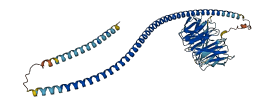
Descriptions
The autoinhibited protein was predicted that may have potential autoinhibitory elements via cis-regPred.
Autoinhibitory domains (AIDs)
Target domain |
|
Relief mechanism |
|
Assay |
cis-regPred |
Accessory elements
No accessory elements
Autoinhibited structure

Activated structure
1 structures for Q09406
| Entry ID | Method | Resolution | Chain | Position | Source |
|---|---|---|---|---|---|
| AF-Q09406-F1 | Predicted | AlphaFoldDB |
No variants for Q09406
| Variant ID(s) | Position | Change | Description | Diseaes Association | Provenance |
|---|---|---|---|---|---|
| No variants for Q09406 | |||||
No associated diseases with Q09406
8 regional properties for Q09406
| Type | Name | Position | InterPro Accession |
|---|---|---|---|
| repeat | WD40 repeat | 234 - 281 | IPR001680-1 |
| repeat | WD40 repeat | 279 - 402 | IPR001680-2 |
| repeat | WD40 repeat | 403 - 443 | IPR001680-3 |
| repeat | WD40 repeat | 446 - 534 | IPR001680-4 |
| conserved_site | WD40 repeat, conserved site | 305 - 319 | IPR019775 |
| repeat | G-protein beta WD-40 repeat | 305 - 319 | IPR020472-1 |
| repeat | G-protein beta WD-40 repeat | 346 - 360 | IPR020472-2 |
| repeat | G-protein beta WD-40 repeat | 389 - 403 | IPR020472-3 |
5 GO annotations of cellular component
| Name | Definition |
|---|---|
| Atg12-Atg5-Atg16 complex | A protein complex required for the expansion of the autophagosomal membrane. In budding yeast, this complex consists of Atg12p, Atg5p and Atg16p. |
| autophagosome membrane | The lipid bilayer surrounding an autophagosome, a double-membrane-bounded vesicle in which endogenous cellular material is sequestered. |
| cytoplasm | The contents of a cell excluding the plasma membrane and nucleus, but including other subcellular structures. |
| phagophore assembly site membrane | A cellular membrane associated with the phagophore assembly site. |
| plasma membrane | The membrane surrounding a cell that separates the cell from its external environment. It consists of a phospholipid bilayer and associated proteins. |
No GO annotations of molecular function
| Name | Definition |
|---|---|
| No GO annotations for molecular function |
8 GO annotations of biological process
| Name | Definition |
|---|---|
| aggrephagy | Selective degradation of protein aggregates by macroautophagy. |
| autophagosome assembly | The formation of a double membrane-bounded structure, the autophagosome, that occurs when a specialized membrane sac, called the isolation membrane, starts to enclose a portion of the cytoplasm. |
| autophagy | The cellular catabolic process in which cells digest parts of their own cytoplasm; allows for both recycling of macromolecular constituents under conditions of cellular stress and remodeling the intracellular structure for cell differentiation. |
| defense response to Gram-positive bacterium | Reactions triggered in response to the presence of a Gram-positive bacterium that act to protect the cell or organism. |
| germ cell proliferation | The multiplication or reproduction of germ cells, reproductive cells in multicellular organisms, resulting in the expansion of a cell population. |
| germ-line stem cell division | The self-renewing division of a germline stem cell to produce a daughter stem cell and a daughter germ cell, which will divide to form the gametes. |
| macroautophagy | The major inducible pathway for the general turnover of cytoplasmic constituents in eukaryotic cells, it is also responsible for the degradation of active cytoplasmic enzymes and organelles during nutrient starvation. Macroautophagy involves the formation of double-membrane-bounded autophagosomes which enclose the cytoplasmic constituent targeted for degradation in a membrane-bounded structure. Autophagosomes then fuse with a lysosome (or vacuole) releasing single-membrane-bounded autophagic bodies that are then degraded within the lysosome (or vacuole). Some types of macroautophagy, e.g. pexophagy, mitophagy, involve selective targeting of the targets to be degraded. |
| protein lipidation | The covalent attachment of lipid groups to an amino acid in a protein. |
5 homologous proteins in AiPD
| UniProt AC | Gene Name | Protein Name | Species | Evidence Code |
|---|---|---|---|---|
| Q8NAA4 | ATG16L2 | Protein Atg16l2 | Homo sapiens (Human) | PR |
| Q676U5 | ATG16L1 | Autophagy-related protein 16-1 | Homo sapiens (Human) | PR |
| Q6KAU8 | Atg16l2 | Protein Atg16l2 | Mus musculus (Mouse) | PR |
| Q8C0J2 | Atg16l1 | Autophagy-related protein 16-1 | Mus musculus (Mouse) | PR |
| Q5I0B9 | atg16 | Autophagy-related protein 16 | Xenopus tropicalis (Western clawed frog) (Silurana tropicalis) | PR |
| 10 | 20 | 30 | 40 | 50 | 60 |
| MTDNRTSFRL | EILNRLCKRE | RQQRCVKDMF | KNYSLLDEQL | QQSHRSRSVS | VNDEHFKGNV |
| 70 | 80 | 90 | 100 | 110 | 120 |
| NDRLAVMKEE | MANVYRMKSK | NDQDLIDANR | KLADSESRYS | LVSSQRDKLR | IETDAIVKKM |
| 130 | 140 | 150 | 160 | 170 | 180 |
| TVLENELAEL | KEENSVINTE | RVSLVATCNY | LTEKKTQLDN | ERFQLLNRIR | ELQEKSAEFM |
| 190 | 200 | 210 | 220 | 230 | 240 |
| NAEIALQEER | AQMRIREQIA | KATADLNLGD | ERASSAFGTS | PETLDEFMMT | DVLPSEVKFK |
| 250 | 260 | 270 | 280 | 290 | 300 |
| LSTHDGEVHD | VEWMSDDTFA | TAGSDSKVQI | WRVSPNKTDA | SKVSTLSGCL | GPVNRLDYDS |
| 310 | 320 | 330 | 340 | 350 | 360 |
| QRHVCLASSN | DKTCRLWNID | SQRLLSTFSG | HTDKVSSARL | FQSHNVISGS | ADRTIKNWDI |
| 370 | 380 | 390 | 400 | 410 | 420 |
| SSIRCLKSYL | VGSTVFDIVA | KCGVSQSSFI | SSHFDKKVRF | WDARSSDATY | SVELGQKVSS |
| 430 | 440 | 450 | 460 | 470 | 480 |
| LDISMDGLQV | LASSRDDTLS | LIDVRNYGII | HLYSAEQYKT | SCDSTRAIFS | STGEYVLAGS |
| 490 | 500 | 510 | 520 | 530 | |
| SNSSVFIWNT | KTTKLEKVVK | TARSDSAQIM | SLAWNPSGRG | LLACDRQKTC | TLWR |