Q8BLU2
Gene name |
Mettl21c |
Protein name |
Protein-lysine methyltransferase METTL21C |
Names |
Methyltransferase-like protein 21C |
Species |
Mus musculus (Mouse) |
KEGG Pathway |
mmu:433294 |
EC number |
|
Protein Class |
|
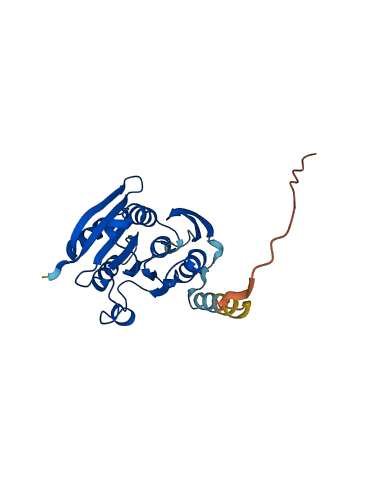
Descriptions
The autoinhibited protein was predicted that may have potential autoinhibitory elements via cis-regPred.
Autoinhibitory domains (AIDs)
Target domain |
|
Relief mechanism |
|
Assay |
cis-regPred |
Accessory elements
No accessory elements
Autoinhibited structure

Activated structure
1 structures for Q8BLU2
| Entry ID | Method | Resolution | Chain | Position | Source |
|---|---|---|---|---|---|
| AF-Q8BLU2-F1 | Predicted | AlphaFoldDB |
14 variants for Q8BLU2
| Variant ID(s) | Position | Change | Description | Diseaes Association | Provenance |
|---|---|---|---|---|---|
| rs33476170 | 37 | R>H | No | EVA | |
| rs3389917778 | 41 | K>Q | No | EVA | |
| rs3388466642 | 65 | Q>L | No | EVA | |
| rs3388467011 | 67 | S>T | No | EVA | |
| rs3389910324 | 111 | S>A | No | EVA | |
| rs238501102 | 138 | L>F | No | EVA | |
| rs33474839 | 144 | C>R | No | EVA | |
| rs229651934 | 147 | H>Y | No | EVA | |
| rs3388467532 | 148 | L>I | No | EVA | |
| rs212534325 | 170 | C>F | No | EVA | |
| rs263129723 | 213 | A>T | No | EVA | |
| rs229672937 | 219 | G>D | No | EVA | |
| rs237349729 | 233 | Y>H | No | EVA | |
| rs33473963 | 245 | L>F | No | EVA |
No associated diseases with Q8BLU2
No regional properties for Q8BLU2
| Type | Name | Position | InterPro Accession |
|---|---|---|---|
| No domain, repeats, and functional sites for Q8BLU2 | |||
4 GO annotations of cellular component
| Name | Definition |
|---|---|
| cytoplasm | The contents of a cell excluding the plasma membrane and nucleus, but including other subcellular structures. |
| cytosol | The part of the cytoplasm that does not contain organelles but which does contain other particulate matter, such as protein complexes. |
| nucleus | A membrane-bounded organelle of eukaryotic cells in which chromosomes are housed and replicated. In most cells, the nucleus contains all of the cell's chromosomes except the organellar chromosomes, and is the site of RNA synthesis and processing. In some species, or in specialized cell types, RNA metabolism or DNA replication may be absent. |
| protein-containing complex | A stable assembly of two or more macromolecules, i.e. proteins, nucleic acids, carbohydrates or lipids, in which at least one component is a protein and the constituent parts function together. |
2 GO annotations of molecular function
| Name | Definition |
|---|---|
| heat shock protein binding | Binding to a heat shock protein, a protein synthesized or activated in response to heat shock. |
| protein-lysine N-methyltransferase activity | Catalysis of the transfer of a methyl group from S-adenosyl-L-methionine to the epsilon-amino group of a lysine residue in a protein substrate. |
7 GO annotations of biological process
| Name | Definition |
|---|---|
| cellular response to dexamethasone stimulus | Any process that results in a change in state or activity of a cell (in terms of movement, secretion, enzyme production, gene expression, etc.) as a result of a dexamethasone stimulus. |
| hormone-mediated apoptotic signaling pathway | The series of molecular signals mediated by the detection of a hormone, and which triggers the apoptotic signaling pathway in a cell. The pathway starts with reception of a hormone signal, and ends when the execution phase of apoptosis is triggered. |
| peptidyl-lysine methylation | The methylation of peptidyl-lysine to form either the mono-, di- or trimethylated derivative. |
| peptidyl-lysine trimethylation | The methylation of peptidyl-lysine to form peptidyl-N6,N6,N6-trimethyl-L-lysine. |
| protein methylation | The addition of a methyl group to a protein amino acid. A methyl group is derived from methane by the removal of a hydrogen atom. |
| regulation of release of sequestered calcium ion into cytosol by sarcoplasmic reticulum | Any process that modulates the rate, frequency or extent of release of sequestered calcium ion into cytosol by the sarcoplasmic reticulum, the process in which the release of sequestered calcium ion by sarcoplasmic reticulum into cytosol occurs via calcium release channels. |
| skeletal muscle tissue development | The developmental sequence of events leading to the formation of adult skeletal muscle tissue. The main events are: the fusion of myoblasts to form myotubes that increase in size by further fusion to them of myoblasts, the formation of myofibrils within their cytoplasm and the establishment of functional neuromuscular junctions with motor neurons. At this stage they can be regarded as mature muscle fibers. |
6 homologous proteins in AiPD
| UniProt AC | Gene Name | Protein Name | Species | Evidence Code |
|---|---|---|---|---|
| Q12367 | RKM5 | Ribosomal lysine N-methyltransferase 5 | Saccharomyces cerevisiae (strain ATCC 204508 / S288c) (Baker's yeast) | PR |
| Q58DC7 | METTL21E | Protein-lysine methyltransferase METTL21E | Bos taurus (Bovine) | PR |
| A6QP81 | METTL21C | Protein-lysine methyltransferase METTL21C | Bos taurus (Bovine) | PR |
| Q5VZV1 | METTL21C | Protein-lysine methyltransferase METTL21C | Homo sapiens (Human) | PR |
| Q8CDZ2 | Mettl21e | Protein-lysine methyltransferase METTL21E | Mus musculus (Mouse) | PR |
| A7IQW5 | C42C1.13 | Protein-lysine methyltransferase C42C1.13 | Caenorhabditis elegans | PR |
| 10 | 20 | 30 | 40 | 50 | 60 |
| MDQHLHIAQQ | PLLSGTPQED | GFAGPSVEFD | RIESSLRSIQ | KFVPTDYASY | TQEHYQFAGK |
| 70 | 80 | 90 | 100 | 110 | 120 |
| KIIIQESIEN | YGTVVWPGAT | ALCQYLEDHT | EELNLQDAKI | LEIGAGAGLV | SIVSSLLGAQ |
| 130 | 140 | 150 | 160 | 170 | 180 |
| VTATDLPDVL | GNLQYNILKN | TLECTAHLPE | VRELVWGEDL | EQSFPKSTCC | YDYVLASDVV |
| 190 | 200 | 210 | 220 | 230 | 240 |
| YHHYFLDKLL | ATMVYLSQPG | TVVLWANKFR | FSADYEFLGK | FKQAFDTTLL | AEYSESSVKL |
| FKGILKWE |