Q8BFY6
Gene name |
Pef1 |
Protein name |
Peflin |
Names |
PEF protein with a long N-terminal hydrophobic domain, Penta-EF hand domain-containing protein 1 |
Species |
Mus musculus (Mouse) |
KEGG Pathway |
mmu:67898 |
EC number |
|
Protein Class |
|
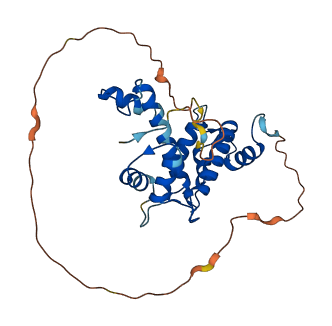
Descriptions
The autoinhibited protein was predicted that may have potential autoinhibitory elements via cis-regPred.
Autoinhibitory domains (AIDs)
Target domain |
|
Relief mechanism |
|
Assay |
cis-regPred |
Accessory elements
No accessory elements
Autoinhibited structure

Activated structure
1 structures for Q8BFY6
| Entry ID | Method | Resolution | Chain | Position | Source |
|---|---|---|---|---|---|
| AF-Q8BFY6-F1 | Predicted | AlphaFoldDB |
10 variants for Q8BFY6
| Variant ID(s) | Position | Change | Description | Diseaes Association | Provenance |
|---|---|---|---|---|---|
| rs237008483 | 6 | N>D | No | EVA | |
| rs3388716976 | 38 | S>I | No | EVA | |
| rs3388714827 | 42 | P>R | No | EVA | |
| rs3388721931 | 73 | G>D | No | EVA | |
| rs3388707786 | 119 | A>V | No | EVA | |
| rs3388713848 | 137 | S>F | No | EVA | |
| rs3388721932 | 144 | D>G | No | EVA | |
| rs3394760867 | 148 | L>H | No | EVA | |
| rs3388711206 | 224 | S>Y | No | EVA | |
| rs3388719597 | 241 | L>M | No | EVA |
No associated diseases with Q8BFY6
4 regional properties for Q8BFY6
| Type | Name | Position | InterPro Accession |
|---|---|---|---|
| domain | EF-hand domain | 105 - 174 | IPR002048-1 |
| domain | EF-hand domain | 172 - 207 | IPR002048-2 |
| binding_site | EF-Hand 1, calcium-binding site | 118 - 130 | IPR018247-1 |
| binding_site | EF-Hand 1, calcium-binding site | 185 - 197 | IPR018247-2 |
Functions
4 GO annotations of cellular component
| Name | Definition |
|---|---|
| COPII vesicle coat | One of two multimeric complexes that forms a membrane vesicle coat. COPII is best characterized in S. cerevisiae, where the subunits are called Sar1p, Sec13p, Sec31p, Sec23p, and Sec24p. Vesicles with COPII coats are found associated with endoplasmic reticulum (ER) membranes at steady state. |
| Cul3-RING ubiquitin ligase complex | A ubiquitin ligase complex in which a cullin from the Cul3 subfamily and a RING domain protein form the catalytic core; substrate specificity is conferred by a BTB-domain-containing protein. |
| cytoplasm | The contents of a cell excluding the plasma membrane and nucleus, but including other subcellular structures. |
| endoplasmic reticulum | The irregular network of unit membranes, visible only by electron microscopy, that occurs in the cytoplasm of many eukaryotic cells. The membranes form a complex meshwork of tubular channels, which are often expanded into slitlike cavities called cisternae. The ER takes two forms, rough (or granular), with ribosomes adhering to the outer surface, and smooth (with no ribosomes attached). |
6 GO annotations of molecular function
| Name | Definition |
|---|---|
| calcium ion binding | Binding to a calcium ion (Ca2+). |
| calcium-dependent protein binding | Binding to a protein or protein complex in the presence of calcium. |
| identical protein binding | Binding to an identical protein or proteins. |
| protein dimerization activity | The formation of a protein dimer, a macromolecular structure consists of two noncovalently associated identical or nonidentical subunits. |
| protein heterodimerization activity | Binding to a nonidentical protein to form a heterodimer. |
| ubiquitin ligase-substrate adaptor activity | The binding activity of a molecule that brings together a ubiquitin ligase and its substrate. Usually mediated by F-box BTB/POZ domain proteins. |
6 GO annotations of biological process
| Name | Definition |
|---|---|
| COPII vesicle coating | The addition of COPII proteins and adaptor proteins to ER membranes during the formation of transport vesicles, forming a vesicle coat. |
| endoplasmic reticulum to Golgi vesicle-mediated transport | The directed movement of substances from the endoplasmic reticulum (ER) to the Golgi, mediated by COP II vesicles. Small COP II coated vesicles form from the ER and then fuse directly with the cis-Golgi. Larger structures are transported along microtubules to the cis-Golgi. |
| neural crest cell development | The process aimed at the progression of a neural crest cell over time, from initial commitment of the cell to its specific fate, to the fully functional differentiated cell. |
| neural crest formation | The formation of the specialized region of ectoderm between the neural ectoderm (neural plate) and non-neural ectoderm. The neural crest gives rise to the neural crest cells that migrate away from this region as neural tube formation procedes. |
| positive regulation of protein monoubiquitination | Any process that activates or increases the frequency, rate or extent of protein monoubiquitination. |
| response to calcium ion | Any process that results in a change in state or activity of a cell or an organism (in terms of movement, secretion, enzyme production, gene expression, etc.) as a result of a calcium ion stimulus. |
6 homologous proteins in AiPD
| UniProt AC | Gene Name | Protein Name | Species | Evidence Code |
|---|---|---|---|---|
| Q6MZZ7 | CAPN13 | Calpain-13 | Homo sapiens (Human) | PR |
| P28676 | GCA | Grancalcin | Homo sapiens (Human) | PR |
| Q9UBV8 | PEF1 | Peflin | Homo sapiens (Human) | PR |
| Q3UW68 | Capn13 | Calpain-13 | Mus musculus (Mouse) | PR |
| Q5BK10 | Capn13 | Calpain-13 | Rattus norvegicus (Rat) | PR |
| Q641Z8 | Pef1 | Peflin | Rattus norvegicus (Rat) | PR |
| 10 | 20 | 30 | 40 | 50 | 60 |
| MASYPNGQSC | PGAAGQVPGV | PPGGYYPGPP | HGGGQYGSGL | PPGGGYGAPA | PGGPYGYPSA |
| 70 | 80 | 90 | 100 | 110 | 120 |
| GGVPSGTPSG | PYGGIPPGGP | YGQLPPGGPY | GTQPGHYGQG | GVPPNVDPEA | YSWFQSVDAD |
| 130 | 140 | 150 | 160 | 170 | 180 |
| HSGYISLKEL | KQALVNSNWS | SFNDETCLMM | INMFDKTKSG | RIDVAGFSAL | WKFLQQWRNL |
| 190 | 200 | 210 | 220 | 230 | 240 |
| FQQYDRDRSG | SISSTELQQA | LSQMGYNLSP | QFTQLLVSRY | CARSAIPAMQ | LDCFIKVCTQ |
| 250 | 260 | 270 | |||
| LQVLTEAFRE | KDTAVQGNIR | LSFEDFVTMT | ASRML |