Q80W32
Gene name |
Iqcg (Drc9) |
Protein name |
Dynein regulatory complex protein 9 |
Names |
IQ domain-containing protein G |
Species |
Mus musculus (Mouse) |
KEGG Pathway |
mmu:69707 |
EC number |
|
Protein Class |
|
Descriptions
The autoinhibited protein was predicted that may have potential autoinhibitory elements via cis-regPred.
Autoinhibitory domains (AIDs)
Target domain |
|
Relief mechanism |
|
Assay |
cis-regPred |
Accessory elements
No accessory elements
Autoinhibited structure

Activated structure
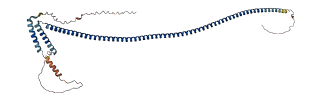
1 structures for Q80W32
| Entry ID | Method | Resolution | Chain | Position | Source |
|---|---|---|---|---|---|
| AF-Q80W32-F1 | Predicted | AlphaFoldDB |
22 variants for Q80W32
| Variant ID(s) | Position | Change | Description | Diseaes Association | Provenance |
|---|---|---|---|---|---|
| rs3389405741 | 9 | V>M | No | EVA | |
| rs212794584 | 10 | E>G | No | EVA | |
| rs266189851 | 49 | I>T | No | EVA | |
| rs233218159 | 69 | D>N | No | EVA | |
| rs240131688 | 89 | T>I | No | EVA | |
| rs4171104 | 99 | M>T | No | EVA | |
| rs231838466 | 101 | T>I | No | EVA | |
| rs3389419394 | 116 | S>P | No | EVA | |
| rs263423660 | 130 | F>L | No | EVA | |
| rs3389412369 | 130 | F>Y | No | EVA | |
| rs3389374347 | 160 | N>T | No | EVA | |
| rs3389329061 | 235 | Q>K | No | EVA | |
| rs3389329080 | 261 | K>Q | No | EVA | |
| rs3389411473 | 268 | E>K | No | EVA | |
| rs3389406429 | 269 | L>F | No | EVA | |
| rs3389329040 | 274 | I>T | No | EVA | |
| rs3389374359 | 281 | T>I | No | EVA | |
| rs32569179 | 336 | V>A | No | EVA | |
| rs3389404621 | 370 | D>G | No | EVA | |
| rs3389393137 | 403 | D>N | No | EVA | |
| rs3389411510 | 413 | K>R | No | EVA | |
| rs3389428887 | 415 | K>T | No | EVA |
No associated diseases with Q80W32
1 regional properties for Q80W32
| Type | Name | Position | InterPro Accession |
|---|---|---|---|
| binding_site | IQ motif, EF-hand binding site | 372 - 401 | IPR000048 |
Functions
5 GO annotations of cellular component
| Name | Definition |
|---|---|
| cytoplasm | The contents of a cell excluding the plasma membrane and nucleus, but including other subcellular structures. |
| cytosol | The part of the cytoplasm that does not contain organelles but which does contain other particulate matter, such as protein complexes. |
| manchette | A tubular array of microtubules that extends from the perinuclear ring surrounding the spermatid nucleus to the flagellar axoneme. The manchette may also contain F-actin filaments. |
| motile cilium | A cilium which may have a variable arrangement of axonemal microtubules and also contains molecular motors. It may beat with a whip-like pattern that promotes cell motility or transport of fluids and other cells across a cell surface, such as on epithelial cells that line the lumenal ducts of various tissues; or they may display a distinct twirling motion that directs fluid flow asymmetrically across the cellular surface to affect asymmetric body plan organization. Motile cilia can be found in single as well as multiple copies per cell. |
| sperm flagellum | A microtubule-based flagellum (or cilium) that is part of a sperm, a mature male germ cell that develops from a spermatid. |
2 GO annotations of molecular function
| Name | Definition |
|---|---|
| calmodulin binding | Binding to calmodulin, a calcium-binding protein with many roles, both in the calcium-bound and calcium-free states. |
| Hsp70 protein binding | Binding to a Hsp70 protein, heat shock proteins around 70kDa in size. |
3 GO annotations of biological process
| Name | Definition |
|---|---|
| cilium organization | A process that is carried out at the cellular level which results in the assembly, arrangement of constituent parts, or disassembly of a cilium, a specialized eukaryotic organelle that consists of a filiform extrusion of the cell surface. Each cilium is bounded by an extrusion of the cytoplasmic membrane, and contains a regular longitudinal array of microtubules, anchored basally in a centriole. |
| sperm axoneme assembly | The assembly and organization of the sperm flagellar axoneme, the bundle of microtubules and associated proteins that forms the core of the eukaryotic sperm flagellum, and is responsible for movement. |
| spermatid development | The process whose specific outcome is the progression of a spermatid over time, from its formation to the mature structure. |
5 homologous proteins in AiPD
| UniProt AC | Gene Name | Protein Name | Species | Evidence Code |
|---|---|---|---|---|
| Q2T9V2 | IQCG | Dynein regulatory complex protein 9 | Bos taurus (Bovine) | PR |
| Q9H095 | IQCG | Dynein regulatory complex protein 9 | Homo sapiens (Human) | PR |
| Q9D3V1 | Iqcd | Dynein regulatory complex protein 10 | Mus musculus (Mouse) | PR |
| Q5PQQ6 | Iqcg | Dynein regulatory complex protein 9 | Rattus norvegicus (Rat) | PR |
| Q5XIR6 | Iqcd | Dynein regulatory complex protein 10 | Rattus norvegicus (Rat) | PR |
| 10 | 20 | 30 | 40 | 50 | 60 |
| MDEEEVEVVE | SPSEVLQPEV | TVVVTGEPPE | AAEEDLDYEE | EEETSPEVIE | TLSLLDVLRV |
| 70 | 80 | 90 | 100 | 110 | 120 |
| SAVMEDVIDQ | LSILGYIIPV | QYERRQSLTQ | KASHEGASMI | TTTPKKSTSL | LTKEKSMMAE |
| 130 | 140 | 150 | 160 | 170 | 180 |
| NKQRGQDFTF | KKPTKQTMMT | LETLKKIQND | RQYFSDVIAN | AMMEMQDSGS | FTSLLKALGK |
| 190 | 200 | 210 | 220 | 230 | 240 |
| ERDSKMNFHD | VITREEKGRK | QIKTLQKQLL | DVKRERQMQV | QNGNEYIAHL | RDQLQEMKAK |
| 250 | 260 | 270 | 280 | 290 | 300 |
| TNLENLYMKR | NAELQISQTQ | KKCNRAEELL | LEEIEKLRMK | TEEENRVHTE | IEMFLKKQQQ |
| 310 | 320 | 330 | 340 | 350 | 360 |
| KLEEKLEFWM | EKFDKDTEAK | QNELNALKAA | KASDLVHLQD | LAKMIREYEQ | VIIEDRIEKE |
| 370 | 380 | 390 | 400 | 410 | |
| KTRKKLEQDD | LELRSIVKLQ | AWWRGSVVRK | EIGNFKMPKK | DKDDSKDSKG | KEKEKRRKK |