Q3UYV9
Gene name |
Ncbp1 (Cbp80) |
Protein name |
Nuclear cap-binding protein subunit 1 |
Names |
80 kDa nuclear cap-binding protein, CBP80, NCBP 80 kDa subunit |
Species |
Mus musculus (Mouse) |
KEGG Pathway |
mmu:433702 |
EC number |
|
Protein Class |
|
Descriptions
The autoinhibited protein was predicted that may have potential autoinhibitory elements via cis-regPred.
Autoinhibitory domains (AIDs)
Target domain |
|
Relief mechanism |
|
Assay |
cis-regPred |
Accessory elements
No accessory elements
Autoinhibited structure

Activated structure
3 structures for Q3UYV9
| Entry ID | Method | Resolution | Chain | Position | Source |
|---|---|---|---|---|---|
| 3UKZ | X-ray | 230 A | C | 1-23 | PDB |
| 3UL0 | X-ray | 200 A | C | 1-23 | PDB |
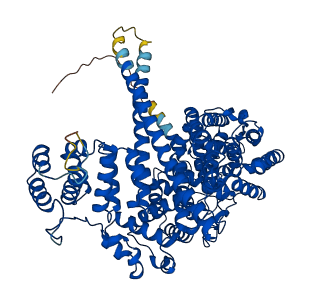
| AF-Q3UYV9-F1 | Predicted | AlphaFoldDB |
33 variants for Q3UYV9
| Variant ID(s) | Position | Change | Description | Diseaes Association | Provenance |
|---|---|---|---|---|---|
| rs3394247044 | 54 | A>NSLIA* | No | EVA | |
| rs3388679888 | 187 | K>* | No | EVA | |
| rs3388681287 | 224 | P>Q | No | EVA | |
| rs13461913 | 242 | D>N | No | EVA | |
| rs3388671825 | 269 | P>S | No | EVA | |
| rs3388683087 | 280 | S>T | No | EVA | |
| rs3388671832 | 301 | P>L | No | EVA | |
| rs3388677821 | 311 | R>M | No | EVA | |
| rs3411698896 | 404 | T>R | No | EVA | |
| rs3388677775 | 476 | L>Q | No | EVA | |
| rs3388682108 | 482 | T>A | No | EVA | |
| rs3388684607 | 483 | C>F | No | EVA | |
| rs3388683928 | 483 | C>S | No | EVA | |
| rs3388677377 | 484 | I>T | No | EVA | |
| rs3388671895 | 485 | Y>H | No | EVA | |
| rs3388687375 | 502 | L>H | No | EVA | |
| rs3388680891 | 510 | S>G | No | EVA | |
| rs3388686789 | 530 | V>I | No | EVA | |
| rs3388687352 | 568 | K>T | No | EVA | |
| rs3388687372 | 607 | K>N | No | EVA | |
| rs3388682129 | 613 | I>T | No | EVA | |
| rs3388682160 | 613 | I>V | No | EVA | |
| rs3388677768 | 615 | D>Y | No | EVA | |
| rs3388663743 | 616 | C>R | No | EVA | |
| rs3388686763 | 623 | I>N | No | EVA | |
| rs3388677803 | 646 | R>H | No | EVA | |
| rs3388682170 | 672 | R>Q | No | EVA | |
| rs3394204577 | 703 | Q>H | No | EVA | |
| rs3394111984 | 704 | S>C | No | EVA | |
| rs3394204676 | 704 | S>T | No | EVA | |
| rs3388682118 | 730 | T>A | No | EVA | |
| rs3388675925 | 737 | T>S | No | EVA | |
| rs3388683953 | 749 | Q>L | No | EVA |
No associated diseases with Q3UYV9
9 GO annotations of cellular component
| Name | Definition |
|---|---|
| cytoplasm | The contents of a cell excluding the plasma membrane and nucleus, but including other subcellular structures. |
| cytosol | The part of the cytoplasm that does not contain organelles but which does contain other particulate matter, such as protein complexes. |
| mitochondrion | A semiautonomous, self replicating organelle that occurs in varying numbers, shapes, and sizes in the cytoplasm of virtually all eukaryotic cells. It is notably the site of tissue respiration. |
| mRNA cap binding complex | Any protein complex that binds to an mRNA cap at any time in the lifetime of the mRNA. |
| nuclear cap binding complex | A conserved heterodimeric protein complex that binds to the 5' terminal cap structure m7G(5')ppp(5')N of nascent eukaryotic RNA polymerase II transcripts such as pre-mRNA and U snRNA. The consists of proteins known as CBP20 and CBP80, binds to cap structures in the nucleus, and is involved in pre-mRNA splicing, 3'-end formation, and RNA nuclear export. |
| nucleoplasm | That part of the nuclear content other than the chromosomes or the nucleolus. |
| nucleus | A membrane-bounded organelle of eukaryotic cells in which chromosomes are housed and replicated. In most cells, the nucleus contains all of the cell's chromosomes except the organellar chromosomes, and is the site of RNA synthesis and processing. In some species, or in specialized cell types, RNA metabolism or DNA replication may be absent. |
| ribonucleoprotein complex | A macromolecular complex that contains both RNA and protein molecules. |
| RNA cap binding complex | Any protein complex that binds to a specialized RNA cap structure at any time in the lifetime of the RNA. |
3 GO annotations of molecular function
| Name | Definition |
|---|---|
| mRNA binding | Binding to messenger RNA (mRNA), an intermediate molecule between DNA and protein. mRNA includes UTR and coding sequences, but does not contain introns. |
| RNA 7-methylguanosine cap binding | Binding to a 7-methylguanosine group added cotranscriptionally to the 5' end of RNA molecules transcribed by polymerase II. |
| RNA cap binding | Binding to a 7-methylguanosine (m7G) group or derivative located at the 5' end of an RNA molecule. |
24 GO annotations of biological process
| Name | Definition |
|---|---|
| 7-methylguanosine mRNA capping | Addition of the 7-methylguanosine cap to the 5' end of a nascent messenger RNA transcript. |
| alternative mRNA splicing, via spliceosome | The process of generating multiple mRNA molecules from a given set of exons by differential use of exons from the primary transcript(s) to form multiple mature mRNAs that vary in their exon composition. |
| cap-dependent translational initiation | The process where the cap structure, composed of a 7- methylguanosine (m7G) group and associated cap-binding proteins, located at the 5' end of an mRNA molecule, which serves as a molecular tag that marks the spot where the 40S ribosomal subunit, is recruited and will then scan in a 5' to 3' direction until an AUG codon is encountered in an appropriate sequence context to initiate mRNA translation. |
| defense response to virus | Reactions triggered in response to the presence of a virus that act to protect the cell or organism. |
| histone mRNA metabolic process | The chemical reactions and pathways involving an mRNA encoding a histone. |
| miRNA-mediated gene silencing | A post-transcriptional gene silencing pathway in which regulatory microRNAs (miRNAs) elicit silencing of specific target genes. miRNAs are endogenous 21-24 nucleotide small RNAs processed from stem-loop RNA precursors (pre-miRNAs). Once incorporated into a RNA-induced silencing complex (RISC), miRNAs can downregulate gene expression by either of two posttranscriptional mechanisms: endonucleolytic cleavage of the RNA (often mRNA) or mRNA translational repression, usually accompanied by poly-A tail shortening and subsequent degradation of the mRNA. miRNAs are present in all the animals and in plants, whereas siRNAs are present in lower animals and in plants. |
| mRNA 3'-end processing | Any process involved in forming the mature 3' end of an mRNA molecule. |
| mRNA export from nucleus | The directed movement of mRNA from the nucleus to the cytoplasm. |
| mRNA splicing, via spliceosome | The joining together of exons from one or more primary transcripts of messenger RNA (mRNA) and the excision of intron sequences, via a spliceosomal mechanism, so that mRNA consisting only of the joined exons is produced. |
| mRNA transcription by RNA polymerase II | The cellular synthesis of messenger RNA (mRNA) from a DNA template by RNA polymerase II, originating at an RNA polymerase II promoter. |
| nuclear-transcribed mRNA catabolic process, nonsense-mediated decay | The nonsense-mediated decay pathway for nuclear-transcribed mRNAs degrades mRNAs in which an amino-acid codon has changed to a nonsense codon; this prevents the translation of such mRNAs into truncated, and potentially harmful, proteins. |
| positive regulation of cell growth | Any process that activates or increases the frequency, rate, extent or direction of cell growth. |
| positive regulation of mRNA 3'-end processing | Any process that activates or increases the frequency, rate or extent of mRNA 3'-end processing. |
| positive regulation of mRNA splicing, via spliceosome | Any process that activates or increases the rate or extent of mRNA splicing via a spliceosomal mechanism. |
| positive regulation of phosphorylation of RNA polymerase II C-terminal domain | Any process that activates or increases the frequency, rate or extent of phosphorylation of RNA polymerase II C-terminal domain. |
| positive regulation of RNA binding | Any process that activates or increases the frequency, rate or extent of RNA binding. |
| positive regulation of transcription elongation by RNA polymerase II | Any process that activates or increases the frequency, rate or extent of transcription elongation, the extension of an RNA molecule after transcription initiation and promoter clearance by the addition of ribonucleotides, catalyzed by RNA polymerase II. |
| pre-mRNA cleavage required for polyadenylation | The targeted, endonucleolytic cleavage of a pre-mRNA, required for polyadenylation of the 3' end. This cleavage is directed by binding sites near the 3' end of the mRNA and leaves a 3' hydoxyl end which then becomes a target for adenylation. |
| primary miRNA processing | A process involved in the conversion of a primary microRNA transcript into a pre-microRNA molecule. |
| regulation of mRNA processing | Any process that modulates the frequency, rate or extent of mRNA processing, those processes involved in the conversion of a primary mRNA transcript into a mature mRNA prior to its translation into polypeptide. |
| regulation of translational initiation | Any process that modulates the frequency, rate or extent of translational initiation. |
| RNA catabolic process | The chemical reactions and pathways resulting in the breakdown of RNA, ribonucleic acid, one of the two main type of nucleic acid, consisting of a long, unbranched macromolecule formed from ribonucleotides joined in 3',5'-phosphodiester linkage. |
| snRNA export from nucleus | The directed movement of snRNA from the nucleus to the cytoplasm. |
| spliceosomal complex assembly | The aggregation, arrangement and bonding together of a spliceosomal complex, a ribonucleoprotein apparatus that catalyzes nuclear mRNA splicing via transesterification reactions. |
6 homologous proteins in AiPD
| UniProt AC | Gene Name | Protein Name | Species | Evidence Code |
|---|---|---|---|---|
| Q5ZJZ6 | NCBP1 | Nuclear cap-binding protein subunit 1 | Gallus gallus (Chicken) | PR |
| Q7K4N3 | Cbp80 | Nuclear cap-binding protein subunit 1 | Drosophila melanogaster (Fruit fly) | PR |
| Q09161 | NCBP1 | Nuclear cap-binding protein subunit 1 | Homo sapiens (Human) | PR |
| Q56A27 | Ncbp1 | Nuclear cap-binding protein subunit 1 | Rattus norvegicus (Rat) | PR |
| Q9SIU2 | ABH1 | Nuclear cap-binding protein subunit 1 | Arabidopsis thaliana (Mouse-ear cress) | PR |
| Q6DIE2 | ncbp1 | Nuclear cap-binding protein subunit 1 | Xenopus tropicalis (Western clawed frog) (Silurana tropicalis) | PR |
| 10 | 20 | 30 | 40 | 50 | 60 |
| MSRRRHSYEN | DGGQPHKRRK | TSDANETEDH | LESLICKVGE | KSACSLESNL | EGLAGVLEAD |
| 70 | 80 | 90 | 100 | 110 | 120 |
| LPNYKSKILR | LLCTVARLLP | EKLTIYTTLV | GLLNARNYNF | GGEFVEAMIR | QLKESLKANN |
| 130 | 140 | 150 | 160 | 170 | 180 |
| YNEAVYLVRF | LSDLVNCHVI | AAPSMVAMFE | NFVSVTQEED | VPQVRRDWYV | YAFLSSLPWV |
| 190 | 200 | 210 | 220 | 230 | 240 |
| GKELYEKKDA | EMDRIFSTTE | SYLKRRQKTH | VPMLQVWTAD | KPHPQEEYLD | CLWAQIQKLK |
| 250 | 260 | 270 | 280 | 290 | 300 |
| KDRWQERHIL | RPYLAFDSIL | CEALQHNLPP | FTPPPHTEDS | VYPMPRVIFR | MFDYTDDPEG |
| 310 | 320 | 330 | 340 | 350 | 360 |
| PVMPGSHSVE | RFVIEENLHC | IIKSYWKERK | TCAAQLVSYP | GKNKIPLNYH | IVEVIFAELF |
| 370 | 380 | 390 | 400 | 410 | 420 |
| QLPAPPHIDV | MYTTLLIELC | KLQPGSLPQV | LAQATEMLYM | RLDTMSTTCV | DRFINWFSHH |
| 430 | 440 | 450 | 460 | 470 | 480 |
| LSNFQFRWSW | EDWSDCLTQD | LESPKPKFVR | EVLEKCMRLS | YHQHILDIVP | PTFSALCPAN |
| 490 | 500 | 510 | 520 | 530 | 540 |
| PTCIYKYGDE | SSNSLPGHSV | ALCLSVAFKS | KATNDEIFSI | LKDVPNPNQV | DDDDEGFRFN |
| 550 | 560 | 570 | 580 | 590 | 600 |
| PLKIEVFVQT | LLHLAAKSFS | HSFSALAKFH | EVFKTLAESD | KGKLHVLRVM | FEVWRNHPQM |
| 610 | 620 | 630 | 640 | 650 | 660 |
| IAVLVDKMIR | TQIVDCAAVA | NWIFSSELSR | DFTRLFVWEI | LHSTIRKMNK | HVLKIQKELE |
| 670 | 680 | 690 | 700 | 710 | 720 |
| EAKEKLARQH | KRRSDDDDRS | SDRKDGALEE | QIERLQEKVE | AAQSEQKNLF | LVIFQRFIMI |
| 730 | 740 | 750 | 760 | 770 | 780 |
| LTEHLVRCET | DGTSILTPWY | KNCIERLQQI | FLQHHQTIQQ | YMVTLENLLF | TAELDPHILA |
| VFQQFCALQA |