Q3U9G9
Gene name |
Lbr |
Protein name |
Delta(14)-sterol reductase LBR |
Names |
Delta-14-SR, 3-beta-hydroxysterol Delta (14)-reductase, C-14 sterol reductase, C14SR, Integral nuclear envelope inner membrane protein, Lamin-B receptor, Sterol C14-reductase |
Species |
Mus musculus (Mouse) |
KEGG Pathway |
mmu:98386 |
EC number |
1.3.1.70: With NAD(+) or NADP(+) as acceptor |
Protein Class |
|
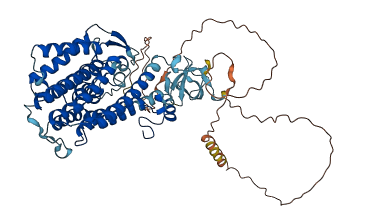
Descriptions
The autoinhibited protein was predicted that may have potential autoinhibitory elements via cis-regPred.
Autoinhibitory domains (AIDs)
Target domain |
|
Relief mechanism |
|
Assay |
cis-regPred |
Accessory elements
No accessory elements
Autoinhibited structure

Activated structure
1 structures for Q3U9G9
| Entry ID | Method | Resolution | Chain | Position | Source |
|---|---|---|---|---|---|
| AF-Q3U9G9-F1 | Predicted | AlphaFoldDB |
29 variants for Q3U9G9
| Variant ID(s) | Position | Change | Description | Diseaes Association | Provenance |
|---|---|---|---|---|---|
| rs257353747 | 7 | V>A | No | EVA | |
| rs3388522511 | 10 | E>G | No | EVA | |
| rs3388521986 | 18 | G>V | No | EVA | |
| rs3388521952 | 20 | S>F | No | EVA | |
| rs3388522557 | 20 | S>P | No | EVA | |
| rs265125650 | 52 | S>N | No | EVA | |
| rs13475296 | 66 | G>S | No | EVA | |
| rs3391121969 | 147 | E>V | No | EVA | |
| rs13475294 | 174 | T>A | No | EVA | |
| rs3391081185 | 202 | P>A | No | EVA | |
| rs3391071863 | 203 | A>G | No | EVA | |
| rs3390901433 | 225 | G>S | No | EVA | |
| rs3388522429 | 247 | K>N | No | EVA | |
| rs3391098921 | 317 | S>A | No | EVA | |
| rs3391122000 | 320 | L>Q | No | EVA | |
| rs3391063032 | 323 | A>D | No | EVA | |
| rs3388522490 | 327 | G>D | No | EVA | |
| rs263959127 | 353 | A>V | No | EVA | |
| rs1133393197 | 380 | F>L | No | EVA | |
| rs1134925993 | 382 | G>V | No | EVA | |
| rs225554668 | 389 | L>V | No | EVA | |
| rs253841263 | 396 | F>I | No | EVA | |
| rs3388522438 | 397 | F>L | No | EVA | |
| rs1134125892 | 403 | G>E | No | EVA | |
| rs257784278 | 451 | A>T | No | EVA | |
| rs3388518550 | 511 | I>T | No | EVA | |
| rs3391062305 | 544 | S>N | No | EVA | |
| rs48602781 | 585 | I>T | No | EVA | |
| rs3388516464 | 595 | E>G | No | EVA |
2 associated diseases with Q3U9G9
[MIM: 251230]: Microcephaly-micromelia syndrome (MIMIS)
A severe autosomal recessive disorder characterized by intrauterine growth restriction, marked microcephaly, craniofacial anomalies, skeletal dysplasia, and variable malformations of the limbs, particularly the upper limbs. It usually results in death in utero or in the perinatal period. {ECO:0000269|PubMed:28630177}. Note=The disease is caused by variants affecting the gene represented in this entry. This extremely rare syndrome is caused by an intronic mutation that leads to the retention of intron 6, probably resulting in non-sense mediated mRNA decay. This isoform has also been detected in healthy tissues, but at much lower levels than in MIMIS samples. {ECO:0000269|PubMed:28630177}.
[MIM: 617604]: Microcephaly, short stature, and limb abnormalities (MISSLA)
An autosomal recessive disorder characterized by intrauterine growth retardation, microcephaly, variable short stature, and limb abnormalities mainly affecting the upper limb and radial ray. Mild intellectual disability and developmental delay is observed in some patients. {ECO:0000269|PubMed:28191891}. Note=The disease is caused by variants affecting the gene represented in this entry.
Without disease ID
- A severe autosomal recessive disorder characterized by intrauterine growth restriction, marked microcephaly, craniofacial anomalies, skeletal dysplasia, and variable malformations of the limbs, particularly the upper limbs. It usually results in death in utero or in the perinatal period. {ECO:0000269|PubMed:28630177}. Note=The disease is caused by variants affecting the gene represented in this entry. This extremely rare syndrome is caused by an intronic mutation that leads to the retention of intron 6, probably resulting in non-sense mediated mRNA decay. This isoform has also been detected in healthy tissues, but at much lower levels than in MIMIS samples. {ECO:0000269|PubMed:28630177}.
- An autosomal recessive disorder characterized by intrauterine growth retardation, microcephaly, variable short stature, and limb abnormalities mainly affecting the upper limb and radial ray. Mild intellectual disability and developmental delay is observed in some patients. {ECO:0000269|PubMed:28191891}. Note=The disease is caused by variants affecting the gene represented in this entry.
No regional properties for Q3U9G9
| Type | Name | Position | InterPro Accession |
|---|---|---|---|
| No domain, repeats, and functional sites for Q3U9G9 | |||
Functions
| Description | ||
|---|---|---|
| EC Number | 1.3.1.70 | With NAD(+) or NADP(+) as acceptor |
| Subcellular Localization |
|
|
| PANTHER Family | ||
| PANTHER Subfamily | ||
| PANTHER Protein Class | ||
| PANTHER Pathway Category | No pathway information available | |
9 GO annotations of cellular component
| Name | Definition |
|---|---|
| cytoplasm | The contents of a cell excluding the plasma membrane and nucleus, but including other subcellular structures. |
| endoplasmic reticulum membrane | The lipid bilayer surrounding the endoplasmic reticulum. |
| integral component of membrane | The component of a membrane consisting of the gene products and protein complexes having at least some part of their peptide sequence embedded in the hydrophobic region of the membrane. |
| nuclear envelope | The double lipid bilayer enclosing the nucleus and separating its contents from the rest of the cytoplasm; includes the intermembrane space, a gap of width 20-40 nm (also called the perinuclear space). |
| nuclear inner membrane | The inner, i.e. lumen-facing, lipid bilayer of the nuclear envelope. |
| nuclear lamina | The fibrous, electron-dense layer lying on the nucleoplasmic side of the inner membrane of a cell nucleus, composed of lamin filaments. The polypeptides of the lamina are thought to be concerned in the dissolution of the nuclear envelope and its re-formation during mitosis. The lamina is composed of lamin A and lamin C filaments cross-linked into an orthogonal lattice, which is attached via lamin B to the inner nuclear membrane through interactions with a lamin B receptor, an IFAP, in the membrane. |
| nuclear membrane | Either of the lipid bilayers that surround the nucleus and form the nuclear envelope; excludes the intermembrane space. |
| nuclear pore | A protein complex providing a discrete opening in the nuclear envelope of a eukaryotic cell, where the inner and outer nuclear membranes are joined. |
| nucleus | A membrane-bounded organelle of eukaryotic cells in which chromosomes are housed and replicated. In most cells, the nucleus contains all of the cell's chromosomes except the organellar chromosomes, and is the site of RNA synthesis and processing. In some species, or in specialized cell types, RNA metabolism or DNA replication may be absent. |
7 GO annotations of molecular function
| Name | Definition |
|---|---|
| chaperone binding | Binding to a chaperone protein, a class of proteins that bind to nascent or unfolded polypeptides and ensure correct folding or transport. |
| chromo shadow domain binding | Binding to a chromo shadow domain, a protein domain that is distantly related, and found in association with, the chromo domain. |
| delta14-sterol reductase activity | Catalysis of the reaction: NADP+ + 4,4-dimethyl-5-alpha-cholesta-8,24-dien-3-beta-ol = NADPH + H+ + 4,4-dimethyl-5-alpha-cholesta-8,14,24-trien-3-beta-ol. |
| DNA binding | Any molecular function by which a gene product interacts selectively and non-covalently with DNA (deoxyribonucleic acid). |
| NADPH binding | Binding to the reduced form, NADPH, of nicotinamide-adenine dinucleotide phosphate, a coenzyme involved in many redox and biosynthetic reactions. |
| nuclear localization sequence binding | Binding to a nuclear localization sequence, a specific peptide sequence that acts as a signal to localize the protein within the nucleus. |
| oxidoreductase activity, acting on the CH-CH group of donors | Catalysis of an oxidation-reduction (redox) reaction in which a CH-CH group acts as a hydrogen or electron donor and reduces a hydrogen or electron acceptor. |
3 GO annotations of biological process
| Name | Definition |
|---|---|
| cholesterol biosynthetic process | The chemical reactions and pathways resulting in the formation of cholesterol, cholest-5-en-3 beta-ol, the principal sterol of vertebrates and the precursor of many steroids, including bile acids and steroid hormones. |
| neutrophil differentiation | The process in which a myeloid precursor cell acquires the specialized features of a neutrophil. |
| sterol biosynthetic process | The chemical reactions and pathways resulting in the formation of sterols, steroids with one or more hydroxyl groups and a hydrocarbon side-chain in the molecule. |
6 homologous proteins in AiPD
| UniProt AC | Gene Name | Protein Name | Species | Evidence Code |
|---|---|---|---|---|
| Q5E9J5 | DHCR7 | 7-dehydrocholesterol reductase | Bos taurus (Bovine) | PR |
| P23913 | LBR | Delta(14)-sterol reductase LBR | Gallus gallus (Chicken) | PR |
| Q9UBM7 | DHCR7 | 7-dehydrocholesterol reductase | Homo sapiens (Human) | PR |
| Q14739 | LBR | Delta(14)-sterol reductase LBR | Homo sapiens (Human) | PR |
| O08984 | Lbr | Delta(14)-sterol reductase LBR | Rattus norvegicus (Rat) | PR |
| Q6P4M0 | dhcr7 | 7-dehydrocholesterol reductase | Xenopus tropicalis (Western clawed frog) (Silurana tropicalis) | PR |
| 10 | 20 | 30 | 40 | 50 | 60 |
| MPSRKFVEGE | VVRGRWPGSS | LYYEVEILSH | DNKSQLYTVK | YKDGTELELK | ESDIKPLKSF |
| 70 | 80 | 90 | 100 | 110 | 120 |
| KQRKSGSISS | SPSRRRGSRS | RSRSRSRSRS | PGRAPKGSRR | SVSASHEGDV | KEKKEKEMRR |
| 130 | 140 | 150 | 160 | 170 | 180 |
| EILQVKLTPL | VLKPFGNSVS | VYNGEPEHME | KNATPYKDKQ | ERIILSTEDR | YIVTQYSLRP |
| 190 | 200 | 210 | 220 | 230 | 240 |
| RREEVKAKEI | ESEEQNLVTK | GPAPLGTFQV | TTPQRKDLEF | GGVPGAVLIM | LGLPACVLLL |
| 250 | 260 | 270 | 280 | 290 | 300 |
| LLQCRQKDPG | LLHFPPPLPA | LHELWEPRVC | GVYLLWFFVQ | ALFHLLPVGK | VAEGTPLVDG |
| 310 | 320 | 330 | 340 | 350 | 360 |
| RRLQYRLNGL | YAFILTSAAL | GAAVFWGVEL | CYLYTHFLQL | ALAATGFSVL | LSAYLYVRSL |
| 370 | 380 | 390 | 400 | 410 | 420 |
| RAPREELSPA | SSGNAVYDFF | IGRELNPRLG | AFDLKFFCEL | RPGLIGWVVI | NLVMLLMEMK |
| 430 | 440 | 450 | 460 | 470 | 480 |
| IQERAAPSLA | MILVNSFQLL | YVVDALWNEE | ALLTSMDIMH | DGFGFMLAFG | DLVWVPFTYS |
| 490 | 500 | 510 | 520 | 530 | 540 |
| LQAFYLVSHP | HDLSWPLASV | IIALKLCGYV | IFRCANSQKN | AFRKNPTDPK | LAHLKTIHTS |
| 550 | 560 | 570 | 580 | 590 | 600 |
| TGKSLLVSGW | WGFVRHPNYL | GDLIMALAWS | LPCGFNHLLP | YFYIIYFTAL | LIHREARDEH |
| 610 | 620 | ||||
| QCRRKYGLAW | EKYCQRVPYR | IFPYIY |