Q17770
Gene name |
pdi-2 (C07A12.4) |
Protein name |
Protein disulfide-isomerase 2 |
Names |
PDI 1, Prolyl 4-hydroxylase subunit beta-2 |
Species |
Caenorhabditis elegans |
KEGG Pathway |
cel:CELE_C07A12.4 |
EC number |
5.3.4.1: Transposing S-S bonds |
Protein Class |
|
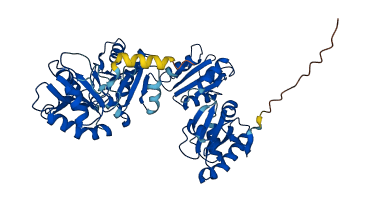
Descriptions
The autoinhibited protein was predicted that may have potential autoinhibitory elements via cis-regPred.
Autoinhibitory domains (AIDs)
Target domain |
|
Relief mechanism |
|
Assay |
cis-regPred |
Accessory elements
No accessory elements
Autoinhibited structure

Activated structure
1 structures for Q17770
| Entry ID | Method | Resolution | Chain | Position | Source |
|---|---|---|---|---|---|
| AF-Q17770-F1 | Predicted | AlphaFoldDB |
No variants for Q17770
| Variant ID(s) | Position | Change | Description | Diseaes Association | Provenance |
|---|---|---|---|---|---|
| No variants for Q17770 | |||||
No associated diseases with Q17770
6 regional properties for Q17770
| Type | Name | Position | InterPro Accession |
|---|---|---|---|
| domain | Protein disulfide-isomerase, thioredoxin-like domain | 28 - 128 | IPR005788-1 |
| domain | Protein disulfide-isomerase, thioredoxin-like domain | 368 - 467 | IPR005788-2 |
| domain | Thioredoxin domain | 10 - 130 | IPR013766-1 |
| domain | Thioredoxin domain | 342 - 470 | IPR013766-2 |
| conserved_site | Thioredoxin, conserved site | 44 - 62 | IPR017937-1 |
| conserved_site | Thioredoxin, conserved site | 385 - 403 | IPR017937-2 |
Functions
| Description | ||
|---|---|---|
| EC Number | 5.3.4.1 | Transposing S-S bonds |
| Subcellular Localization |
|
|
| PANTHER Family | ||
| PANTHER Subfamily | ||
| PANTHER Protein Class | ||
| PANTHER Pathway Category | No pathway information available | |
3 GO annotations of cellular component
| Name | Definition |
|---|---|
| endoplasmic reticulum | The irregular network of unit membranes, visible only by electron microscopy, that occurs in the cytoplasm of many eukaryotic cells. The membranes form a complex meshwork of tubular channels, which are often expanded into slitlike cavities called cisternae. The ER takes two forms, rough (or granular), with ribosomes adhering to the outer surface, and smooth (with no ribosomes attached). |
| endoplasmic reticulum lumen | The volume enclosed by the membranes of the endoplasmic reticulum. |
| procollagen-proline 4-dioxygenase complex | A protein complex that catalyzes the formation of procollagen trans-4-hydroxy-L-proline and succinate from procollagen L-proline and 2-oxoglutarate, requiring Fe2+ and ascorbate. Contains two alpha subunits that contribute to most parts of the catalytic sites, and two beta subunits that are identical to protein-disulfide isomerase. |
2 GO annotations of molecular function
| Name | Definition |
|---|---|
| protein disulfide isomerase activity | Catalysis of the rearrangement of both intrachain and interchain disulfide bonds in proteins. |
| protein-glutamine gamma-glutamyltransferase activity | Catalysis of the reaction: protein glutamine + alkylamine = protein N5-alkylglutamine + NH3. This reaction is the formation of the N6-(L-isoglutamyl)-L-lysine isopeptide, resulting in cross-linking polypeptide chains; the gamma-carboxamide groups of peptidyl-glutamine residues act as acyl donors, and the 6-amino-groups of peptidyl-lysine residues act as acceptors, to give intra- and intermolecular N6-(5-glutamyl)lysine cross-links. |
6 GO annotations of biological process
| Name | Definition |
|---|---|
| endoplasmic reticulum unfolded protein response | The series of molecular signals generated as a consequence of the presence of unfolded proteins in the endoplasmic reticulum (ER) or other ER-related stress; results in changes in the regulation of transcription and translation. |
| macromolecule modification | The covalent alteration of one or more monomeric units in a polypeptide, polynucleotide, polysaccharide, or other biological macromolecule, resulting in a change in its properties. |
| peptidyl-proline hydroxylation to 4-hydroxy-L-proline | The modification of peptidyl-proline to form 4-hydroxy-L-proline; catalyzed by procollagen-proline,2-oxoglutarate-4-dioxygenase. |
| protein deglutathionylation | The protein modification process in which a glutathione molecule is removed from a protein amino acid by breaking a disulfide linkage. |
| protein folding | The process of assisting in the covalent and noncovalent assembly of single chain polypeptides or multisubunit complexes into the correct tertiary structure. |
| response to endoplasmic reticulum stress | Any process that results in a change in state or activity of a cell (in terms of movement, secretion, enzyme production, gene expression, etc.) as a result of a stress acting at the endoplasmic reticulum. ER stress usually results from the accumulation of unfolded or misfolded proteins in the ER lumen. |
6 homologous proteins in AiPD
| UniProt AC | Gene Name | Protein Name | Species | Evidence Code |
|---|---|---|---|---|
| Q29RV1 | PDIA4 | Protein disulfide-isomerase A4 | Bos taurus (Bovine) | PR |
| Q8N807 | PDILT | Protein disulfide-isomerase-like protein of the testis | Homo sapiens (Human) | PR |
| Q13087 | PDIA2 | Protein disulfide-isomerase A2 | Homo sapiens (Human) | PR |
| Q5WA72 | PDIL1-5 | Protein disulfide isomerase-like 1-5 | Oryza sativa subsp japonica (Rice) | PR |
| A3KPF5 | PDIL1-5 | Protein disulfide isomerase-like 1-5 | Arabidopsis thaliana (Mouse-ear cress) | PR |
| Q66GQ3 | PDIL1-6 | Protein disulfide isomerase-like 1-6 | Arabidopsis thaliana (Mouse-ear cress) | PR |
| 10 | 20 | 30 | 40 | 50 | 60 |
| MFRLVGLFFL | VLGASAAVIE | EEENVIVLTK | DNFDEVINGN | EFILVEFYAP | WCGHCKSLAP |
| 70 | 80 | 90 | 100 | 110 | 120 |
| EYAKAATQLK | EEGSDIKLGK | LDATVHGEVS | SKFEVRGYPT | LKLFRNGKPQ | EYNGGRDHDS |
| 130 | 140 | 150 | 160 | 170 | 180 |
| IIAWLKKKTG | PVAKPLADAD | AVKELQESAD | VVVIGYFKDT | TSDDAKTFLE | VAAGIDDVPF |
| 190 | 200 | 210 | 220 | 230 | 240 |
| GISTEDAVKS | EIELKGEGIV | LFKKFDDGRV | AFDEKLTQDG | LKTWIQANRL | ALVSEFTQET |
| 250 | 260 | 270 | 280 | 290 | 300 |
| ASVIFGGEIK | SHNLLFVSKE | SSEFAKLEQE | FKNAAKQFKG | KVLFVYINTD | VEENARIMEF |
| 310 | 320 | 330 | 340 | 350 | 360 |
| FGLKKDELPA | IRLISLEEDM | TKFKPDFEEI | TTENISKFTQ | NYLDGSVKPH | LMSEDIPEDW |
| 370 | 380 | 390 | 400 | 410 | 420 |
| DKNPVKILVG | KNFEQVARDN | TKNVLVEFYA | PWCGHCKQLA | PTWDKLGEKF | ADDESIVIAK |
| 430 | 440 | 450 | 460 | 470 | 480 |
| MDSTLNEVED | VKIQSFPTIK | FFPAGSNKVV | DYTGDRTIEG | FTKFLETNGK | EGAGASEEEK |
| 490 | |||||
| AEEEADEEGH | TEL |