Q12229
Gene name |
UBX3 (YDL091C) |
Protein name |
UBX domain-containing protein 3 |
Names |
|
Species |
Saccharomyces cerevisiae (strain ATCC 204508 / S288c) (Baker's yeast) |
KEGG Pathway |
sce:YDL091C |
EC number |
|
Protein Class |
|
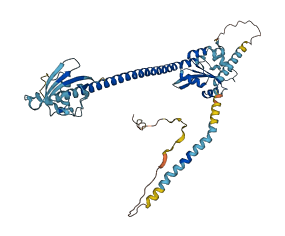
Descriptions
The autoinhibited protein was predicted that may have potential autoinhibitory elements via cis-regPred.
Autoinhibitory domains (AIDs)
Target domain |
|
Relief mechanism |
|
Assay |
cis-regPred |
Accessory elements
No accessory elements
Autoinhibited structure

Activated structure
1 structures for Q12229
| Entry ID | Method | Resolution | Chain | Position | Source |
|---|---|---|---|---|---|
| AF-Q12229-F1 | Predicted | AlphaFoldDB |
5 variants for Q12229
| Variant ID(s) | Position | Change | Description | Diseaes Association | Provenance |
|---|---|---|---|---|---|
| s04-294401 | 120 | T>M | No | SGRP | |
| s04-294391 | 123 | E>D | No | SGRP | |
| s04-294288 | 158 | G>R | No | SGRP | |
| s04-294092 | 223 | D>G | No | SGRP | |
| s04-293625 | 379 | A>T | No | SGRP |
No associated diseases with Q12229
5 GO annotations of cellular component
| Name | Definition |
|---|---|
| clathrin-coated vesicle | A vesicle with a coat formed of clathrin connected to the membrane via one of the clathrin adaptor complexes. |
| cytoplasm | The contents of a cell excluding the plasma membrane and nucleus, but including other subcellular structures. |
| Dsc E3 ubiquitin ligase complex | An E3 ubiquitin ligase complex localized to the ER and Golgi membrane. In fission yeast comprises Dsc1, 2, 3 and 4. Involved in the processes of fission yeast sre1 (human SREBP) transcriptional activator proteolytic cleavage, the multivesicular body (MVB) pathway, and a post-endoplasmic reticulum pathway for protein catabolism. |
| endoplasmic reticulum | The irregular network of unit membranes, visible only by electron microscopy, that occurs in the cytoplasm of many eukaryotic cells. The membranes form a complex meshwork of tubular channels, which are often expanded into slitlike cavities called cisternae. The ER takes two forms, rough (or granular), with ribosomes adhering to the outer surface, and smooth (with no ribosomes attached). |
| Golgi membrane | The lipid bilayer surrounding any of the compartments of the Golgi apparatus. |
2 GO annotations of molecular function
| Name | Definition |
|---|---|
| clathrin binding | Binding to a clathrin heavy or light chain, the main components of the coat of coated vesicles and coated pits, and which also occurs in synaptic vesicles. |
| ubiquitin binding | Binding to ubiquitin, a protein that when covalently bound to other cellular proteins marks them for proteolytic degradation. |
5 GO annotations of biological process
| Name | Definition |
|---|---|
| clathrin-dependent endocytosis | An endocytosis process that begins when material is taken up into clathrin-coated pits, which then pinch off to form clathrin-coated endocytic vesicles. |
| histone H2B ubiquitination | The modification of histone H2B by addition of ubiquitin groups. |
| protein ubiquitination | The process in which one or more ubiquitin groups are added to a protein. |
| ubiquitin-dependent ERAD pathway | The series of steps necessary to target endoplasmic reticulum (ER)-resident proteins for degradation by the cytoplasmic proteasome. Begins with recognition of the ER-resident protein, includes retrotranslocation (dislocation) of the protein from the ER to the cytosol, protein ubiquitination necessary for correct substrate transfer, transport of the protein to the proteasome, and ends with degradation of the protein by the cytoplasmic proteasome. |
| ubiquitin-dependent protein catabolic process | The chemical reactions and pathways resulting in the breakdown of a protein or peptide by hydrolysis of its peptide bonds, initiated by the covalent attachment of a ubiquitin group, or multiple ubiquitin groups, to the protein. |
5 homologous proteins in AiPD
| UniProt AC | Gene Name | Protein Name | Species | Evidence Code |
|---|---|---|---|---|
| Q06682 | UBX5 | UBX domain-containing protein 5 | Saccharomyces cerevisiae (strain ATCC 204508 / S288c) (Baker's yeast) | PR |
| Q04228 | UBX2 | UBX domain-containing protein 2 | Saccharomyces cerevisiae (strain ATCC 204508 / S288c) (Baker's yeast) | PR |
| Q96LJ8 | UBXN10 | UBX domain-containing protein 10 | Homo sapiens (Human) | PR |
| Q96CS3 | FAF2 | FAS-associated factor 2 | Homo sapiens (Human) | PR |
| Q3TDN2 | Faf2 | FAS-associated factor 2 | Mus musculus (Mouse) | PR |
| 10 | 20 | 30 | 40 | 50 | 60 |
| MDIFRHTFGN | NDDSFIRIPG | AFREEPPADL | NGRTEDQNSN | TNEPTQSRDG | RLKSILHFLF |
| 70 | 80 | 90 | 100 | 110 | 120 |
| QAPLIVLYYL | LNFIVRSSRL | LKPLLRLHGF | YQRKHNRLLD | HSSQLHRLLE | NLENEAQAVT |
| 130 | 140 | 150 | 160 | 170 | 180 |
| CSEGNGNNDD | GSNTDSTSNN | ESSGVQFSFG | SLYNPENGTF | SKSIMQNSYT | ELLDACSEQV |
| 190 | 200 | 210 | 220 | 230 | 240 |
| KFGVIYLHDP | LLDNHMDYVN | KILCSEAFVN | MIRKYQVLLW | YGDVTTSEGL | QVSNALKIRQ |
| 250 | 260 | 270 | 280 | 290 | 300 |
| YPLLGIISLK | AEKKIELIAR | VEGSISNYKA | QDLEAIFSKN | YSRLIQLRQQ | RQNIEMQRLI |
| 310 | 320 | 330 | 340 | 350 | 360 |
| RQQQDSRYQD | SLRRDQQRES | ERLEQTQREQ | MEREHQRIEN | QWLLWRKSQL | KPEPSSDKDA |
| 370 | 380 | 390 | 400 | 410 | 420 |
| SKVAIRLENG | QRLVRKFDAS | LPTEEIYAFV | ELQLHDMLNS | ENDTLPVYQP | ANYQHQYSFK |
| 430 | 440 | 450 | |||
| LITPVPRREL | DLSTKISDVS | GIYPSGNIVM | ERLDE |