Q04228
Gene name |
UBX2 (SEL1, YML013W, YM9571.05) |
Protein name |
UBX domain-containing protein 2 |
Names |
Secretion lowering protein 1 |
Species |
Saccharomyces cerevisiae (strain ATCC 204508 / S288c) (Baker's yeast) |
KEGG Pathway |
sce:YML013W |
EC number |
|
Protein Class |
|
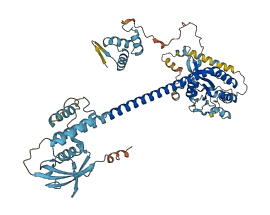
Descriptions
The autoinhibited protein was predicted that may have potential autoinhibitory elements via cis-regPred.
Autoinhibitory domains (AIDs)
Target domain |
|
Relief mechanism |
|
Assay |
cis-regPred |
Accessory elements
No accessory elements
Autoinhibited structure

Activated structure
1 structures for Q04228
| Entry ID | Method | Resolution | Chain | Position | Source |
|---|---|---|---|---|---|
| AF-Q04228-F1 | Predicted | AlphaFoldDB |
11 variants for Q04228
| Variant ID(s) | Position | Change | Description | Diseaes Association | Provenance |
|---|---|---|---|---|---|
| s13-244183 | 12 | H>L | No | SGRP | |
| s13-244246 | 33 | E>G | No | SGRP | |
| s13-244359 | 71 | P>S | No | SGRP | |
| s13-244405 | 86 | A>V | No | SGRP | |
| s13-244671 | 175 | S>P | No | SGRP | |
| s13-244791 | 215 | K>E | No | SGRP | |
| s13-244894 | 249 | T>I | No | SGRP | |
| s13-244974 | 276 | N>D | No | SGRP | |
| s13-245554 | 469 | V>A | No | SGRP | |
| s13-245572 | 475 | A>V | No | SGRP | |
| s13-245628 | 494 | M>V | No | SGRP |
No associated diseases with Q04228
1 regional properties for Q04228
| Type | Name | Position | InterPro Accession |
|---|---|---|---|
| domain | UBX domain | 424 - 570 | IPR001012 |
8 GO annotations of cellular component
| Name | Definition |
|---|---|
| Doa10p ubiquitin ligase complex | A multiprotein complex that recognizes and ubiquitinates membrane proteins with misfolded cytosolic domains during ER-associated protein degradation (ERAD). In S. cerevisiae, this complex contains the ubiquitin ligase Ssm4p/Doa10p. |
| endoplasmic reticulum | The irregular network of unit membranes, visible only by electron microscopy, that occurs in the cytoplasm of many eukaryotic cells. The membranes form a complex meshwork of tubular channels, which are often expanded into slitlike cavities called cisternae. The ER takes two forms, rough (or granular), with ribosomes adhering to the outer surface, and smooth (with no ribosomes attached). |
| Hrd1p ubiquitin ligase complex | A multiprotein complex that recognizes and ubiquitinates proteins with misfolded luminal and membrane domains during ER-associated protein degradation (ERAD). In S. cerevisiae, this complex contains the ubiquitin ligase Hrd1p. In mammals, this complex contains the ubiquitin ligase HRD1 (Synoviolin) or AMFR (gp78). |
| Hrd1p ubiquitin ligase ERAD-L complex | A multiprotein complex that recognizes and ubiquitinates proteins with misfolded luminal domains during ER-associated protein degradation (ERAD). In S. cerevisiae, this complex contains the ubiquitin ligase Hrd1p. |
| integral component of endoplasmic reticulum membrane | The component of the endoplasmic reticulum membrane consisting of the gene products and protein complexes having at least some part of their peptide sequence embedded in the hydrophobic region of the membrane. |
| integral component of plasma membrane | The component of the plasma membrane consisting of the gene products and protein complexes having at least some part of their peptide sequence embedded in the hydrophobic region of the membrane. |
| lipid droplet | An intracellular non-membrane-bounded organelle comprising a matrix of coalesced lipids surrounded by a phospholipid monolayer. May include associated proteins. |
| mitochondrial outer membrane | The outer, i.e. cytoplasm-facing, lipid bilayer of the mitochondrial envelope. |
3 GO annotations of molecular function
| Name | Definition |
|---|---|
| protein-containing complex binding | Binding to a macromolecular complex. |
| protein-macromolecule adaptor activity | The binding activity of a protein that brings together two or more macromolecules in contact, permitting those molecules to function in a coordinated way. The adaptor can bring together two proteins, or a protein and another macromolecule such as a lipid or a nucleic acid. |
| ubiquitin binding | Binding to ubiquitin, a protein that when covalently bound to other cellular proteins marks them for proteolytic degradation. |
6 GO annotations of biological process
| Name | Definition |
|---|---|
| ER-associated misfolded protein catabolic process | The chemical reactions and pathways resulting in the breakdown of misfolded proteins transported from the endoplasmic reticulum and targeted to cytoplasmic proteasomes for degradation. |
| lipid droplet organization | A process that is carried out at the cellular level which results in the assembly, arrangement of constituent parts, or disassembly of a lipid particle. |
| mitochondria-associated ubiquitin-dependent protein catabolic process | The chemical reactions and pathways resulting in the breakdown of proteins transported from mitochondria and targeted to cytoplasmic proteasomes for degradation as a response to oxidative stress conditions. |
| mitochondrial protein processing | The peptide cleavage of mitochondrial proteins, including cleavage contributing to their import. |
| proteasome-mediated ubiquitin-dependent protein catabolic process | The chemical reactions and pathways resulting in the breakdown of a protein or peptide by hydrolysis of its peptide bonds, initiated by the covalent attachment of ubiquitin, and mediated by the proteasome. |
| ubiquitin-dependent ERAD pathway | The series of steps necessary to target endoplasmic reticulum (ER)-resident proteins for degradation by the cytoplasmic proteasome. Begins with recognition of the ER-resident protein, includes retrotranslocation (dislocation) of the protein from the ER to the cytosol, protein ubiquitination necessary for correct substrate transfer, transport of the protein to the proteasome, and ends with degradation of the protein by the cytoplasmic proteasome. |
5 homologous proteins in AiPD
| UniProt AC | Gene Name | Protein Name | Species | Evidence Code |
|---|---|---|---|---|
| Q06682 | UBX5 | UBX domain-containing protein 5 | Saccharomyces cerevisiae (strain ATCC 204508 / S288c) (Baker's yeast) | PR |
| Q12229 | UBX3 | UBX domain-containing protein 3 | Saccharomyces cerevisiae (strain ATCC 204508 / S288c) (Baker's yeast) | PR |
| Q96LJ8 | UBXN10 | UBX domain-containing protein 10 | Homo sapiens (Human) | PR |
| Q96CS3 | FAF2 | FAS-associated factor 2 | Homo sapiens (Human) | PR |
| Q3TDN2 | Faf2 | FAS-associated factor 2 | Mus musculus (Mouse) | PR |
| 10 | 20 | 30 | 40 | 50 | 60 |
| MPVVNHEDSE | FHLSHTEEDK | LNEFQVITNF | PPEDLPDVVR | LLRNHGWQLE | PALSRYFDGE |
| 70 | 80 | 90 | 100 | 110 | 120 |
| WKGEPDQMGE | PTQTSTPMAE | TLVPPALGPR | PLLFTASLPV | VRPLPANFRN | DFRTIGLNGR |
| 130 | 140 | 150 | 160 | 170 | 180 |
| SNTVWSMFES | FSYDGNPFLF | ILLLIPRIIN | RLSATIFTFF | CTLLSLHSIS | GGGNSGKPKI |
| 190 | 200 | 210 | 220 | 230 | 240 |
| SKVPKAPTRE | THIPLAEILG | DTKDKDAFCE | LKSFKPDISF | NEALRIAKEE | FKFMLLILVG |
| 250 | 260 | 270 | 280 | 290 | 300 |
| DTYDTDTDTV | DVNSKLLLEK | ILLNKKTLQY | LRKIDNDLII | YLKCVHELEP | WLVARQLGVR |
| 310 | 320 | 330 | 340 | 350 | 360 |
| NTPEIFLIAN | VANKASHSET | LPSQRLSILG | KLKVNSLNRF | LQSLTNVVEK | YTPELVVNKT |
| 370 | 380 | 390 | 400 | 410 | 420 |
| EMHELRMSRE | IKKLQEDAYK | KSLEMDRIKA | IEKEKSLKHA | QDLKLNSTAR | QLKWLKACID |
| 430 | 440 | 450 | 460 | 470 | 480 |
| EIQPFETTGK | QATLQFRTSS | GKRFVKKFPS | MTTLYQIYQS | IGCHIYLAVY | SSDPAEWSNA |
| 490 | 500 | 510 | 520 | 530 | 540 |
| LQDKIRQLSA | DDDMLCFKEG | QLETATATTI | EELGHIINNE | LTSFDLERGK | LEFDFELVSP |
| 550 | 560 | 570 | 580 | ||
| FPKYTVHPNE | HMSVDQVPQL | WPNGSLLVEA | LDEEDEEDEE | NEEQ |