Q11193
Gene name |
sor-3 (C04E7.2) |
Protein name |
Sop-2-related protein 3 |
Names |
|
Species |
Caenorhabditis elegans |
KEGG Pathway |
cel:CELE_C04E7.2 |
EC number |
|
Protein Class |
|
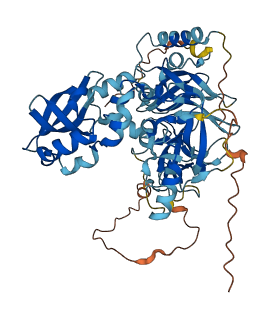
Descriptions
The autoinhibited protein was predicted that may have potential autoinhibitory elements via cis-regPred.
Autoinhibitory domains (AIDs)
Target domain |
|
Relief mechanism |
|
Assay |
cis-regPred |
Accessory elements
No accessory elements
Autoinhibited structure

Activated structure
1 structures for Q11193
| Entry ID | Method | Resolution | Chain | Position | Source |
|---|---|---|---|---|---|
| AF-Q11193-F1 | Predicted | AlphaFoldDB |
No variants for Q11193
| Variant ID(s) | Position | Change | Description | Diseaes Association | Provenance |
|---|---|---|---|---|---|
| No variants for Q11193 | |||||
No associated diseases with Q11193
1 regional properties for Q11193
| Type | Name | Position | InterPro Accession |
|---|---|---|---|
| repeat | Mbt repeat | 173 - 224 | IPR004092 |
2 GO annotations of cellular component
| Name | Definition |
|---|---|
| cytoplasm | The contents of a cell excluding the plasma membrane and nucleus, but including other subcellular structures. |
| nucleus | A membrane-bounded organelle of eukaryotic cells in which chromosomes are housed and replicated. In most cells, the nucleus contains all of the cell's chromosomes except the organellar chromosomes, and is the site of RNA synthesis and processing. In some species, or in specialized cell types, RNA metabolism or DNA replication may be absent. |
2 GO annotations of molecular function
| Name | Definition |
|---|---|
| chromatin binding | Binding to chromatin, the network of fibers of DNA, protein, and sometimes RNA, that make up the chromosomes of the eukaryotic nucleus during interphase. |
| histone binding | Binding to a histone, any of a group of water-soluble proteins found in association with the DNA of eukaryotic or archaeal chromosomes. They are involved in the condensation and coiling of chromosomes during cell division and have also been implicated in gene regulation and DNA replication. They may be chemically modified (methylated, acetlyated and others) to regulate gene transcription. |
7 GO annotations of biological process
| Name | Definition |
|---|---|
| anterior/posterior pattern specification | The regionalization process in which specific areas of cell differentiation are determined along the anterior-posterior axis. The anterior-posterior axis is defined by a line that runs from the head or mouth of an organism to the tail or opposite end of the organism. |
| axon guidance | The chemotaxis process that directs the migration of an axon growth cone to a specific target site in response to a combination of attractive and repulsive cues. |
| negative regulation of DNA-templated transcription | Any process that stops, prevents, or reduces the frequency, rate or extent of cellular DNA-templated transcription. |
| negative regulation of multicellular organism growth | Any process that stops, prevents, or reduces the frequency, rate or extent of growth of an organism to reach its usual body size. |
| nematode larval development | The process whose specific outcome is the progression of the nematode larva over time, from its formation to the mature structure. Nematode larval development begins with the newly hatched first-stage larva (L1) and ends with the end of the last larval stage (for example the fourth larval stage (L4) in C. elegans). Each stage of nematode larval development is characterized by proliferation of specific cell lineages and an increase in body size without alteration of the basic body plan. Nematode larval stages are separated by molts in which each stage-specific exoskeleton, or cuticle, is shed and replaced anew. |
| neuron fate specification | The process in which a cell becomes capable of differentiating autonomously into a neuron in an environment that is neutral with respect to the developmental pathway. Upon specification, the cell fate can be reversed. |
| regulation of cell migration | Any process that modulates the frequency, rate or extent of cell migration. |
4 homologous proteins in AiPD
| UniProt AC | Gene Name | Protein Name | Species | Evidence Code |
|---|---|---|---|---|
| Q9UHJ3 | SFMBT1 | Scm-like with four MBT domains protein 1 | Homo sapiens (Human) | PR |
| Q9JMD1 | Sfmbt1 | Scm-like with four MBT domains protein 1 | Mus musculus (Mouse) | PR |
| Q9JMD2 | Sfmbt1 | Scm-like with four MBT domains protein 1 | Rattus norvegicus (Rat) | PR |
| B2D6M2 | lin-61 | Protein lin-61 | Caenorhabditis elegans | PR |
| 10 | 20 | 30 | 40 | 50 | 60 |
| MDTTNQSEDI | KPCDSDLMES | ILMFDEPISD | ILAHNKLWIS | HARTRSNFFP | QEGRHISNQH |
| 70 | 80 | 90 | 100 | 110 | 120 |
| TEAATSLKMW | MLSKNLVVIV | KRKDDIFPCK | ILTRNPENLF | VARFLESGKE | KHIQVEYSDI |
| 130 | 140 | 150 | 160 | 170 | 180 |
| IMTRSELEKA | LPLCQHLIPA | RNWDDFYIIR | DFEKATPYFE | QGLSALVKPG | QQFELQLEDA |
| 190 | 200 | 210 | 220 | 230 | 240 |
| PDFYVMATVV | KNYRGFLLVE | YQNFKRWIHM | LSPYCHEIGW | GKNEKQEYLK | RGPYNRHMNV |
| 250 | 260 | 270 | 280 | 290 | 300 |
| DLVAGLVKQS | TNQKLGAVPE | IVFRNNCPVP | HRIPEYSACV | YLDLDQKRFY | FAHKVTTKTC |
| 310 | 320 | 330 | 340 | 350 | 360 |
| RNNRHFFNIS | IGKNLVTSKQ | NNRPYEFHVY | HPRILPYSVA | KRMEVQIILP | PDVKLLPDES |
| 370 | 380 | 390 | 400 | 410 | 420 |
| NLDGYLRTYC | NPCDKHKTSD | RVQPSPKIAK | KKNGPLLLDD | TPDAMFRSRP | LLGDNIGAHK |
| 430 | 440 | 450 | 460 | 470 | 480 |
| EWTNFMNHIP | DYKRKDLLKS | MDTLKFCEIF | RPTPTGALQL | TAAEVTGQQE | CMLRLKVSGE |
| 490 | 500 | 510 | 520 | 530 | |
| DEPVYIHNAD | PHLYHLGACL | DMELAINFHG | EFFDEKPLKK | NKNANNGFSS | F |