Q09639
Gene name |
grk-2 (W02B3.2) |
Protein name |
G protein-coupled receptor kinase 2 |
Names |
|
Species |
Caenorhabditis elegans |
KEGG Pathway |
cel:CELE_W02B3.2 |
EC number |
2.7.11.16: Protein-serine/threonine kinases |
Protein Class |
|
Descriptions
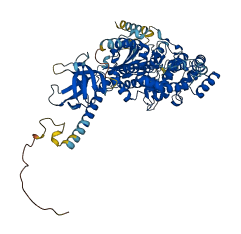
The autoinhibited protein was predicted that may have potential autoinhibitory elements via cis-regPred.
Autoinhibitory domains (AIDs)
Target domain |
|
Relief mechanism |
|
Assay |
cis-regPred |
Accessory elements
335-356 (Activation loop from InterPro)
Target domain |
191-455 (Protein kinase domain) |
Relief mechanism |
|
Assay |
|
Autoinhibited structure

Activated structure
1 structures for Q09639
| Entry ID | Method | Resolution | Chain | Position | Source |
|---|---|---|---|---|---|
| AF-Q09639-F1 | Predicted | AlphaFoldDB |
No variants for Q09639
| Variant ID(s) | Position | Change | Description | Diseaes Association | Provenance |
|---|---|---|---|---|---|
| No variants for Q09639 | |||||
No associated diseases with Q09639
5 regional properties for Q09639
| Type | Name | Position | InterPro Accession |
|---|---|---|---|
| domain | Protein kinase domain | 186 - 448 | IPR000719 |
| domain | AGC-kinase, C-terminal | 449 - 528 | IPR000961 |
| active_site | Serine/threonine-protein kinase, active site | 307 - 319 | IPR008271 |
| domain | RGS domain | 52 - 171 | IPR016137 |
| binding_site | Protein kinase, ATP binding site | 192 - 224 | IPR017441 |
Functions
| Description | ||
|---|---|---|
| EC Number | 2.7.11.16 | Protein-serine/threonine kinases |
| Subcellular Localization |
|
|
| PANTHER Family | ||
| PANTHER Subfamily | ||
| PANTHER Protein Class | ||
| PANTHER Pathway Category | No pathway information available | |
No GO annotations of cellular component
| Name | Definition |
|---|---|
| No GO annotations for cellular component |
4 GO annotations of molecular function
| Name | Definition |
|---|---|
| ATP binding | Binding to ATP, adenosine 5'-triphosphate, a universally important coenzyme and enzyme regulator. |
| G protein-coupled receptor binding | Binding to a G protein-coupled receptor. |
| G protein-coupled receptor kinase activity | Catalysis of the reaction: ATP + G protein-coupled receptor = ADP + G protein-coupled receptor phosphate. |
| protein kinase activity | Catalysis of the phosphorylation of an amino acid residue in a protein, usually according to the reaction: a protein + ATP = a phosphoprotein + ADP. |
15 GO annotations of biological process
| Name | Definition |
|---|---|
| chemotaxis | The directed movement of a motile cell or organism, or the directed growth of a cell guided by a specific chemical concentration gradient. Movement may be towards a higher concentration (positive chemotaxis) or towards a lower concentration (negative chemotaxis). |
| G protein-coupled receptor signaling pathway | The series of molecular signals initiated by a ligand binding to its receptor, in which the activated receptor promotes the exchange of GDP for GTP on the alpha-subunit of an associated heterotrimeric G-protein complex. The GTP-bound activated alpha-G-protein then dissociates from the beta- and gamma-subunits to further transmit the signal within the cell. The pathway begins with receptor-ligand interaction, and ends with regulation of a downstream cellular process. The pathway can start from the plasma membrane, Golgi or nuclear membrane. |
| hyperosmotic response | Any process that results in a change in state or activity of a cell or an organism (in terms of movement, secretion, enzyme production, gene expression, etc.) as a result of detection of, or exposure to, a hyperosmotic environment, i.e. an environment with a higher concentration of solutes than the organism or cell. |
| multicellular organismal process | Any biological process, occurring at the level of a multicellular organism, pertinent to its function. |
| negative regulation of dopamine receptor signaling pathway | Any process that stops, prevents, or reduces the frequency, rate or extent of dopamine receptor protein signaling pathway activity. A dopamine receptor signaling pathway is the series of molecular signals generated as a consequence of a dopamine receptor binding to one of its physiological ligands. |
| olfactory behavior | The behavior of an organism in response to an odor. |
| positive regulation of cation channel activity | Any process that activates or increases the frequency, rate or extent of cation channel activity. |
| positive regulation of chemotaxis | Any process that activates or increases the frequency, rate or extent of the directed movement of a motile cell or organism in response to a specific chemical concentration gradient. |
| positive regulation of growth rate | Any process that increases the rate of growth of all or part of an organism. |
| positive regulation of locomotion | Any process that activates or increases the frequency, rate or extent of locomotion of a cell or organism. |
| positive regulation of oviposition | Any process that activates or increases the frequency, rate or extent of oviposition. |
| protein phosphorylation | The process of introducing a phosphate group on to a protein. |
| regulation of signal transduction | Any process that modulates the frequency, rate or extent of signal transduction. |
| response to salt | Any process that results in a change in state or activity of a cell or an organism (in terms of movement, secretion, enzyme production, gene expression, etc.) as a result of a salt stimulus. |
| serotonin catabolic process | The chemical reactions and pathways resulting in the breakdown of serotonin (5-hydroxytryptamine), a monoamine neurotransmitter occurring in the peripheral and central nervous systems, also having hormonal properties. |
19 homologous proteins in AiPD
| UniProt AC | Gene Name | Protein Name | Species | Evidence Code |
|---|---|---|---|---|
| P43249 | GRK5 | G protein-coupled receptor kinase 5 | Bos taurus (Bovine) | SS |
| P21146 | GRK2 | Beta-adrenergic receptor kinase 1 | Bos taurus (Bovine) | PR |
| P26818 | GRK3 | Beta-adrenergic receptor kinase 2 | Bos taurus (Bovine) | PR |
| P32865 | Gprk1 | G protein-coupled receptor kinase 1 | Drosophila melanogaster (Fruit fly) | PR |
| Q15835 | GRK1 | Rhodopsin kinase GRK1 | Homo sapiens (Human) | PR |
| P34947 | GRK5 | G protein-coupled receptor kinase 5 | Homo sapiens (Human) | EV |
| P32298 | GRK4 | G protein-coupled receptor kinase 4 | Homo sapiens (Human) | SS |
| P43250 | GRK6 | G protein-coupled receptor kinase 6 | Homo sapiens (Human) | EV |
| P25098 | GRK2 | Beta-adrenergic receptor kinase 1 | Homo sapiens (Human) | PR |
| P35626 | GRK3 | Beta-adrenergic receptor kinase 2 | Homo sapiens (Human) | PR |
| O70293 | Grk6 | G protein-coupled receptor kinase 6 | Mus musculus (Mouse) | SS |
| Q8VEB1 | Grk5 | G protein-coupled receptor kinase 5 | Mus musculus (Mouse) | SS |
| Q9WVL4 | Grk1 | Rhodopsin kinase GRK1 | Mus musculus (Mouse) | PR |
| Q3UYH7 | Adrbk2 | Beta-adrenergic receptor kinase 2 | Mus musculus (Mouse) | PR |
| Q99MK8 | Grk2 | Beta-adrenergic receptor kinase 1 | Mus musculus (Mouse) | PR |
| Q62833 | Grk5 | G protein-coupled receptor kinase 5 | Rattus norvegicus (Rat) | SS |
| P97711 | Grk6 | G protein-coupled receptor kinase 6 | Rattus norvegicus (Rat) | SS |
| P26819 | Grk3 | Beta-adrenergic receptor kinase 2 | Rattus norvegicus (Rat) | PR |
| P26817 | Grk2 | Beta-adrenergic receptor kinase 1 | Rattus norvegicus (Rat) | PR |
| 10 | 20 | 30 | 40 | 50 | 60 |
| MADLEAVLAD | VSYLMAMEKS | RSQPAARASK | RIVLPDPSVR | SIMQKFLEKS | GDMKFDKIFN |
| 70 | 80 | 90 | 100 | 110 | 120 |
| QKLGFLLLKD | YAENVSESPC | PQIKFYEAIK | EYEKMETPDE | RLTKAREIYD | HHIMVEMLAH |
| 130 | 140 | 150 | 160 | 170 | 180 |
| AHNYSKESLQ | HVQYHLLKQN | VPPDLFHRYV | LEICDQLRGD | IFQRFLESDK | FTRFCQWKNL |
| 190 | 200 | 210 | 220 | 230 | 240 |
| ELNMQLTMND | FSVHRIIGRG | GFGEVYGCRK | ADTGKMYAMK | CLDKKRIKMK | QGETLALNER |
| 250 | 260 | 270 | 280 | 290 | 300 |
| IMLSLVSTGQ | DCPFIVCMTY | AFQSPDKLCF | ILDLMNGGDL | HYHLSQHGVF | TEQEMIFYAS |
| 310 | 320 | 330 | 340 | 350 | 360 |
| EVILGLEHMH | NRFVVYRDLK | PANILLDENG | HVRVSDLGLA | CDYSKKKPHA | SVGTHGYMAP |
| 370 | 380 | 390 | 400 | 410 | 420 |
| EVLAKGVAYD | SSADWFSLGC | MLYKLLKGHS | PFRQHKSKDK | NEIDKMTLTQ | DIELPNEGLS |
| 430 | 440 | 450 | 460 | 470 | 480 |
| KDCRDLLEGL | LKRDVPDRLG | CRGKGPTEVK | EHPFFKDVDW | QTVYLRRMTP | PLIPPRGEVN |
| 490 | 500 | 510 | 520 | 530 | 540 |
| AADAFDIGNF | DDDEVKGVKL | QDGDSDLYKN | FNIVISERWQ | NEIAETIFEV | VNQDADKAES |
| 550 | 560 | 570 | 580 | 590 | 600 |
| KKRSKQKIKV | AVEEKDSDVI | VHGYIKKLGG | PFTSAWQTKY | GKLYPSRLEL | YPESLTAKPE |
| 610 | 620 | 630 | 640 | 650 | 660 |
| LVFMDQIEDV | CAEMQTIKGE | TAIIVKLRDG | FKEPKICLTN | SDEISLKEWH | TSLRTAHKVS |
| 670 | 680 | 690 | 700 | ||
| QELLQRMGRK | AIKIYGVNHD | PMLSESERPG | SVTRAFLNRA | SSVDSGV |