P97457
Gene name |
Myl11 (Mylpf) |
Protein name |
Myosin regulatory light chain 11 |
Names |
Fast skeletal myosin light chain 2, MLC2F, Myosin light chain 11, Myosin regulatory light chain 2, skeletal muscle isoform |
Species |
Mus musculus (Mouse) |
KEGG Pathway |
mmu:17907 |
EC number |
|
Protein Class |
|
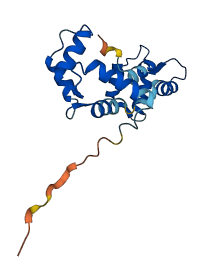
Descriptions
The autoinhibited protein was predicted that may have potential autoinhibitory elements via cis-regPred.
Autoinhibitory domains (AIDs)
Target domain |
|
Relief mechanism |
|
Assay |
cis-regPred |
Accessory elements
No accessory elements
Autoinhibited structure

Activated structure
3 structures for P97457
| Entry ID | Method | Resolution | Chain | Position | Source |
|---|---|---|---|---|---|
| 7NEP | EM | 1020 A | R/S | 21-164 | PDB |
| 7QIO | EM | 900 A | P/Q | 1-169 | PDB |
| AF-P97457-F1 | Predicted | AlphaFoldDB |
11 variants for P97457
| Variant ID(s) | Position | Change | Description | Diseaes Association | Provenance |
|---|---|---|---|---|---|
| rs3388953029 | 2 | A>T | No | EVA | |
| rs3388949109 | 23 | D>Y | No | EVA | |
| rs3388948887 | 25 | T>I | No | EVA | |
| rs3413085472 | 48 | E>G | No | EVA | |
| rs3388922300 | 56 | A>G | No | EVA | |
| rs3398543687 | 82 | V>G | No | EVA | |
| rs3398538659 | 85 | T>I | No | EVA | |
| rs3398471698 | 90 | K>T | No | EVA | |
| rs13472362 | 129 | D>G | No | EVA | |
| rs3388952429 | 131 | F>I | No | EVA | |
| rs3388953180 | 150 | N>K | No | EVA |
No associated diseases with P97457
3 regional properties for P97457
| Type | Name | Position | InterPro Accession |
|---|---|---|---|
| domain | EF-hand domain | 25 - 60 | IPR002048-1 |
| domain | EF-hand domain | 95 - 130 | IPR002048-2 |
| binding_site | EF-Hand 1, calcium-binding site | 38 - 50 | IPR018247 |
2 GO annotations of cellular component
| Name | Definition |
|---|---|
| cytoplasm | The contents of a cell excluding the plasma membrane and nucleus, but including other subcellular structures. |
| myosin complex | A protein complex, formed of one or more myosin heavy chains plus associated light chains and other proteins, that functions as a molecular motor; uses the energy of ATP hydrolysis to move actin filaments or to move vesicles or other cargo on fixed actin filaments; has magnesium-ATPase activity and binds actin. Myosin classes are distinguished based on sequence features of the motor, or head, domain, but also have distinct tail regions that are believed to bind specific cargoes. |
2 GO annotations of molecular function
| Name | Definition |
|---|---|
| calcium ion binding | Binding to a calcium ion (Ca2+). |
| structural constituent of muscle | The action of a molecule that contributes to the structural integrity of a muscle fiber. |
3 GO annotations of biological process
| Name | Definition |
|---|---|
| immune response | Any immune system process that functions in the calibrated response of an organism to a potential internal or invasive threat. |
| muscle contraction | A process in which force is generated within muscle tissue, resulting in a change in muscle geometry. Force generation involves a chemo-mechanical energy conversion step that is carried out by the actin/myosin complex activity, which generates force through ATP hydrolysis. |
| skeletal muscle tissue development | The developmental sequence of events leading to the formation of adult skeletal muscle tissue. The main events are: the fusion of myoblasts to form myotubes that increase in size by further fusion to them of myoblasts, the formation of myofibrils within their cytoplasm and the establishment of functional neuromuscular junctions with motor neurons. At this stage they can be regarded as mature muscle fibers. |
9 homologous proteins in AiPD
| UniProt AC | Gene Name | Protein Name | Species | Evidence Code |
|---|---|---|---|---|
| Q5E9E2 | MYL9 | Myosin regulatory light polypeptide 9 | Bos taurus (Bovine) | PR |
| P19105 | MYL12A | Myosin regulatory light chain 12A | Homo sapiens (Human) | PR |
| Q9BUA6 | MYL10 | Myosin regulatory light chain 10 | Homo sapiens (Human) | PR |
| O14950 | MYL12B | Myosin regulatory light chain 12B | Homo sapiens (Human) | PR |
| P51667 | Myl2 | Myosin regulatory light chain 2, ventricular/cardiac muscle isoform | Mus musculus (Mouse) | PR |
| Q3THE2 | Myl12b | Myosin regulatory light chain 12B | Mus musculus (Mouse) | PR |
| Q62082 | Myl10 | Myosin regulatory light chain 10 | Mus musculus (Mouse) | PR |
| P13832 | Rlc-a | Myosin regulatory light chain RLC-A | Rattus norvegicus (Rat) | PR |
| P18666 | Myl12b | Myosin regulatory light chain 12B | Rattus norvegicus (Rat) | PR |
| 10 | 20 | 30 | 40 | 50 | 60 |
| MAPKKAKRRA | GAEGSSNVFS | MFDQTQIQEF | KEAFTVIDQN | RDGIIDKEDL | RDTFAAMGRL |
| 70 | 80 | 90 | 100 | 110 | 120 |
| NVKNEELDAM | MKEASGPINF | TVFLTMFGEK | LKGADPEDVI | TGAFKVLDPE | GKGTIKKQFL |
| 130 | 140 | 150 | 160 | ||
| EELLTTQCDR | FSQEEIKNMW | AAFPPDVGGN | VDYKNICYVI | THGDAKDQE |