P70584
Gene name |
Acadsb |
Protein name |
Short/branched chain specific acyl-CoA dehydrogenase, mitochondrial |
Names |
SBCAD, 2-methyl branched chain acyl-CoA dehydrogenase, 2-MEBCAD, 2-methylbutyryl-coenzyme A dehydrogenase, 2-methylbutyryl-CoA dehydrogenase |
Species |
Rattus norvegicus (Rat) |
KEGG Pathway |
rno:25618 |
EC number |
1.3.8.5: With a flavin as acceptor |
Protein Class |
|
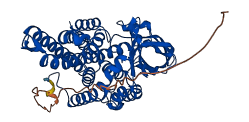
Descriptions
The autoinhibited protein was predicted that may have potential autoinhibitory elements via cis-regPred.
Autoinhibitory domains (AIDs)
Target domain |
|
Relief mechanism |
|
Assay |
cis-regPred |
Accessory elements
No accessory elements
Autoinhibited structure

Activated structure
1 structures for P70584
| Entry ID | Method | Resolution | Chain | Position | Source |
|---|---|---|---|---|---|
| AF-P70584-F1 | Predicted | AlphaFoldDB |
No variants for P70584
| Variant ID(s) | Position | Change | Description | Diseaes Association | Provenance |
|---|---|---|---|---|---|
| No variants for P70584 | |||||
No associated diseases with P70584
5 regional properties for P70584
| Type | Name | Position | InterPro Accession |
|---|---|---|---|
| conserved_site | Acyl-CoA dehydrogenase, conserved site | 175 - 187 | IPR006089-1 |
| conserved_site | Acyl-CoA dehydrogenase, conserved site | 387 - 406 | IPR006089-2 |
| domain | Acyl-CoA oxidase/dehydrogenase, middle domain | 173 - 268 | IPR006091 |
| domain | Acyl-CoA dehydrogenase/oxidase C-terminal | 280 - 428 | IPR009075 |
| domain | Acyl-CoA dehydrogenase/oxidase, N-terminal | 58 - 168 | IPR013786 |
Functions
| Description | ||
|---|---|---|
| EC Number | 1.3.8.5 | With a flavin as acceptor |
| Subcellular Localization |
|
|
| PANTHER Family | ||
| PANTHER Subfamily | ||
| PANTHER Protein Class | ||
| PANTHER Pathway Category | No pathway information available | |
2 GO annotations of cellular component
| Name | Definition |
|---|---|
| mitochondrial matrix | The gel-like material, with considerable fine structure, that lies in the matrix space, or lumen, of a mitochondrion. It contains the enzymes of the tricarboxylic acid cycle and, in some organisms, the enzymes concerned with fatty acid oxidation. |
| mitochondrion | A semiautonomous, self replicating organelle that occurs in varying numbers, shapes, and sizes in the cytoplasm of virtually all eukaryotic cells. It is notably the site of tissue respiration. |
7 GO annotations of molecular function
| Name | Definition |
|---|---|
| 2-methylacyl-CoA dehydrogenase activity | Catalysis of the reaction: 2-methylbutanoyl-CoA + H+ + oxidized = (2E)-2-methylbut-2-enoyl-CoA + reduced |
| acyl-CoA dehydrogenase activity | Catalysis of the reaction: acyl-CoA + oxidized |
| electron transfer activity | Any molecular entity that serves as an electron acceptor and electron donor in an electron transport chain. An electron transport chain is a process in which a series of electron carriers operate together to transfer electrons from donors to any of several different terminal electron acceptors to generate a transmembrane electrochemical gradient. |
| flavin adenine dinucleotide binding | Binding to FAD, flavin-adenine dinucleotide, the coenzyme or the prosthetic group of various flavoprotein oxidoreductase enzymes, in either the oxidized form, FAD, or the reduced form, FADH2. |
| identical protein binding | Binding to an identical protein or proteins. |
| isobutyryl-CoA:FAD oxidoreductase activity | Catalysis of the reaction: H+ + isobutyryl-CoA + FAD <=> methacrylyl-CoA + FADH2. |
| short-branched-chain-acyl-CoA dehydrogenase activity | Catalysis of the reaction: acyl-CoA + acceptor = 2,3-dehydroacyl-CoA + reduced acceptor, where the acyl group is a short branched chain fatty acid residue. |
4 GO annotations of biological process
| Name | Definition |
|---|---|
| acyl-CoA metabolic process | The chemical reactions and pathways involving acyl-CoA, any derivative of coenzyme A in which the sulfhydryl group is in thiolester linkage with an acyl group. |
| fatty acid beta-oxidation | A fatty acid oxidation process that results in the complete oxidation of a long-chain fatty acid. Fatty acid beta-oxidation begins with the addition of coenzyme A to a fatty acid, and occurs by successive cycles of reactions during each of which the fatty acid is shortened by a two-carbon fragment removed as acetyl coenzyme A; the cycle continues until only two or three carbons remain (as acetyl-CoA or propionyl-CoA respectively). |
| fatty acid metabolic process | The chemical reactions and pathways involving fatty acids, aliphatic monocarboxylic acids liberated from naturally occurring fats and oils by hydrolysis. |
| isoleucine catabolic process | The chemical reactions and pathways resulting in the breakdown of isoleucine, (2R*,3R*)-2-amino-3-methylpentanoic acid. |
7 homologous proteins in AiPD
| UniProt AC | Gene Name | Protein Name | Species | Evidence Code |
|---|---|---|---|---|
| Q3ZBF6 | ACADS | Short-chain specific acyl-CoA dehydrogenase, mitochondrial | Bos taurus (Bovine) | PR |
| P16219 | ACADS | Short-chain specific acyl-CoA dehydrogenase, mitochondrial | Homo sapiens (Human) | PR |
| Q07417 | Acads | Short-chain specific acyl-CoA dehydrogenase, mitochondrial | Mus musculus (Mouse) | PR |
| Q9DBL1 | Acadsb | Short/branched chain specific acyl-CoA dehydrogenase, mitochondrial | Mus musculus (Mouse) | PR |
| P79273 | ACADS | Short-chain specific acyl-CoA dehydrogenase, mitochondrial | Sus scrofa (Pig) | PR |
| P45953 | Acadvl | Very long-chain specific acyl-CoA dehydrogenase, mitochondrial | Rattus norvegicus (Rat) | PR |
| P15651 | Acads | Short-chain specific acyl-CoA dehydrogenase, mitochondrial | Rattus norvegicus (Rat) | PR |
| 10 | 20 | 30 | 40 | 50 | 60 |
| MAVSAFQLWR | AGGLLRRNFL | THSSSWKIPP | RVLKSSQPEA | LLSVTNNALC | FAPLQTFTDE |
| 70 | 80 | 90 | 100 | 110 | 120 |
| DIMMQKAVKK | FAQEQIAPLV | STMDENSKME | KSVIQGLFQQ | GMMGIEVEAK | YGGTEASFLC |
| 130 | 140 | 150 | 160 | 170 | 180 |
| SVLVIEELAK | VDASVALLCD | IQNTVINKLF | RKHGTEEQKA | TYLPKLVTEK | LGSFCLSEAG |
| 190 | 200 | 210 | 220 | 230 | 240 |
| AGSDSFALKT | RADKSGNYYV | INGSKMWISN | AEHAELFLVF | ANVDPPSGYR | GITCFLVDRD |
| 250 | 260 | 270 | 280 | 290 | 300 |
| TEGFQIGRRE | NKMGIRASST | CQLTFENVKV | PETSVLGKIG | HGYKYAIGSL | NEGRIGIAAQ |
| 310 | 320 | 330 | 340 | 350 | 360 |
| MLGLAQGCFD | YTIPYIKERM | QFGKRIFDFQ | GLQHQVAHVA | TQLEAARLLT | YNAARLVEAG |
| 370 | 380 | 390 | 400 | 410 | 420 |
| RPFIKEASMA | KYYASEVAGL | TTSKCIEWMG | GVGYTKDYPV | EKFFRDAKIG | TIYEGTSNIQ |
| 430 | |||||
| LNTIAKHIDA | EY |