P15651
Gene name |
Acads |
Protein name |
Short-chain specific acyl-CoA dehydrogenase, mitochondrial |
Names |
SCAD, Butyryl-CoA dehydrogenase |
Species |
Rattus norvegicus (Rat) |
KEGG Pathway |
rno:64304 |
EC number |
1.3.8.1: With a flavin as acceptor |
Protein Class |
|
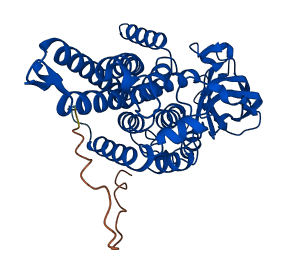
Descriptions
The autoinhibited protein was predicted that may have potential autoinhibitory elements via cis-regPred.
Autoinhibitory domains (AIDs)
Target domain |
|
Relief mechanism |
|
Assay |
cis-regPred |
Accessory elements
No accessory elements
Autoinhibited structure

Activated structure
2 structures for P15651
| Entry ID | Method | Resolution | Chain | Position | Source |
|---|---|---|---|---|---|
| 1JQI | X-ray | 225 A | A/B | 25-412 | PDB |
| AF-P15651-F1 | Predicted | AlphaFoldDB |
No variants for P15651
| Variant ID(s) | Position | Change | Description | Diseaes Association | Provenance |
|---|---|---|---|---|---|
| No variants for P15651 | |||||
No associated diseases with P15651
5 regional properties for P15651
| Type | Name | Position | InterPro Accession |
|---|---|---|---|
| conserved_site | Acyl-CoA dehydrogenase, conserved site | 153 - 165 | IPR006089-1 |
| conserved_site | Acyl-CoA dehydrogenase, conserved site | 365 - 384 | IPR006089-2 |
| domain | Acyl-CoA oxidase/dehydrogenase, middle domain | 151 - 246 | IPR006091 |
| domain | Acyl-CoA dehydrogenase/oxidase C-terminal | 258 - 406 | IPR009075 |
| domain | Acyl-CoA dehydrogenase/oxidase, N-terminal | 36 - 147 | IPR013786 |
Functions
| Description | ||
|---|---|---|
| EC Number | 1.3.8.1 | With a flavin as acceptor |
| Subcellular Localization |
|
|
| PANTHER Family | ||
| PANTHER Subfamily | ||
| PANTHER Protein Class | ||
| PANTHER Pathway Category | No pathway information available | |
3 GO annotations of cellular component
| Name | Definition |
|---|---|
| mitochondrial matrix | The gel-like material, with considerable fine structure, that lies in the matrix space, or lumen, of a mitochondrion. It contains the enzymes of the tricarboxylic acid cycle and, in some organisms, the enzymes concerned with fatty acid oxidation. |
| mitochondrial membrane | Either of the lipid bilayers that surround the mitochondrion and form the mitochondrial envelope. |
| mitochondrion | A semiautonomous, self replicating organelle that occurs in varying numbers, shapes, and sizes in the cytoplasm of virtually all eukaryotic cells. It is notably the site of tissue respiration. |
5 GO annotations of molecular function
| Name | Definition |
|---|---|
| acyl-CoA dehydrogenase activity | Catalysis of the reaction: acyl-CoA + oxidized |
| butyryl-CoA dehydrogenase activity | Catalysis of the reaction: butanoyl-CoA + electron-transfer flavoprotein = 2-butenoyl-CoA + reduced electron-transfer flavoprotein. |
| fatty-acyl-CoA binding | Binding to a fatty-acyl-CoA, any derivative of coenzyme A in which the sulfhydryl group is in thiolester linkage with a fatty acyl group. |
| flavin adenine dinucleotide binding | Binding to FAD, flavin-adenine dinucleotide, the coenzyme or the prosthetic group of various flavoprotein oxidoreductase enzymes, in either the oxidized form, FAD, or the reduced form, FADH2. |
| identical protein binding | Binding to an identical protein or proteins. |
5 GO annotations of biological process
| Name | Definition |
|---|---|
| butyrate catabolic process | The chemical reactions and pathways resulting in the breakdown of butyrate, the anion of butyric acid. |
| fatty acid beta-oxidation | A fatty acid oxidation process that results in the complete oxidation of a long-chain fatty acid. Fatty acid beta-oxidation begins with the addition of coenzyme A to a fatty acid, and occurs by successive cycles of reactions during each of which the fatty acid is shortened by a two-carbon fragment removed as acetyl coenzyme A; the cycle continues until only two or three carbons remain (as acetyl-CoA or propionyl-CoA respectively). |
| fatty acid beta-oxidation using acyl-CoA dehydrogenase | A fatty acid beta-oxidation pathway in which the initial step of each oxidation cycle, which converts an acyl-CoA to a trans-2-enoyl-CoA, is catalyzed by acyl-CoA dehydrogenase; the electrons removed by oxidation pass through the respiratory chain to oxygen and leave H2O as the product. Fatty acid beta-oxidation begins with the addition of coenzyme A to a fatty acid, and ends when only two or three carbons remain (as acetyl-CoA or propionyl-CoA respectively). |
| response to glucocorticoid | Any process that results in a change in state or activity of a cell or an organism (in terms of movement, secretion, enzyme production, gene expression, etc.) as a result of a glucocorticoid stimulus. Glucocorticoids are hormonal C21 corticosteroids synthesized from cholesterol with the ability to bind with the cortisol receptor and trigger similar effects. Glucocorticoids act primarily on carbohydrate and protein metabolism, and have anti-inflammatory effects. |
| response to starvation | Any process that results in a change in state or activity of a cell or an organism (in terms of movement, secretion, enzyme production, gene expression, etc.) as a result of a starvation stimulus, deprivation of nourishment. |
7 homologous proteins in AiPD
| UniProt AC | Gene Name | Protein Name | Species | Evidence Code |
|---|---|---|---|---|
| Q3ZBF6 | ACADS | Short-chain specific acyl-CoA dehydrogenase, mitochondrial | Bos taurus (Bovine) | PR |
| P16219 | ACADS | Short-chain specific acyl-CoA dehydrogenase, mitochondrial | Homo sapiens (Human) | PR |
| Q9DBL1 | Acadsb | Short/branched chain specific acyl-CoA dehydrogenase, mitochondrial | Mus musculus (Mouse) | PR |
| Q07417 | Acads | Short-chain specific acyl-CoA dehydrogenase, mitochondrial | Mus musculus (Mouse) | PR |
| P79273 | ACADS | Short-chain specific acyl-CoA dehydrogenase, mitochondrial | Sus scrofa (Pig) | PR |
| P70584 | Acadsb | Short/branched chain specific acyl-CoA dehydrogenase, mitochondrial | Rattus norvegicus (Rat) | PR |
| P45953 | Acadvl | Very long-chain specific acyl-CoA dehydrogenase, mitochondrial | Rattus norvegicus (Rat) | PR |
| 10 | 20 | 30 | 40 | 50 | 60 |
| MAAALLARAG | GSLGRALRAR | DWRRLHTVYQ | SVELPETHQM | LRQTCRDFAE | KELVPIAAQL |
| 70 | 80 | 90 | 100 | 110 | 120 |
| DKEHLFPTSQ | VKKMGELGLL | AMDVPEELSG | AGLDYLAYSI | ALEEISRGCA | STGVIMSVNN |
| 130 | 140 | 150 | 160 | 170 | 180 |
| SLYLGPILKF | GSSQQKQQWI | TPFTNGDKIG | CFALSEPGNG | SDAGAASTTA | REEGDSWVLN |
| 190 | 200 | 210 | 220 | 230 | 240 |
| GTKAWITNSW | EASATVVFAS | TDRSRQNKGI | SAFLVPMPTP | GLTLGKKEDK | LGIRASSTAN |
| 250 | 260 | 270 | 280 | 290 | 300 |
| LIFEDCRIPK | ENLLGEPGMG | FKIAMQTLDM | GRIGIASQAL | GIAQASLDCA | VKYAENRHAF |
| 310 | 320 | 330 | 340 | 350 | 360 |
| GAPLTKLQNI | QFKLADMALA | LESARLLTWR | AAMLKDNKKP | FTKESAMAKL | AASEAATAIS |
| 370 | 380 | 390 | 400 | 410 | |
| HQAIQILGGM | GYVTEMPAER | YYRDARITEI | YEGTSEIQRL | VIAGHLLRSY | RS |