P45953
Gene name |
Acadvl |
Protein name |
Very long-chain specific acyl-CoA dehydrogenase, mitochondrial |
Names |
VLCAD |
Species |
Rattus norvegicus (Rat) |
KEGG Pathway |
rno:25363 |
EC number |
1.3.8.9: With a flavin as acceptor |
Protein Class |
|
Descriptions
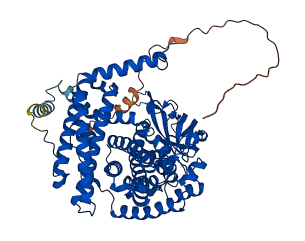
The autoinhibited protein was predicted that may have potential autoinhibitory elements via cis-regPred.
Autoinhibitory domains (AIDs)
Target domain |
|
Relief mechanism |
|
Assay |
cis-regPred |
Accessory elements
No accessory elements
Autoinhibited structure

Activated structure
1 structures for P45953
| Entry ID | Method | Resolution | Chain | Position | Source |
|---|---|---|---|---|---|
| AF-P45953-F1 | Predicted | AlphaFoldDB |
No variants for P45953
| Variant ID(s) | Position | Change | Description | Diseaes Association | Provenance |
|---|---|---|---|---|---|
| No variants for P45953 | |||||
No associated diseases with P45953
Functions
| Description | ||
|---|---|---|
| EC Number | 1.3.8.9 | With a flavin as acceptor |
| Subcellular Localization |
|
|
| PANTHER Family | ||
| PANTHER Subfamily | ||
| PANTHER Protein Class | ||
| PANTHER Pathway Category | No pathway information available | |
5 GO annotations of cellular component
| Name | Definition |
|---|---|
| extrinsic component of mitochondrial inner membrane | The component of mitochondrial inner membrane consisting of gene products and protein complexes that are loosely bound to one of its surfaces, but not integrated into the hydrophobic region. |
| mitochondrial inner membrane | The inner, i.e. lumen-facing, lipid bilayer of the mitochondrial envelope. It is highly folded to form cristae. |
| mitochondrial membrane | Either of the lipid bilayers that surround the mitochondrion and form the mitochondrial envelope. |
| mitochondrial nucleoid | The region of a mitochondrion to which the DNA is confined. |
| mitochondrion | A semiautonomous, self replicating organelle that occurs in varying numbers, shapes, and sizes in the cytoplasm of virtually all eukaryotic cells. It is notably the site of tissue respiration. |
6 GO annotations of molecular function
| Name | Definition |
|---|---|
| acyl-CoA dehydrogenase activity | Catalysis of the reaction: acyl-CoA + oxidized |
| fatty-acyl-CoA binding | Binding to a fatty-acyl-CoA, any derivative of coenzyme A in which the sulfhydryl group is in thiolester linkage with a fatty acyl group. |
| flavin adenine dinucleotide binding | Binding to FAD, flavin-adenine dinucleotide, the coenzyme or the prosthetic group of various flavoprotein oxidoreductase enzymes, in either the oxidized form, FAD, or the reduced form, FADH2. |
| identical protein binding | Binding to an identical protein or proteins. |
| long-chain-acyl-CoA dehydrogenase activity | Catalysis of the reaction: a long-chain 2,3-saturated fatty acyl-CoA + H+ + oxidized = a long-chain (2E)-enoyl-CoA + reduced |
| very-long-chain-acyl-CoA dehydrogenase activity | Catalysis of the reaction: a very-long-chain 2,3-saturated fatty acyl-CoA + H+ + oxidized = a very-long-chain (2E)-enoyl-CoA + reduced |
9 GO annotations of biological process
| Name | Definition |
|---|---|
| epithelial cell differentiation | The process in which a relatively unspecialized cell acquires specialized features of an epithelial cell, any of the cells making up an epithelium. |
| fatty acid beta-oxidation | A fatty acid oxidation process that results in the complete oxidation of a long-chain fatty acid. Fatty acid beta-oxidation begins with the addition of coenzyme A to a fatty acid, and occurs by successive cycles of reactions during each of which the fatty acid is shortened by a two-carbon fragment removed as acetyl coenzyme A; the cycle continues until only two or three carbons remain (as acetyl-CoA or propionyl-CoA respectively). |
| fatty acid beta-oxidation using acyl-CoA dehydrogenase | A fatty acid beta-oxidation pathway in which the initial step of each oxidation cycle, which converts an acyl-CoA to a trans-2-enoyl-CoA, is catalyzed by acyl-CoA dehydrogenase; the electrons removed by oxidation pass through the respiratory chain to oxygen and leave H2O as the product. Fatty acid beta-oxidation begins with the addition of coenzyme A to a fatty acid, and ends when only two or three carbons remain (as acetyl-CoA or propionyl-CoA respectively). |
| fatty acid catabolic process | The chemical reactions and pathways resulting in the breakdown of a fatty acid, any of the aliphatic monocarboxylic acids that can be liberated by hydrolysis from naturally occurring fats and oils. Fatty acids are predominantly straight-chain acids of 4 to 24 carbon atoms, which may be saturated or unsaturated; branched fatty acids and hydroxy fatty acids also occur, and very long chain acids of over 30 carbons are found in waxes. |
| negative regulation of fatty acid biosynthetic process | Any process that stops, prevents, or reduces the frequency, rate or extent of the chemical reactions and pathways resulting in the formation of fatty acids. |
| negative regulation of fatty acid oxidation | Any process that stops, prevents, or reduces the frequency, rate or extent of fatty acid oxidation. |
| regulation of cholesterol metabolic process | Any process that modulates the rate, frequency, or extent of cholesterol metabolism, the chemical reactions and pathways involving cholesterol, cholest-5-en-3 beta-ol, the principal sterol of vertebrates and the precursor of many steroids, including bile acids and steroid hormones. |
| response to cold | Any process that results in a change in state or activity of a cell or an organism (in terms of movement, secretion, enzyme production, gene expression, etc.) as a result of a cold stimulus, a temperature stimulus below the optimal temperature for that organism. |
| temperature homeostasis | A homeostatic process in which an organism modulates its internal body temperature. |
5 homologous proteins in AiPD
| UniProt AC | Gene Name | Protein Name | Species | Evidence Code |
|---|---|---|---|---|
| P48818 | ACADVL | Very long-chain specific acyl-CoA dehydrogenase, mitochondrial | Bos taurus (Bovine) | PR |
| P49748 | ACADVL | Very long-chain specific acyl-CoA dehydrogenase, mitochondrial | Homo sapiens (Human) | PR |
| P50544 | Acadvl | Very long-chain specific acyl-CoA dehydrogenase, mitochondrial | Mus musculus (Mouse) | PR |
| P70584 | Acadsb | Short/branched chain specific acyl-CoA dehydrogenase, mitochondrial | Rattus norvegicus (Rat) | PR |
| P15651 | Acads | Short-chain specific acyl-CoA dehydrogenase, mitochondrial | Rattus norvegicus (Rat) | PR |
| 10 | 20 | 30 | 40 | 50 | 60 |
| MQSARMTPSV | GRQLLRLGAR | SSRSAALQGQ | PRPTSAQRLY | ASEATQAVLE | KPETLSSDAS |
| 70 | 80 | 90 | 100 | 110 | 120 |
| TREKPARAES | KSFAVGMFKG | QLTTDQVFPY | PSVLNEGQTQ | FLKELVGPVA | RFFEEVNDPA |
| 130 | 140 | 150 | 160 | 170 | 180 |
| KNDSLEKVEE | DTLQGLKELG | AFGLQVPSEL | GGLGLSNTQY | ARLAEIVGMH | DLGVSVTLGA |
| 190 | 200 | 210 | 220 | 230 | 240 |
| HQSIGFKGIL | LYGTKAQKEK | YLPRVASGQA | LAAFCLTEPS | SGSDVASIRS | SAVPSPCGKY |
| 250 | 260 | 270 | 280 | 290 | 300 |
| YTLNGSKIWI | SNGGLADIFT | VFAKTPIKDA | ATGAVKEKIT | AFVVERSFGG | VTHGLPEKKM |
| 310 | 320 | 330 | 340 | 350 | 360 |
| GIKASNTSEV | YFDGVKVPAE | NVLGEVGDGF | KVAVNILNNG | RFGMAATLAG | TMKAIIAKAV |
| 370 | 380 | 390 | 400 | 410 | 420 |
| DHATNRTQFG | DKIHNFGVIQ | EKLARMAILQ | YVTESMAYML | SANMDQGFKD | FQIEAAISKI |
| 430 | 440 | 450 | 460 | 470 | 480 |
| FGSEAAWKVT | DECIQIMGGM | GFMKEPGVER | VLRDIRIFRI | FEGTNDILRL | FVALQGCMDK |
| 490 | 500 | 510 | 520 | 530 | 540 |
| GKELTGLGNA | LKNPLGNVGL | LIGEASKQLR | RRTGIGSGLS | LSGIVHPELS | RSGELAVQAL |
| 550 | 560 | 570 | 580 | 590 | 600 |
| EQFATVVEAK | LMKHKKGIVN | EQFLLQRLAD | GAIDLYAMVV | VLSRASRSLS | EGYPTAQHEK |
| 610 | 620 | 630 | 640 | 650 | |
| MLCDSWCIEA | ATRIRENMAS | LQSNPQQQEL | FRNFRSISKA | MVENGGLVTS | NPLRV |