P70266
Gene name |
Pfkfb1 |
Protein name |
6-phosphofructo-2-kinase/fructose-2,6-bisphosphatase 1 |
Names |
6PF-2-K/Fru-2,6-P2ase 1, PFK/FBPase 1, 6PF-2-K/Fru-2,6-P2ase liver isozyme |
Species |
Mus musculus (Mouse) |
KEGG Pathway |
mmu:18639 |
EC number |
2.7.1.105: Phosphotransferases with an alcohol group as acceptor |
Protein Class |
|
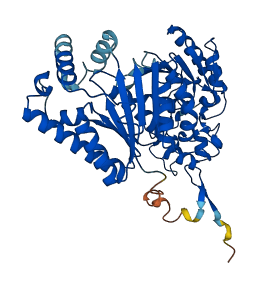
Descriptions
The autoinhibited protein was predicted that may have potential autoinhibitory elements via cis-regPred.
Autoinhibitory domains (AIDs)
Target domain |
|
Relief mechanism |
|
Assay |
cis-regPred |
Accessory elements
No accessory elements
Autoinhibited structure

Activated structure
1 structures for P70266
| Entry ID | Method | Resolution | Chain | Position | Source |
|---|---|---|---|---|---|
| AF-P70266-F1 | Predicted | AlphaFoldDB |
23 variants for P70266
| Variant ID(s) | Position | Change | Description | Diseaes Association | Provenance |
|---|---|---|---|---|---|
| rs3389578867 | 4 | E>G | No | EVA | |
| rs3389591110 | 23 | S>N | No | EVA | |
| rs3389572113 | 60 | T>K | No | EVA | |
| rs3389545860 | 81 | Y>F | No | EVA | |
| rs3389588552 | 147 | A>T | No | EVA | |
| rs3412267645 | 156 | F>I | No | EVA | |
| rs3389574318 | 163 | D>N | No | EVA | |
| rs3412132890 | 192 | D>E | No | EVA | |
| rs3412331019 | 203 | N>Y | No | EVA | |
| rs3389545889 | 208 | D>N | No | EVA | |
| rs3412720487 | 211 | L>S | No | EVA | |
| rs3389572045 | 212 | D>H | No | EVA | |
| rs3389574365 | 262 | S>N | No | EVA | |
| rs3410995816 | 269 | R>H | No | EVA | |
| rs3412267657 | 304 | S>C | No | EVA | |
| rs3389572086 | 321 | E>K | No | EVA | |
| rs3389578859 | 351 | A>V | No | EVA | |
| rs3409590579 | 392 | C>* | No | EVA | |
| rs3412232702 | 392 | C>S | No | EVA | |
| rs3412444653 | 403 | Y>P | No | EVA | |
| rs3389578848 | 429 | A>V | No | EVA | |
| rs3389528828 | 461 | E>* | No | EVA | |
| rs3389528828 | 461 | E>K | No | EVA |
No associated diseases with P70266
Functions
| Description | ||
|---|---|---|
| EC Number | 2.7.1.105 | Phosphotransferases with an alcohol group as acceptor |
| Subcellular Localization |
|
|
| PANTHER Family | ||
| PANTHER Subfamily | ||
| PANTHER Protein Class | ||
| PANTHER Pathway Category | No pathway information available | |
2 GO annotations of cellular component
| Name | Definition |
|---|---|
| 6-phosphofructo-2-kinase/fructose-2,6-biphosphatase complex | A homodimeric, bifunctional enzyme complex which catalyzes the synthesis and degradation of fructose 2,6-bisphosphate, and is required for both glycolysis and gluconeogenesis. |
| cytosol | The part of the cytoplasm that does not contain organelles but which does contain other particulate matter, such as protein complexes. |
6 GO annotations of molecular function
| Name | Definition |
|---|---|
| 6-phosphofructo-2-kinase activity | Catalysis of the reaction: beta-D-fructose 6-phosphate + ATP = beta-D-fructose 2,6-bisphosphate + ADP + 2 H(+). |
| ATP binding | Binding to ATP, adenosine 5'-triphosphate, a universally important coenzyme and enzyme regulator. |
| fructose-2,6-bisphosphate 2-phosphatase activity | Catalysis of the reaction: D-fructose 2,6-bisphosphate + H2O = D-fructose-6-phosphate + phosphate. |
| fructose-6-phosphate binding | Binding to fructose 6-phosphate. |
| identical protein binding | Binding to an identical protein or proteins. |
| kinase binding | Binding to a kinase, any enzyme that catalyzes the transfer of a phosphate group. |
10 GO annotations of biological process
| Name | Definition |
|---|---|
| animal organ regeneration | The regrowth of a lost or destroyed animal organ. |
| carbohydrate phosphorylation | The process of introducing a phosphate group into a carbohydrate, any organic compound based on the general formula Cx(H2O)y. |
| fructose 2,6-bisphosphate metabolic process | The chemical reactions and pathways involving fructose 2,6-bisphosphate. The D enantiomer is an important regulator of the glycolytic and gluconeogenic pathways. It inhibits fructose 1,6-bisphosphatase and activates phosphofructokinase. |
| fructose metabolic process | The chemical reactions and pathways involving fructose, the ketohexose arabino-2-hexulose. Fructose exists in a open chain form or as a ring compound. D-fructose is the sweetest of the sugars and is found free in a large number of fruits and honey. |
| positive regulation of glucokinase activity | Any process that activates or increases the frequency, rate or extent of glucokinase activity, the catalysis of the transfer of a phosphate group, usually from ATP, to a glucose molecule. |
| response to cAMP | Any process that results in a change in state or activity of a cell or an organism (in terms of movement, secretion, enzyme production, gene expression, etc.) as a result of a cAMP (cyclic AMP, adenosine 3',5'-cyclophosphate) stimulus. |
| response to glucagon | Any process that results in a change in state or activity of a cell or an organism (in terms of movement, secretion, enzyme production, gene expression, etc.) as a result of a glucagon stimulus. |
| response to glucocorticoid | Any process that results in a change in state or activity of a cell or an organism (in terms of movement, secretion, enzyme production, gene expression, etc.) as a result of a glucocorticoid stimulus. Glucocorticoids are hormonal C21 corticosteroids synthesized from cholesterol with the ability to bind with the cortisol receptor and trigger similar effects. Glucocorticoids act primarily on carbohydrate and protein metabolism, and have anti-inflammatory effects. |
| response to insulin | Any process that results in a change in state or activity of a cell or an organism (in terms of movement, secretion, enzyme production, gene expression, etc.) as a result of an insulin stimulus. Insulin is a polypeptide hormone produced by the islets of Langerhans of the pancreas in mammals, and by the homologous organs of other organisms. |
| response to starvation | Any process that results in a change in state or activity of a cell or an organism (in terms of movement, secretion, enzyme production, gene expression, etc.) as a result of a starvation stimulus, deprivation of nourishment. |
13 homologous proteins in AiPD
| UniProt AC | Gene Name | Protein Name | Species | Evidence Code |
|---|---|---|---|---|
| P32604 | FBP26 | Fructose-2,6-bisphosphatase | Saccharomyces cerevisiae (strain ATCC 204508 / S288c) (Baker's yeast) | PR |
| P26285 | PFKFB2 | 6-phosphofructo-2-kinase/fructose-2,6-bisphosphatase 2 | Bos taurus (Bovine) | PR |
| P49872 | PFKFB1 | 6-phosphofructo-2-kinase/fructose-2,6-bisphosphatase 1 | Bos taurus (Bovine) | PR |
| O60825 | PFKFB2 | 6-phosphofructo-2-kinase/fructose-2,6-bisphosphatase 2 | Homo sapiens (Human) | PR |
| Q16875 | PFKFB3 | 6-phosphofructo-2-kinase/fructose-2,6-bisphosphatase 3 | Homo sapiens (Human) | PR |
| Q16877 | PFKFB4 | 6-phosphofructo-2-kinase/fructose-2,6-bisphosphatase 4 | Homo sapiens (Human) | PR |
| P16118 | PFKFB1 | 6-phosphofructo-2-kinase/fructose-2,6-bisphosphatase 1 | Homo sapiens (Human) | PR |
| P70265 | Pfkfb2 | 6-phosphofructo-2-kinase/fructose-2,6-bisphosphatase 2 | Mus musculus (Mouse) | PR |
| Q6DTY7 | Pfkfb4 | 6-phosphofructo-2-kinase/fructose-2,6-bisphosphatase 4 | Mus musculus (Mouse) | PR |
| O35552 | Pfkfb3 | 6-phosphofructo-2-kinase/fructose-2,6-bisphosphatase 3 | Rattus norvegicus (Rat) | PR |
| P25114 | Pfkfb4 | 6-phosphofructo-2-kinase/fructose-2,6-bisphosphatase 4 | Rattus norvegicus (Rat) | PR |
| Q9JJH5 | Pfkfb2 | 6-phosphofructo-2-kinase/fructose-2,6-bisphosphatase 2 | Rattus norvegicus (Rat) | PR |
| P07953 | Pfkfb1 | 6-phosphofructo-2-kinase/fructose-2,6-bisphosphatase 1 | Rattus norvegicus (Rat) | PR |
| 10 | 20 | 30 | 40 | 50 | 60 |
| MSREMGELTQ | TRLQKIWIPH | SSSSSLLQRR | RGSSIPQFTN | SPTMVIMVGL | PARGKTYIST |
| 70 | 80 | 90 | 100 | 110 | 120 |
| KLTRYLNWIG | TPTKVFNLGQ | YRREAVSYRN | YEFFRPDNME | AQLIRKQCAL | AALKDVHKYL |
| 130 | 140 | 150 | 160 | 170 | 180 |
| SREEGHVAVF | DATNTTRERR | SLILQFAKEH | GYKVFFIESI | CNDPDIIAEN | IKQVKLGSPD |
| 190 | 200 | 210 | 220 | 230 | 240 |
| YIDCDQEKVL | EDFLKRIECY | EINYQPLDEE | LDSHLSYIKI | FDVGTRYMVN | RVQDHVQSRT |
| 250 | 260 | 270 | 280 | 290 | 300 |
| AYYLMNIHVT | PRSIYLCRHG | ESELNLRGRI | GGDSGLSARG | KQYAYALANF | IRSQSISSLK |
| 310 | 320 | 330 | 340 | 350 | 360 |
| VWTSHMKRTI | QTAEALGVPY | EQWKALNEID | AGVCEEMTYE | EIQEHYPEEF | ALRDQDKYRY |
| 370 | 380 | 390 | 400 | 410 | 420 |
| RYPKGESYED | LVQRLEPVIM | ELERQENVLV | ICHQAVMRCL | LAYFLDKSSD | ELPYLKCPLH |
| 430 | 440 | 450 | 460 | 470 | |
| TVLKLTPVAY | GCRVESIYLN | VEAVNTHRDK | PENVDITREP | EEALDTVPAH | Y |