P70265
Gene name |
Pfkfb2 |
Protein name |
6-phosphofructo-2-kinase/fructose-2,6-bisphosphatase 2 |
Names |
6PF-2-K/Fru-2,6-P2ase 2, PFK/FBPase 2, 6PF-2-K/Fru-2,6-P2ase heart-type isozyme |
Species |
Mus musculus (Mouse) |
KEGG Pathway |
mmu:18640 |
EC number |
2.7.1.105: Phosphotransferases with an alcohol group as acceptor |
Protein Class |
|
Descriptions
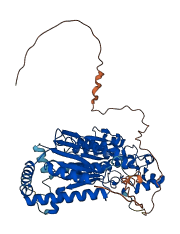
The autoinhibited protein was predicted that may have potential autoinhibitory elements via cis-regPred.
Autoinhibitory domains (AIDs)
Target domain |
|
Relief mechanism |
|
Assay |
cis-regPred |
Accessory elements
No accessory elements
Autoinhibited structure

Activated structure
1 structures for P70265
| Entry ID | Method | Resolution | Chain | Position | Source |
|---|---|---|---|---|---|
| AF-P70265-F1 | Predicted | AlphaFoldDB |
No variants for P70265
| Variant ID(s) | Position | Change | Description | Diseaes Association | Provenance |
|---|---|---|---|---|---|
| No variants for P70265 | |||||
No associated diseases with P70265
Functions
| Description | ||
|---|---|---|
| EC Number | 2.7.1.105 | Phosphotransferases with an alcohol group as acceptor |
| Subcellular Localization |
|
|
| PANTHER Family | ||
| PANTHER Subfamily | ||
| PANTHER Protein Class | ||
| PANTHER Pathway Category | No pathway information available | |
3 GO annotations of cellular component
| Name | Definition |
|---|---|
| cytoplasm | The contents of a cell excluding the plasma membrane and nucleus, but including other subcellular structures. |
| cytosol | The part of the cytoplasm that does not contain organelles but which does contain other particulate matter, such as protein complexes. |
| nucleoplasm | That part of the nuclear content other than the chromosomes or the nucleolus. |
5 GO annotations of molecular function
| Name | Definition |
|---|---|
| 6-phosphofructo-2-kinase activity | Catalysis of the reaction: beta-D-fructose 6-phosphate + ATP = beta-D-fructose 2,6-bisphosphate + ADP + 2 H(+). |
| ATP binding | Binding to ATP, adenosine 5'-triphosphate, a universally important coenzyme and enzyme regulator. |
| fructose-2,6-bisphosphate 2-phosphatase activity | Catalysis of the reaction: D-fructose 2,6-bisphosphate + H2O = D-fructose-6-phosphate + phosphate. |
| kinase binding | Binding to a kinase, any enzyme that catalyzes the transfer of a phosphate group. |
| protein kinase binding | Binding to a protein kinase, any enzyme that catalyzes the transfer of a phosphate group, usually from ATP, to a protein substrate. |
9 GO annotations of biological process
| Name | Definition |
|---|---|
| fructose 2,6-bisphosphate metabolic process | The chemical reactions and pathways involving fructose 2,6-bisphosphate. The D enantiomer is an important regulator of the glycolytic and gluconeogenic pathways. It inhibits fructose 1,6-bisphosphatase and activates phosphofructokinase. |
| fructose metabolic process | The chemical reactions and pathways involving fructose, the ketohexose arabino-2-hexulose. Fructose exists in a open chain form or as a ring compound. D-fructose is the sweetest of the sugars and is found free in a large number of fruits and honey. |
| glucose catabolic process | The chemical reactions and pathways resulting in the breakdown of glucose, the aldohexose gluco-hexose. |
| glycolytic process | The chemical reactions and pathways resulting in the breakdown of a carbohydrate into pyruvate, with the concomitant production of a small amount of ATP and the reduction of NAD(P) to NAD(P)H. Glycolysis begins with the metabolism of a carbohydrate to generate products that can enter the pathway and ends with the production of pyruvate. Pyruvate may be converted to acetyl-coenzyme A, ethanol, lactate, or other small molecules. |
| lactate metabolic process | The chemical reactions and pathways involving lactate, the anion of lactic acid. |
| positive regulation of glucokinase activity | Any process that activates or increases the frequency, rate or extent of glucokinase activity, the catalysis of the transfer of a phosphate group, usually from ATP, to a glucose molecule. |
| positive regulation of insulin secretion | Any process that activates or increases the frequency, rate or extent of the regulated release of insulin. |
| pyruvate metabolic process | The chemical reactions and pathways involving pyruvate, 2-oxopropanoate. |
| response to glucose | Any process that results in a change in state or activity of a cell or an organism (in terms of movement, secretion, enzyme production, gene expression, etc.) as a result of a glucose stimulus. |
13 homologous proteins in AiPD
| UniProt AC | Gene Name | Protein Name | Species | Evidence Code |
|---|---|---|---|---|
| P32604 | FBP26 | Fructose-2,6-bisphosphatase | Saccharomyces cerevisiae (strain ATCC 204508 / S288c) (Baker's yeast) | PR |
| P49872 | PFKFB1 | 6-phosphofructo-2-kinase/fructose-2,6-bisphosphatase 1 | Bos taurus (Bovine) | PR |
| P26285 | PFKFB2 | 6-phosphofructo-2-kinase/fructose-2,6-bisphosphatase 2 | Bos taurus (Bovine) | PR |
| Q16877 | PFKFB4 | 6-phosphofructo-2-kinase/fructose-2,6-bisphosphatase 4 | Homo sapiens (Human) | PR |
| P16118 | PFKFB1 | 6-phosphofructo-2-kinase/fructose-2,6-bisphosphatase 1 | Homo sapiens (Human) | PR |
| Q16875 | PFKFB3 | 6-phosphofructo-2-kinase/fructose-2,6-bisphosphatase 3 | Homo sapiens (Human) | PR |
| O60825 | PFKFB2 | 6-phosphofructo-2-kinase/fructose-2,6-bisphosphatase 2 | Homo sapiens (Human) | PR |
| P70266 | Pfkfb1 | 6-phosphofructo-2-kinase/fructose-2,6-bisphosphatase 1 | Mus musculus (Mouse) | PR |
| Q6DTY7 | Pfkfb4 | 6-phosphofructo-2-kinase/fructose-2,6-bisphosphatase 4 | Mus musculus (Mouse) | PR |
| P25114 | Pfkfb4 | 6-phosphofructo-2-kinase/fructose-2,6-bisphosphatase 4 | Rattus norvegicus (Rat) | PR |
| P07953 | Pfkfb1 | 6-phosphofructo-2-kinase/fructose-2,6-bisphosphatase 1 | Rattus norvegicus (Rat) | PR |
| O35552 | Pfkfb3 | 6-phosphofructo-2-kinase/fructose-2,6-bisphosphatase 3 | Rattus norvegicus (Rat) | PR |
| Q9JJH5 | Pfkfb2 | 6-phosphofructo-2-kinase/fructose-2,6-bisphosphatase 2 | Rattus norvegicus (Rat) | PR |
| 10 | 20 | 30 | 40 | 50 | 60 |
| MSENSTFSTE | DSCNSSYKPH | ASNLRRAGKT | CSWASYMTNS | PTLIVMIGLP | ARGKTYVSKK |
| 70 | 80 | 90 | 100 | 110 | 120 |
| LTRYLNWIGV | PTKVFNLGVY | RREAVKSYQS | YDFFRHDNEE | AMKIRKQCAL | VALEDVKAYF |
| 130 | 140 | 150 | 160 | 170 | 180 |
| TEESGQIAVF | DATNTTRERR | DMILNFAKQN | AFKVFFVESV | CDDPDVIAAN | ILEVKVSSPD |
| 190 | 200 | 210 | 220 | 230 | 240 |
| YPERNRENVM | EDFLKRIECY | KVTYQPLDPD | NYDKDLSFIK | VMNVGQRFLV | NRVQDYIQSK |
| 250 | 260 | 270 | 280 | 290 | 300 |
| IVYYLMNIHV | HPRTIYLCRH | GESEFNLLGK | IGGDSGLSVR | GKQFAHALKK | FLEEQEIQDL |
| 310 | 320 | 330 | 340 | 350 | 360 |
| KVWTSQLKRT | IQTAESLGVT | YEQWKILNEI | DAGVCEEMTY | SEIEQRYPEE | FALRDQEKYL |
| 370 | 380 | 390 | 400 | 410 | 420 |
| YRYPGGESYQ | DLVQRLEPVI | MELERQGNIL | VISHQAVMRC | LLAYFLDKGA | DELPYLRCPL |
| 430 | 440 | 450 | 460 | 470 | 480 |
| HIIFKLTPVA | YGCKVETITL | NVDAVDTHRD | KPTHNFPKSQ | TPVRMRRNSF | TPLSSSNTIR |
| 490 | 500 | 510 | |||
| RPRNYSVGSR | PLKPLSPLRA | LDMQEGADQP | KTQVSIPVV |