P48410
Gene name |
Abcd1 |
Protein name |
ATP-binding cassette sub-family D member 1 |
Names |
Adrenoleukodystrophy protein, ALDP |
Species |
Mus musculus (Mouse) |
KEGG Pathway |
mmu:11666 |
EC number |
|
Protein Class |
|
Descriptions
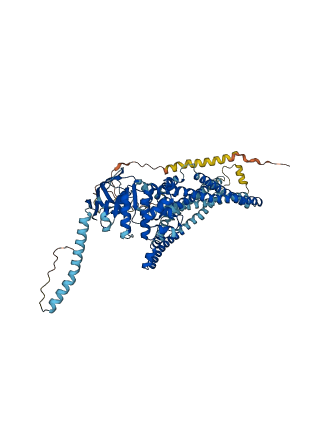
The autoinhibited protein was predicted that may have potential autoinhibitory elements via cis-regPred.
Autoinhibitory domains (AIDs)
Target domain |
|
Relief mechanism |
|
Assay |
cis-regPred |
Accessory elements
No accessory elements
Autoinhibited structure

Activated structure
1 structures for P48410
| Entry ID | Method | Resolution | Chain | Position | Source |
|---|---|---|---|---|---|
| AF-P48410-F1 | Predicted | AlphaFoldDB |
44 variants for P48410
| Variant ID(s) | Position | Change | Description | Diseaes Association | Provenance |
|---|---|---|---|---|---|
| rs3389519694 | 7 | P>S | No | EVA | |
| rs245820283 | 17 | R>G | No | EVA | |
| rs3389512121 | 21 | V>I | No | EVA | |
| rs3166627 | 26 | A>S | No | EVA | |
| rs3389567560 | 40 | L>R | No | EVA | |
| rs3389519639 | 55 | Q>H | No | EVA | |
| rs3389556357 | 57 | A>G | No | EVA | |
| rs3389471596 | 58 | S>Y | No | EVA | |
| rs3389575678 | 61 | T>I | No | EVA | |
| rs3389512139 | 67 | M>I | No | EVA | |
| rs3389575720 | 79 | L>M | No | EVA | |
| rs3389471568 | 81 | L>V | No | EVA | |
| rs3389557147 | 85 | R>L | No | EVA | |
| rs3389567524 | 123 | V>E | No | EVA | |
| rs214358757 | 147 | I>V | No | EVA | |
| rs3389564151 | 167 | V>E | No | EVA | |
| rs3389564105 | 205 | A>V | No | EVA | |
| rs3389579745 | 207 | S>Y | No | EVA | |
| rs3389543273 | 219 | L>I | No | EVA | |
| rs3410821555 | 220 | L>M | No | EVA | |
| rs3389543334 | 284 | S>Y | No | EVA | |
| rs3389543268 | 340 | S>C | No | EVA | |
| rs3389564122 | 355 | T>P | No | EVA | |
| rs29037768 | 371 | E>G | No | EVA | |
| rs3389543324 | 396 | A>E | No | EVA | |
| rs3410717153 | 416 | T>LAV* | No | EVA | |
| rs3389519708 | 422 | M>I | No | EVA | |
| rs3409407064 | 446 | G>E | No | EVA | |
| rs3389556424 | 455 | V>A | No | EVA | |
| rs3389556501 | 479 | I>F | No | EVA | |
| rs3389567593 | 496 | R>G | No | EVA | |
| rs3389543305 | 545 | R>M | No | EVA | |
| rs3410788129 | 548 | M>I | No | EVA | |
| rs3410788125 | 599 | C>S | No | EVA | |
| rs3410296788 | 627 | L>P | No | EVA | |
| rs3410674581 | 628 | L>P | No | EVA | |
| rs3411038270 | 629 | D>N | No | EVA | |
| rs3410788132 | 657 | I>T | No | EVA | |
| rs3389567534 | 669 | H>Q | No | EVA | |
| rs3389567526 | 693 | T>I | No | EVA | |
| rs3389579816 | 714 | Q>H | No | EVA | |
| rs8248912 | 727 | V>L | No | EVA | |
| rs8248913 | 733 | G>E | No | EVA | |
| rs8248915 | 734 | V>I | No | EVA |
No associated diseases with P48410
4 regional properties for P48410
Functions
9 GO annotations of cellular component
| Name | Definition |
|---|---|
| cytoplasm | The contents of a cell excluding the plasma membrane and nucleus, but including other subcellular structures. |
| endoplasmic reticulum membrane | The lipid bilayer surrounding the endoplasmic reticulum. |
| integral component of peroxisomal membrane | The component of the peroxisomal membrane consisting of the gene products and protein complexes having at least some part of their peptide sequence embedded in the hydrophobic region of the membrane. |
| lysosomal membrane | The lipid bilayer surrounding the lysosome and separating its contents from the cell cytoplasm. |
| mitochondrial membrane | Either of the lipid bilayers that surround the mitochondrion and form the mitochondrial envelope. |
| mitochondrion | A semiautonomous, self replicating organelle that occurs in varying numbers, shapes, and sizes in the cytoplasm of virtually all eukaryotic cells. It is notably the site of tissue respiration. |
| perinuclear region of cytoplasm | Cytoplasm situated near, or occurring around, the nucleus. |
| peroxisomal membrane | The lipid bilayer surrounding a peroxisome. |
| peroxisome | A small organelle enclosed by a single membrane, and found in most eukaryotic cells. Contains peroxidases and other enzymes involved in a variety of metabolic processes including free radical detoxification, lipid catabolism and biosynthesis, and hydrogen peroxide metabolism. |
11 GO annotations of molecular function
| Name | Definition |
|---|---|
| ABC-type fatty-acyl-CoA transporter activity | Catalysis of the reaction ATP + H(2)O + fatty acyl CoA(Side 1) <=> ADP + phosphate + fatty acyl CoA(Side 2). A fatty acyl CoA group is any acyl group derived from a fatty acid with a coenzyme A group attached to it. |
| acyl-CoA hydrolase activity | Catalysis of the reaction: acyl-CoA + H2O = CoA + a carboxylate. |
| ADP binding | Binding to ADP, adenosine 5'-diphosphate. |
| ATP binding | Binding to ATP, adenosine 5'-triphosphate, a universally important coenzyme and enzyme regulator. |
| ATP hydrolysis activity | Catalysis of the reaction: ATP + H2O = ADP + H+ phosphate. ATP hydrolysis is used in some reactions as an energy source, for example to catalyze a reaction or drive transport against a concentration gradient. |
| ATPase-coupled transmembrane transporter activity | Primary active transporter of a solute across a membrane, via the reaction: ATP + H2O = ADP + phosphate, to directly drive the transport of a substance across a membrane. The transport protein may be transiently phosphorylated (P-type transporters), or not (ABC-type transporters and other families of transporters). Primary active transport occurs up the solute's concentration gradient and is driven by a primary energy source. |
| enzyme binding | Binding to an enzyme, a protein with catalytic activity. |
| identical protein binding | Binding to an identical protein or proteins. |
| long-chain fatty acid transporter activity | Enables the transfer of long-chain fatty acids from one side of a membrane to the other. A long-chain fatty acid is a fatty acid with a chain length between C13 and C22. |
| protein heterodimerization activity | Binding to a nonidentical protein to form a heterodimer. |
| protein homodimerization activity | Binding to an identical protein to form a homodimer. |
20 GO annotations of biological process
| Name | Definition |
|---|---|
| fatty acid beta-oxidation | A fatty acid oxidation process that results in the complete oxidation of a long-chain fatty acid. Fatty acid beta-oxidation begins with the addition of coenzyme A to a fatty acid, and occurs by successive cycles of reactions during each of which the fatty acid is shortened by a two-carbon fragment removed as acetyl coenzyme A; the cycle continues until only two or three carbons remain (as acetyl-CoA or propionyl-CoA respectively). |
| fatty acid elongation | The elongation of a fatty acid chain by the sequential addition of two-carbon units. |
| fatty acid homeostasis | Any process involved in the maintenance of an internal steady state of fatty acid within an organism or cell. |
| long-chain fatty acid catabolic process | The chemical reactions and pathways resulting in the breakdown of long-chain fatty acids, a fatty acid with a chain length between C13 and C22. |
| long-chain fatty acid import into peroxisome | The directed movement of long-chain fatty acids into a peroxisome. A long-chain fatty acid is a fatty acid with a chain length between C13 and C22. |
| myelin maintenance | The process of preserving the structure and function of mature myelin. This includes maintaining the compact structure of myelin necessary for its electrical insulating characteristics as well as the structure of non-compact regions such as Schmidt-Lantermann clefts and paranodal loops. This does not include processes responsible for maintaining the nodes of Ranvier, which are not part of the myelin sheath. |
| negative regulation of cytokine production involved in inflammatory response | Any process that stops, prevents or reduces the frequency, rate or extent of cytokine production involved in inflammatory response. |
| negative regulation of reactive oxygen species biosynthetic process | Any process that stops, prevents or reduces the frequency, rate or extent of reactive oxygen species biosynthetic process. |
| neuron projection maintenance | The organization process that preserves a neuron projection in a stable functional or structural state. A neuron projection is a prolongation or process extending from a nerve cell, e.g. an axon or dendrite. |
| peroxisome organization | A process that is carried out at the cellular level which results in the assembly, arrangement of constituent parts, or disassembly of a peroxisome. A peroxisome is a small, membrane-bounded organelle that uses dioxygen (O2) to oxidize organic molecules. |
| positive regulation of fatty acid beta-oxidation | Any process that activates or increases the frequency, rate or extent of fatty acid beta-oxidation. |
| positive regulation of unsaturated fatty acid biosynthetic process | Any process that activates or increases the frequency, rate or extent of unsaturated fatty acid biosynthetic process. |
| regulation of cellular response to oxidative stress | Any process that modulates the frequency, rate or extent of cellular response to oxidative stress. |
| regulation of fatty acid beta-oxidation | Any process that modulates the frequency, rate or extent of fatty acid bbeta-oxidation. |
| regulation of mitochondrial depolarization | Any process that modulates the frequency, rate or extent of the change in the membrane potential of the mitochondria from negative to positive. |
| regulation of oxidative phosphorylation | Any process that modulates the frequency, rate or extent of the chemical reactions and pathways resulting in the phosphorylation of ADP to ATP that accompanies the oxidation of a metabolite through the operation of the respiratory chain. Oxidation of compounds establishes a proton gradient across the membrane, providing the energy for ATP synthesis. |
| sterol homeostasis | Any process involved in the maintenance of an internal steady state of sterol within an organism or cell. |
| very long-chain fatty acid catabolic process | The chemical reactions and pathways resulting in the breakdown of a fatty acid which has a chain length greater than C22. |
| very long-chain fatty acid metabolic process | The chemical reactions and pathways involving a fatty acid which has a chain length greater than C22. |
| very long-chain fatty-acyl-CoA catabolic process | The chemical reactions and pathways resulting in the breakdown of very long-chain fatty-acyl-CoAs, any derivative of coenzyme A in which the sulfhydryl group is in a thioester linkage with a medium-chain fatty-acyl group. A very long-chain fatty acid is a fatty acid which has a chain length greater than C22. |
11 homologous proteins in AiPD
| UniProt AC | Gene Name | Protein Name | Species | Evidence Code |
|---|---|---|---|---|
| P34230 | PXA2 | Peroxisomal long-chain fatty acid import protein 1 | Saccharomyces cerevisiae (strain ATCC 204508 / S288c) (Baker's yeast) | PR |
| P31826 | yddA | Inner membrane ABC transporter ATP-binding protein YddA | Escherichia coli (strain K12) | PR |
| P28288 | ABCD3 | ATP-binding cassette sub-family D member 3 | Homo sapiens (Human) | PR |
| P33897 | ABCD1 | ATP-binding cassette sub-family D member 1 | Homo sapiens (Human) | PR |
| Q9UBJ2 | ABCD2 | ATP-binding cassette sub-family D member 2 | Homo sapiens (Human) | PR |
| O14678 | ABCD4 | Lysosomal cobalamin transporter ABCD4 | Homo sapiens (Human) | PR |
| O89016 | Abcd4 | Lysosomal cobalamin transporter ABCD4 | Mus musculus (Mouse) | PR |
| P55096 | Abcd3 | ATP-binding cassette sub-family D member 3 | Mus musculus (Mouse) | PR |
| Q61285 | Abcd2 | ATP-binding cassette sub-family D member 2 | Mus musculus (Mouse) | PR |
| Q9QY44 | Abcd2 | ATP-binding cassette sub-family D member 2 | Rattus norvegicus (Rat) | PR |
| P16970 | Abcd3 | ATP-binding cassette sub-family D member 3 | Rattus norvegicus (Rat) | PR |
| 10 | 20 | 30 | 40 | 50 | 60 |
| MPVLSTPRPS | RVTTLKRTAV | VLALTAYGVH | KIYPLVRQCL | TPARGPQVPA | GEPTQEASGA |
| 70 | 80 | 90 | 100 | 110 | 120 |
| TATKAGMNRV | FLQRLLALLR | LLFPRVLCRE | TGLLALHSAA | LVSRTFLSVY | VARLDGRLAR |
| 130 | 140 | 150 | 160 | 170 | 180 |
| CIVRKDPRAF | SWQLLQWLLI | ALPATFINSA | IRYLEGQLAL | SFRSRLVAHA | YGLYFSQQTY |
| 190 | 200 | 210 | 220 | 230 | 240 |
| YRVSNMDGRL | RNPDQSLTED | VVAFAASVAH | LYSNLTKPLL | DVAVTSYTLL | RAARSRGAGT |
| 250 | 260 | 270 | 280 | 290 | 300 |
| AWPSAIAGLV | VFLTANVLRA | FSPKFGELVA | EEARRKGELR | YMHSRVVANS | EEIAFYGGHE |
| 310 | 320 | 330 | 340 | 350 | 360 |
| VELALLQHSY | QDLASQINLI | LLERLWYVML | EQFLMKYVWS | ASGLLMVAVP | IITATGYAES |
| 370 | 380 | 390 | 400 | 410 | 420 |
| DSEAMKKAAL | EMKEEELVSE | RTEAFTIARN | LLTAAADATE | RIMSSYKEVT | ELAGYTARVY |
| 430 | 440 | 450 | 460 | 470 | 480 |
| EMFQVFEDVK | HCRFKRTGDL | EEAQAGPGVM | VQSGVHVEGP | LKIQGQVVDV | EQGIICENIP |
| 490 | 500 | 510 | 520 | 530 | 540 |
| IITPTGEVVV | ASLNIRVEEG | MHLLITGPNG | CGKSSLFRIL | GGLWPTYSGV | LYKPPPQRMF |
| 550 | 560 | 570 | 580 | 590 | 600 |
| YIPQRPYMSV | GSLRDQVIYP | DSAEDMRRKG | CSEQQLEAIL | GIVHLRHILQ | REGGWEAVCD |
| 610 | 620 | 630 | 640 | 650 | 660 |
| WKDVLSGGEK | QRIGMARMFY | HRPKYALLDE | CTSAVSIDVE | GKIFQAAKDA | GIALLSITHR |
| 670 | 680 | 690 | 700 | 710 | 720 |
| PSLWKYHTHL | LQFDGEGGWK | FEKLDSAARL | SLTEEKQRLE | QQLAGIPKMQ | GRLQELRQIL |
| 730 | |||||
| GEAAAPVQPL | VPGVPT |