P55096
Gene name |
Abcd3 (Pmp70, Pxmp1) |
Protein name |
ATP-binding cassette sub-family D member 3 |
Names |
68 kDa peroxisomal membrane protein, PMP68, 70 kDa peroxisomal membrane protein, PMP70 |
Species |
Mus musculus (Mouse) |
KEGG Pathway |
mmu:19299 |
EC number |
|
Protein Class |
|
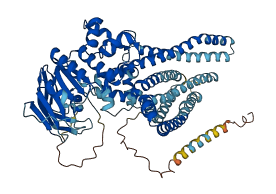
Descriptions
The autoinhibited protein was predicted that may have potential autoinhibitory elements via cis-regPred.
Autoinhibitory domains (AIDs)
Target domain |
|
Relief mechanism |
|
Assay |
cis-regPred |
Accessory elements
No accessory elements
Autoinhibited structure

Activated structure
1 structures for P55096
| Entry ID | Method | Resolution | Chain | Position | Source |
|---|---|---|---|---|---|
| AF-P55096-F1 | Predicted | AlphaFoldDB |
29 variants for P55096
| Variant ID(s) | Position | Change | Description | Diseaes Association | Provenance |
|---|---|---|---|---|---|
| rs3388661871 | 42 | K>I | No | EVA | |
| rs3388654319 | 53 | K>* | No | EVA | |
| rs3388650205 | 56 | R>E* | No | EVA | |
| rs3388662450 | 59 | V>G | No | EVA | |
| rs3388642274 | 63 | F>L | No | EVA | |
| rs3388658305 | 213 | D>Y | No | EVA | |
| rs3388657278 | 223 | S>G | No | EVA | |
| rs3388657264 | 227 | A>S | No | EVA | |
| rs3388660777 | 237 | L>* | No | EVA | |
| rs3388656142 | 265 | Y>* | No | EVA | |
| rs3388649656 | 267 | Y>* | No | EVA | |
| rs3393571458 | 267 | Y>* | No | EVA | |
| rs3388654298 | 367 | M>K | No | EVA | |
| rs3388655743 | 373 | R>H | No | EVA | |
| rs3388658896 | 386 | G>S | No | EVA | |
| rs3388660809 | 439 | I>F | No | EVA | |
| rs3388665544 | 439 | I>N | No | EVA | |
| rs3393683565 | 451 | N>I | No | EVA | |
| rs3393583584 | 451 | N>Y | No | EVA | |
| rs3388660778 | 529 | K>* | No | EVA | |
| rs30269732 | 537 | I>V | No | EVA | |
| rs3388660807 | 550 | Q>E | No | EVA | |
| rs3393147605 | 552 | G>S | No | EVA | |
| rs3388665609 | 561 | W>C | No | EVA | |
| rs3388657351 | 579 | M>T | No | EVA | |
| rs3388642241 | 588 | K>R | No | EVA | |
| rs3388665538 | 610 | Y>* | No | EVA | |
| rs3393571461 | 628 | S>A | No | EVA | |
| rs3393364305 | 628 | S>C | No | EVA |
No associated diseases with P55096
4 regional properties for P55096
7 GO annotations of cellular component
| Name | Definition |
|---|---|
| integral component of membrane | The component of a membrane consisting of the gene products and protein complexes having at least some part of their peptide sequence embedded in the hydrophobic region of the membrane. |
| intracellular membrane-bounded organelle | Organized structure of distinctive morphology and function, bounded by a single or double lipid bilayer membrane and occurring within the cell. Includes the nucleus, mitochondria, plastids, vacuoles, and vesicles. Excludes the plasma membrane. |
| mitochondrial inner membrane | The inner, i.e. lumen-facing, lipid bilayer of the mitochondrial envelope. It is highly folded to form cristae. |
| mitochondrion | A semiautonomous, self replicating organelle that occurs in varying numbers, shapes, and sizes in the cytoplasm of virtually all eukaryotic cells. It is notably the site of tissue respiration. |
| peroxisomal matrix | The volume contained within the membranes of a peroxisome; in many cells the matrix contains a crystalloid core largely composed of urate oxidase. |
| peroxisomal membrane | The lipid bilayer surrounding a peroxisome. |
| peroxisome | A small organelle enclosed by a single membrane, and found in most eukaryotic cells. Contains peroxidases and other enzymes involved in a variety of metabolic processes including free radical detoxification, lipid catabolism and biosynthesis, and hydrogen peroxide metabolism. |
8 GO annotations of molecular function
| Name | Definition |
|---|---|
| ABC-type transporter activity | Primary active transporter characterized by two nucleotide-binding domains and two transmembrane domains. Uses the energy generated from ATP hydrolysis to drive the transport of a substance across a membrane. |
| acyl-CoA hydrolase activity | Catalysis of the reaction: acyl-CoA + H2O = CoA + a carboxylate. |
| ATP binding | Binding to ATP, adenosine 5'-triphosphate, a universally important coenzyme and enzyme regulator. |
| ATP hydrolysis activity | Catalysis of the reaction: ATP + H2O = ADP + H+ phosphate. ATP hydrolysis is used in some reactions as an energy source, for example to catalyze a reaction or drive transport against a concentration gradient. |
| ATPase-coupled transmembrane transporter activity | Primary active transporter of a solute across a membrane, via the reaction: ATP + H2O = ADP + phosphate, to directly drive the transport of a substance across a membrane. The transport protein may be transiently phosphorylated (P-type transporters), or not (ABC-type transporters and other families of transporters). Primary active transport occurs up the solute's concentration gradient and is driven by a primary energy source. |
| long-chain fatty acid transporter activity | Enables the transfer of long-chain fatty acids from one side of a membrane to the other. A long-chain fatty acid is a fatty acid with a chain length between C13 and C22. |
| protein homodimerization activity | Binding to an identical protein to form a homodimer. |
| protein self-association | Binding to a domain within the same polypeptide. |
12 GO annotations of biological process
| Name | Definition |
|---|---|
| bile acid and bile salt transport | The directed movement of bile acid and bile salts into, out of or within a cell, or between cells, by means of some agent such as a transporter or pore. |
| bile acid biosynthetic process | The chemical reactions and pathways resulting in the formation of bile acids, any of a group of steroid carboxylic acids occurring in bile. |
| fatty acid beta-oxidation | A fatty acid oxidation process that results in the complete oxidation of a long-chain fatty acid. Fatty acid beta-oxidation begins with the addition of coenzyme A to a fatty acid, and occurs by successive cycles of reactions during each of which the fatty acid is shortened by a two-carbon fragment removed as acetyl coenzyme A; the cycle continues until only two or three carbons remain (as acetyl-CoA or propionyl-CoA respectively). |
| fatty acid biosynthetic process | The chemical reactions and pathways resulting in the formation of a fatty acid, any of the aliphatic monocarboxylic acids that can be liberated by hydrolysis from naturally occurring fats and oils. Fatty acids are predominantly straight-chain acids of 4 to 24 carbon atoms, which may be saturated or unsaturated; branched fatty acids and hydroxy fatty acids also occur, and very long chain acids of over 30 carbons are found in waxes. |
| lipid transport | The directed movement of lipids into, out of or within a cell, or between cells, by means of some agent such as a transporter or pore. Lipids are compounds soluble in an organic solvent but not, or sparingly, in an aqueous solvent. |
| long-chain fatty acid import into peroxisome | The directed movement of long-chain fatty acids into a peroxisome. A long-chain fatty acid is a fatty acid with a chain length between C13 and C22. |
| peroxisome organization | A process that is carried out at the cellular level which results in the assembly, arrangement of constituent parts, or disassembly of a peroxisome. A peroxisome is a small, membrane-bounded organelle that uses dioxygen (O2) to oxidize organic molecules. |
| phytanic acid metabolic process | The chemical reactions and pathways involving phytanic acid. |
| response to organic cyclic compound | Any process that results in a change in state or activity of a cell or an organism (in terms of movement, secretion, enzyme production, gene expression, etc.) as a result of an organic cyclic compound stimulus. |
| response to xenobiotic stimulus | Any process that results in a change in state or activity of a cell or an organism (in terms of movement, secretion, enzyme production, gene expression, etc.) as a result of a stimulus from a xenobiotic, a compound foreign to the organim exposed to it. It may be synthesized by another organism (like ampicilin) or it can be a synthetic chemical. |
| very long-chain fatty acid catabolic process | The chemical reactions and pathways resulting in the breakdown of a fatty acid which has a chain length greater than C22. |
| very long-chain fatty acid metabolic process | The chemical reactions and pathways involving a fatty acid which has a chain length greater than C22. |
9 homologous proteins in AiPD
| UniProt AC | Gene Name | Protein Name | Species | Evidence Code |
|---|---|---|---|---|
| P31826 | yddA | Inner membrane ABC transporter ATP-binding protein YddA | Escherichia coli (strain K12) | PR |
| O14678 | ABCD4 | Lysosomal cobalamin transporter ABCD4 | Homo sapiens (Human) | PR |
| P33897 | ABCD1 | ATP-binding cassette sub-family D member 1 | Homo sapiens (Human) | PR |
| Q9UBJ2 | ABCD2 | ATP-binding cassette sub-family D member 2 | Homo sapiens (Human) | PR |
| P28288 | ABCD3 | ATP-binding cassette sub-family D member 3 | Homo sapiens (Human) | PR |
| O89016 | Abcd4 | Lysosomal cobalamin transporter ABCD4 | Mus musculus (Mouse) | PR |
| P48410 | Abcd1 | ATP-binding cassette sub-family D member 1 | Mus musculus (Mouse) | PR |
| Q61285 | Abcd2 | ATP-binding cassette sub-family D member 2 | Mus musculus (Mouse) | PR |
| P16970 | Abcd3 | ATP-binding cassette sub-family D member 3 | Rattus norvegicus (Rat) | PR |
| 10 | 20 | 30 | 40 | 50 | 60 |
| MAAFSKYLTA | RNTSLAGAAF | LLLCLLHKRR | RALGLHGKKS | GKPPLQNNEK | EGKKERAVVD |
| 70 | 80 | 90 | 100 | 110 | 120 |
| KVFLSRLSQI | LKIMVPRTFC | KETGYLLLIA | VMLVSRTYCD | VWMIQNGTLI | ESGIIGRSSK |
| 130 | 140 | 150 | 160 | 170 | 180 |
| DFKRYLFNFI | AAMPLISLVN | NFLKYGLNEL | KLCFRVRLTR | YLYEEYLQAF | TYYKMGNLDN |
| 190 | 200 | 210 | 220 | 230 | 240 |
| RIANPDQLLT | QDVEKFCNSV | VDLYSNLSKP | FLDIVLYIFK | LTSAIGAQGP | ASMMAYLLVS |
| 250 | 260 | 270 | 280 | 290 | 300 |
| GLFLTRLRRP | IGKMTIMEQK | YEGEYRYVNS | RLITNSEEIA | FYNGNKREKQ | TIHSVFRKLV |
| 310 | 320 | 330 | 340 | 350 | 360 |
| EHLHNFIFFR | FSMGFIDSII | AKYVATVVGY | LVVSRPFLDL | AHPRHLHSTH | SELLEDYYQS |
| 370 | 380 | 390 | 400 | 410 | 420 |
| GRMLLRMSQA | LGRIVLAGRE | MTRLAGFTAR | ITELMQVLKD | LNHGRYERTM | VSQQEKGIEG |
| 430 | 440 | 450 | 460 | 470 | 480 |
| AQASPLVPGA | GEIINTDNII | KFDHVPLATP | NGDILIQDLS | FEVRSGANVL | ICGPNGCGKS |
| 490 | 500 | 510 | 520 | 530 | 540 |
| SLFRVLGELW | PLFGGRLTKP | ERGKLFYVPQ | RPYMTLGTLR | DQVIYPDGKE | DQKKRGISDQ |
| 550 | 560 | 570 | 580 | 590 | 600 |
| VLKEYLDNVQ | LGHILEREGG | WDSVQDWMDV | LSGGEKQRMA | MARLFYHKPQ | FAILDECTSA |
| 610 | 620 | 630 | 640 | 650 | |
| VSVDVEDYIY | SHCRKVGITL | FTVSHRKSLW | KHHEYYLHMD | GRGNYEFKKI | TEDTVEFGS |