P47962
Gene name |
Rpl5 |
Protein name |
60S ribosomal protein L5 |
Names |
|
Species |
Mus musculus (Mouse) |
KEGG Pathway |
mmu:100503670 |
EC number |
|
Protein Class |
|
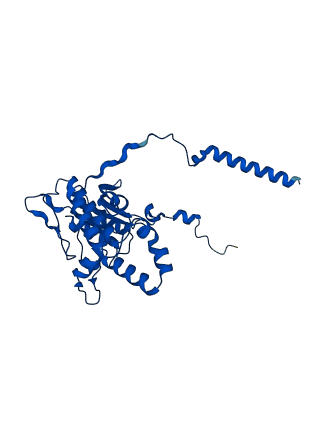
Descriptions
The autoinhibited protein was predicted that may have potential autoinhibitory elements via cis-regPred.
Autoinhibitory domains (AIDs)
Target domain |
|
Relief mechanism |
|
Assay |
cis-regPred |
Accessory elements
No accessory elements

7 variants for P47962
| Variant ID(s) | Position | Change | Description | Diseaes Association | Provenance |
|---|---|---|---|---|---|
| rs3388761734 | 15 | R>G | No | EVA | |
| rs3388769708 | 15 | R>S | No | EVA | |
| rs3388771715 | 110 | L>M | No | EVA | |
| rs3388748216 | 152 | R>L | No | EVA | |
| rs3388776632 | 235 | M>K | No | EVA | |
| rs3388780416 | 242 | K>T | No | EVA | |
| rs229212415 | 260 | E>D | No | EVA |
No associated diseases with P47962
1 regional properties for P47962
| Type | Name | Position | InterPro Accession |
|---|---|---|---|
| domain | Ribosomal protein L5 eukaryotic, C-terminal | 236 - 289 | IPR025607 |
Functions
13 GO annotations of cellular component
| Name | Definition |
|---|---|
| aminoacyl-tRNA synthetase multienzyme complex | A multienzyme complex found in all multicellular eukaryotes composed of eight proteins with aminoacyl-tRNA synthetase activities (abbreviated as: ArgRS, AspRS, GluProRS, GlnRS, IleRS, LeuRS, LysRS, MetRS where RS is the enzyme, preceded by the amino acid it uses as a substrate) as well as three non-synthetase proteins (p43, p38, and p18) with diverse functions. Several of these subunits are known dimers, so the total polypeptide count in the multisynthetase complex is at least fifteen. All of the enzymes in this assembly catalyze the same reaction, the covalent attachment of an amino acid to either the 2'- or 3'-hydroxyl of the 3'-terminal adenosine of tRNA, but using different substrates. |
| cytoplasm | The contents of a cell excluding the plasma membrane and nucleus, but including other subcellular structures. |
| cytosol | The part of the cytoplasm that does not contain organelles but which does contain other particulate matter, such as protein complexes. |
| cytosolic large ribosomal subunit | The large subunit of a ribosome located in the cytosol. |
| cytosolic ribosome | A ribosome located in the cytosol. |
| endoplasmic reticulum | The irregular network of unit membranes, visible only by electron microscopy, that occurs in the cytoplasm of many eukaryotic cells. The membranes form a complex meshwork of tubular channels, which are often expanded into slitlike cavities called cisternae. The ER takes two forms, rough (or granular), with ribosomes adhering to the outer surface, and smooth (with no ribosomes attached). |
| nucleolus | A small, dense body one or more of which are present in the nucleus of eukaryotic cells. It is rich in RNA and protein, is not bounded by a limiting membrane, and is not seen during mitosis. Its prime function is the transcription of the nucleolar DNA into 45S ribosomal-precursor RNA, the processing of this RNA into 5.8S, 18S, and 28S components of ribosomal RNA, and the association of these components with 5S RNA and proteins synthesized outside the nucleolus. This association results in the formation of ribonucleoprotein precursors; these pass into the cytoplasm and mature into the 40S and 60S subunits of the ribosome. |
| nucleoplasm | That part of the nuclear content other than the chromosomes or the nucleolus. |
| nucleus | A membrane-bounded organelle of eukaryotic cells in which chromosomes are housed and replicated. In most cells, the nucleus contains all of the cell's chromosomes except the organellar chromosomes, and is the site of RNA synthesis and processing. In some species, or in specialized cell types, RNA metabolism or DNA replication may be absent. |
| postsynaptic density | An electron dense network of proteins within and adjacent to the postsynaptic membrane of an asymmetric, neuron-neuron synapse. Its major components include neurotransmitter receptors and the proteins that spatially and functionally organize them such as anchoring and scaffolding molecules, signaling enzymes and cytoskeletal components. |
| protein-containing complex | A stable assembly of two or more macromolecules, i.e. proteins, nucleic acids, carbohydrates or lipids, in which at least one component is a protein and the constituent parts function together. |
| ribonucleoprotein complex | A macromolecular complex that contains both RNA and protein molecules. |
| synapse | The junction between an axon of one neuron and a dendrite of another neuron, a muscle fiber or a glial cell. As the axon approaches the synapse it enlarges into a specialized structure, the presynaptic terminal bouton, which contains mitochondria and synaptic vesicles. At the tip of the terminal bouton is the presynaptic membrane; facing it, and separated from it by a minute cleft (the synaptic cleft) is a specialized area of membrane on the receiving cell, known as the postsynaptic membrane. In response to the arrival of nerve impulses, the presynaptic terminal bouton secretes molecules of neurotransmitters into the synaptic cleft. These diffuse across the cleft and transmit the signal to the postsynaptic membrane. |
7 GO annotations of molecular function
| Name | Definition |
|---|---|
| 5S rRNA binding | Binding to a 5S ribosomal RNA, the smallest RNA constituent of a ribosome. |
| mRNA 3'-UTR binding | Binding to a 3' untranslated region of an mRNA molecule. |
| mRNA 5'-UTR binding | Binding to an mRNA molecule at its 5' untranslated region. |
| mRNA binding | Binding to messenger RNA (mRNA), an intermediate molecule between DNA and protein. mRNA includes UTR and coding sequences, but does not contain introns. |
| structural constituent of ribosome | The action of a molecule that contributes to the structural integrity of the ribosome. |
| ubiquitin ligase inhibitor activity | Binds to and stops, prevents or reduces the activity of a ubiquitin ligase. |
| ubiquitin protein ligase binding | Binding to a ubiquitin protein ligase enzyme, any of the E3 proteins. |
15 GO annotations of biological process
| Name | Definition |
|---|---|
| cytoplasmic translation | The chemical reactions and pathways resulting in the formation of a protein in the cytoplasm. This is a ribosome-mediated process in which the information in messenger RNA (mRNA) is used to specify the sequence of amino acids in the protein. |
| negative regulation of protein neddylation | Any process that stops, prevents or reduces the frequency, rate or extent of protein neddylation. |
| negative regulation of ubiquitin protein ligase activity | Any process that stops, prevents or reduces the frequency, rate or extent of ubiquitin protein ligase activity. |
| negative regulation of ubiquitin-dependent protein catabolic process | Any process that stops, prevents, or reduces the frequency, rate or extent of ubiquitin-dependent protein catabolic process. |
| positive regulation of gene expression | Any process that increases the frequency, rate or extent of gene expression. Gene expression is the process in which a gene's coding sequence is converted into a mature gene product (protein or RNA). |
| positive regulation of isoleucine-tRNA ligase activity | Any process that activates or increases the frequency, rate or extent of isoleucine-tRNA ligase activity. |
| positive regulation of methionine-tRNA ligase activity | Any process that activates or increases the frequency, rate or extent of methionine-tRNA ligase activity. |
| positive regulation of phosphatase activity | Any process that increases the rate or frequency of phosphatase activity. Phosphatases catalyze the hydrolysis of phosphoric monoesters, releasing inorganic phosphate. |
| positive regulation of threonine-tRNA ligase activity | Any process that activates or increases the frequency, rate or extent of threonine-tRNA ligase activity. |
| positive regulation of translation | Any process that activates or increases the frequency, rate or extent of the chemical reactions and pathways resulting in the formation of proteins by the translation of mRNA or circRNA. |
| protein stabilization | Any process involved in maintaining the structure and integrity of a protein and preventing it from degradation or aggregation. |
| regulation of signal transduction by p53 class mediator | Any process that modulates the frequency, rate or extent of signal transduction by p53 class mediator. |
| ribosomal large subunit assembly | The aggregation, arrangement and bonding together of constituent RNAs and proteins to form the large ribosomal subunit. |
| ribosomal large subunit biogenesis | A cellular process that results in the biosynthesis of constituent macromolecules, assembly, and arrangement of constituent parts of a large ribosomal subunit; includes transport to the sites of protein synthesis. |
| rRNA processing | Any process involved in the conversion of a primary ribosomal RNA (rRNA) transcript into one or more mature rRNA molecules. |
6 homologous proteins in AiPD
| UniProt AC | Gene Name | Protein Name | Species | Evidence Code |
|---|---|---|---|---|
| Q58DW5 | RPL5 | 60S ribosomal protein L5 | Bos taurus (Bovine) | PR |
| P22451 | RPL5 | 60S ribosomal protein L5 | Gallus gallus (Chicken) | PR |
| P46777 | RPL5 | 60S ribosomal protein L5 | Homo sapiens (Human) | PR |
| P09895 | Rpl5 | 60S ribosomal protein L5 | Rattus norvegicus (Rat) | PR |
| P49405 | rpl-5 | 60S ribosomal protein L5 | Caenorhabditis elegans | PR |
| O76190 | RpL5 | 60S ribosomal protein L5 | Bombyx mori (Silk moth) | PR |
| 10 | 20 | 30 | 40 | 50 | 60 |
| MGFVKVVKNK | AYFKRYQVRF | RRRREGKTDY | YARKRLVIQD | KNKYNTPKYR | MIVRVTNRDI |
| 70 | 80 | 90 | 100 | 110 | 120 |
| ICQIAYARIE | GDMIVCAAYA | HELPKYGVKV | GLTNYAAAYC | TGLLLARRLL | NRFGMDKIYE |
| 130 | 140 | 150 | 160 | 170 | 180 |
| GQVEVNGGEY | NVESIDGQPG | AFTCYLDAGL | ARTTTGNKVF | GALKGAVDGG | LSIPHSTKRF |
| 190 | 200 | 210 | 220 | 230 | 240 |
| PGYDSESKEF | NAEVHRKHIM | GQNVADYMRY | LMEEDEDAYK | KQFSQYIKNN | VTPDMMEEMY |
| 250 | 260 | 270 | 280 | 290 | |
| KKAHAAIREN | PVYEKKPKRE | VKKKRWNRPK | MSLAQKKDRV | AQKKASFLRA | QERAAES |