P21775
Gene name |
Acaa1a |
Protein name |
3-ketoacyl-CoA thiolase A, peroxisomal |
Names |
Acetyl-CoA C-myristoyltransferase, Acetyl-CoA acyltransferase A, Beta-ketothiolase A, Peroxisomal 3-oxoacyl-CoA thiolase A, Thiolase A |
Species |
Rattus norvegicus (Rat) |
KEGG Pathway |
rno:24157 |
EC number |
2.3.1.9: Transferring groups other than amino-acyl groups |
Protein Class |
|
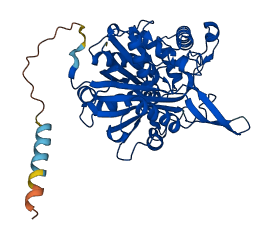
Descriptions
The autoinhibited protein was predicted that may have potential autoinhibitory elements via cis-regPred.
Autoinhibitory domains (AIDs)
Target domain |
|
Relief mechanism |
|
Assay |
cis-regPred |
Accessory elements
No accessory elements
Autoinhibited structure

Activated structure
1 structures for P21775
| Entry ID | Method | Resolution | Chain | Position | Source |
|---|---|---|---|---|---|
| AF-P21775-F1 | Predicted | AlphaFoldDB |
No variants for P21775
| Variant ID(s) | Position | Change | Description | Diseaes Association | Provenance |
|---|---|---|---|---|---|
| No variants for P21775 | |||||
No associated diseases with P21775
5 regional properties for P21775
| Type | Name | Position | InterPro Accession |
|---|---|---|---|
| active_site | Thiolase, active site | 413 - 426 | IPR020610 |
| conserved_site | Thiolase, conserved site | 377 - 393 | IPR020613 |
| active_site | Thiolase, acyl-enzyme intermediate active site | 129 - 147 | IPR020615 |
| domain | Thiolase, N-terminal | 48 - 301 | IPR020616 |
| domain | Thiolase, C-terminal | 310 - 430 | IPR020617 |
Functions
| Description | ||
|---|---|---|
| EC Number | 2.3.1.9 | Transferring groups other than amino-acyl groups |
| Subcellular Localization |
|
|
| PANTHER Family | ||
| PANTHER Subfamily | ||
| PANTHER Protein Class | ||
| PANTHER Pathway Category | No pathway information available | |
2 GO annotations of cellular component
| Name | Definition |
|---|---|
| cytosol | The part of the cytoplasm that does not contain organelles but which does contain other particulate matter, such as protein complexes. |
| peroxisome | A small organelle enclosed by a single membrane, and found in most eukaryotic cells. Contains peroxidases and other enzymes involved in a variety of metabolic processes including free radical detoxification, lipid catabolism and biosynthesis, and hydrogen peroxide metabolism. |
5 GO annotations of molecular function
| Name | Definition |
|---|---|
| acetate CoA-transferase activity | Catalysis of the reaction: acyl-CoA + acetate = a fatty acid anion + acetyl-CoA. |
| acetyl-CoA C-acetyltransferase activity | Catalysis of the reaction: 2 acetyl-CoA = CoA + acetoacetyl-CoA. |
| acetyl-CoA C-acyltransferase activity | Catalysis of the reaction: acyl-CoA + acetyl-CoA = CoA + 3-oxoacyl-CoA. |
| acetyl-CoA C-myristoyltransferase activity | Catalysis of the reaction: myristoyl-CoA + acetyl-CoA = 3-oxopalmitoyl-CoA + CoA. |
| palmitoyl-CoA oxidase activity | Catalysis of the reaction: palmitoyl-CoA + O2 = trans-2,3-dehydropalmitoyl-CoA + hydrogen peroxide. |
8 GO annotations of biological process
| Name | Definition |
|---|---|
| bile acid metabolic process | The chemical reactions and pathways involving bile acids, a group of steroid carboxylic acids occurring in bile, where they are present as the sodium salts of their amides with glycine or taurine. |
| fatty acid beta-oxidation | A fatty acid oxidation process that results in the complete oxidation of a long-chain fatty acid. Fatty acid beta-oxidation begins with the addition of coenzyme A to a fatty acid, and occurs by successive cycles of reactions during each of which the fatty acid is shortened by a two-carbon fragment removed as acetyl coenzyme A; the cycle continues until only two or three carbons remain (as acetyl-CoA or propionyl-CoA respectively). |
| fatty acid beta-oxidation using acyl-CoA oxidase | A fatty acid beta-oxidation pathway in which the initial step, which converts an acyl-CoA to a trans-2-enoyl-CoA, is catalyzed by acyl-CoA oxidase; the electrons removed by oxidation pass directly to oxygen and produce hydrogen peroxide, which is cleaved by peroxisomal catalases. Fatty acid beta-oxidation begins with the addition of coenzyme A to a fatty acid, and ends when only two or three carbons remain (as acetyl-CoA or propionyl-CoA respectively). |
| phenylacetate catabolic process | The chemical reactions and pathways resulting in the breakdown of phenylacetate. |
| response to nutrient | Any process that results in a change in state or activity of a cell or an organism (in terms of movement, secretion, enzyme production, gene expression, etc.) as a result of a nutrient stimulus. |
| response to steroid hormone | Any process that results in a change in state or activity of a cell or an organism (in terms of movement, secretion, enzyme production, gene expression, etc.) as a result of a steroid hormone stimulus. |
| response to xenobiotic stimulus | Any process that results in a change in state or activity of a cell or an organism (in terms of movement, secretion, enzyme production, gene expression, etc.) as a result of a stimulus from a xenobiotic, a compound foreign to the organim exposed to it. It may be synthesized by another organism (like ampicilin) or it can be a synthetic chemical. |
| very long-chain fatty acid metabolic process | The chemical reactions and pathways involving a fatty acid which has a chain length greater than C22. |
5 homologous proteins in AiPD
| UniProt AC | Gene Name | Protein Name | Species | Evidence Code |
|---|---|---|---|---|
| P27796 | POT1 | 3-ketoacyl-CoA thiolase, peroxisomal | Saccharomyces cerevisiae (strain ATCC 204508 / S288c) (Baker's yeast) | PR |
| P09110 | ACAA1 | 3-ketoacyl-CoA thiolase, peroxisomal | Homo sapiens (Human) | PR |
| Q8VCH0 | Acaa1b | 3-ketoacyl-CoA thiolase B, peroxisomal | Mus musculus (Mouse) | PR |
| Q921H8 | Acaa1a | 3-ketoacyl-CoA thiolase A, peroxisomal | Mus musculus (Mouse) | PR |
| P07871 | Acaa1b | 3-ketoacyl-CoA thiolase B, peroxisomal | Rattus norvegicus (Rat) | PR |
| 10 | 20 | 30 | 40 | 50 | 60 |
| MSESVGRTSA | MHRLQVVLGH | LAGRPESSSA | LQAAPCSATF | PQASASDVVV | VHGRRTPIGR |
| 70 | 80 | 90 | 100 | 110 | 120 |
| AGRGGFKDTT | PDELLSAVLT | AVLQDVKLKP | ECLGDISVGN | VLEPGAGAVM | ARIAQFLSGI |
| 130 | 140 | 150 | 160 | 170 | 180 |
| PETVPLSAVN | RQCSSGLQAV | ANIAGGIRNG | SYDIGMACGV | ESMSLSNRGN | PGNISSRLLE |
| 190 | 200 | 210 | 220 | 230 | 240 |
| SDKARDCLIP | MGITSENVAE | RFGISRQKQD | AFALASQQKA | ASAQSKGCFR | AEIVPVTTTV |
| 250 | 260 | 270 | 280 | 290 | 300 |
| LDDKGDRKTI | TVSQDEGVRP | STTMEGLAKL | KPAFKDGGST | TAGNSSQVSD | GAAAVLLARR |
| 310 | 320 | 330 | 340 | 350 | 360 |
| SKAEELGLPI | LGVLRSYAVV | GVPPDIMGIG | PAYAIPAALQ | KAGLTVNDID | IFEINEAFAS |
| 370 | 380 | 390 | 400 | 410 | 420 |
| QALYCVEKLG | IPAEKVNPLG | GAIALGHPLG | CTGARQVVTL | LNELKRRGRR | AYGVVSMCIG |
| 430 | |||||
| TGMGAAAVFE | YPGN |