P20483
Gene name |
stg (cdc25, CG1395) |
Protein name |
M-phase inducer phosphatase |
Names |
Cdc25-like protein, Protein string |
Species |
Drosophila melanogaster (Fruit fly) |
KEGG Pathway |
dme:Dmel_CG1395 |
EC number |
3.1.3.48: Phosphoric monoester hydrolases |
Protein Class |
|
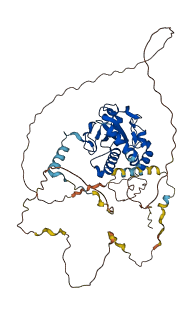
Descriptions
The autoinhibited protein was predicted that may have potential autoinhibitory elements via cis-regPred.
Autoinhibitory domains (AIDs)
Target domain |
|
Relief mechanism |
|
Assay |
cis-regPred |
Accessory elements
No accessory elements
Autoinhibited structure

Activated structure
1 structures for P20483
| Entry ID | Method | Resolution | Chain | Position | Source |
|---|---|---|---|---|---|
| AF-P20483-F1 | Predicted | AlphaFoldDB |
No variants for P20483
| Variant ID(s) | Position | Change | Description | Diseaes Association | Provenance |
|---|---|---|---|---|---|
| No variants for P20483 | |||||
No associated diseases with P20483
1 regional properties for P20483
| Type | Name | Position | InterPro Accession |
|---|---|---|---|
| domain | Rhodanese-like domain | 306 - 432 | IPR001763 |
Functions
| Description | ||
|---|---|---|
| EC Number | 3.1.3.48 | Phosphoric monoester hydrolases |
| Subcellular Localization |
|
|
| PANTHER Family | ||
| PANTHER Subfamily | ||
| PANTHER Protein Class | ||
| PANTHER Pathway Category | No pathway information available | |
3 GO annotations of cellular component
| Name | Definition |
|---|---|
| chromosome | A structure composed of a very long molecule of DNA and associated proteins (e.g. histones) that carries hereditary information. |
| cytoplasm | The contents of a cell excluding the plasma membrane and nucleus, but including other subcellular structures. |
| nucleus | A membrane-bounded organelle of eukaryotic cells in which chromosomes are housed and replicated. In most cells, the nucleus contains all of the cell's chromosomes except the organellar chromosomes, and is the site of RNA synthesis and processing. In some species, or in specialized cell types, RNA metabolism or DNA replication may be absent. |
1 GO annotations of molecular function
| Name | Definition |
|---|---|
| protein tyrosine phosphatase activity | Catalysis of the reaction: protein tyrosine phosphate + H2O = protein tyrosine + phosphate. |
14 GO annotations of biological process
| Name | Definition |
|---|---|
| cell division | The process resulting in division and partitioning of components of a cell to form more cells; may or may not be accompanied by the physical separation of a cell into distinct, individually membrane-bounded daughter cells. |
| centriole replication | The cell cycle process in which a daughter centriole is formed perpendicular to an existing centriole. An immature centriole contains a ninefold radially symmetric array of single microtubules; mature centrioles consist of a radial array of nine microtubule triplets, doublets, or singlets depending upon the species and cell type. Duplicated centrioles also become the ciliary basal body in cells that form cilia during G0. |
| G2/M transition of mitotic cell cycle | The mitotic cell cycle transition by which a cell in G2 commits to M phase. The process begins when the kinase activity of M cyclin/CDK complex reaches a threshold high enough for the cell cycle to proceed. This is accomplished by activating a positive feedback loop that results in the accumulation of unphosphorylated and active M cyclin/CDK complex. |
| gastrulation | A complex and coordinated series of cellular movements that occurs at the end of cleavage during embryonic development of most animals. The details of gastrulation vary from species to species, but usually result in the formation of the three primary germ layers, ectoderm, mesoderm and endoderm. |
| Golgi organization | A process that is carried out at the cellular level which results in the assembly, arrangement of constituent parts, or disassembly of the Golgi apparatus. |
| histoblast morphogenesis | The process in which the anatomical structures derived from the histoblast disc are generated and organized. This includes the transformation of histoblast cells into adult structures during pupal metamorphosis. Histoblast cells are cells founded in the embryo that are the progenitors to the adult abdomen. |
| negative regulation of cell size | Any process that reduces cell size. |
| positive regulation of cell population proliferation | Any process that activates or increases the rate or extent of cell proliferation. |
| positive regulation of G2/M transition of mitotic cell cycle | Any signalling pathway that activates or increases the activity of a cell cycle cyclin-dependent protein kinase to modulate the switch from G2 phase to M phase of the mitotic cell cycle. |
| positive regulation of G2/MI transition of meiotic cell cycle | Any signalling pathway that activates or increases the activity of a cell cycle cyclin-dependent protein kinase to modulate the switch from G2 phase to MI phase of the meiotic cell cycle. |
| positive regulation of mitotic cell cycle | Any process that activates or increases the rate or extent of progression through the mitotic cell cycle. |
| positive regulation of mitotic cell cycle, embryonic | Any process that activates or increases the frequency, rate or extent of progression through the embryonic mitotic cell cycle. |
| protein dephosphorylation | The process of removing one or more phosphoric residues from a protein. |
| regulation of mitotic cell cycle | Any process that modulates the rate or extent of progress through the mitotic cell cycle. |
4 homologous proteins in AiPD
| UniProt AC | Gene Name | Protein Name | Species | Evidence Code |
|---|---|---|---|---|
| P30304 | CDC25A | M-phase inducer phosphatase 1 | Homo sapiens (Human) | PR |
| P30305 | CDC25B | M-phase inducer phosphatase 2 | Homo sapiens (Human) | PR |
| P30306 | Cdc25b | M-phase inducer phosphatase 2 | Mus musculus (Mouse) | PR |
| Q336V5 | ACR2.1 | Arsenate reductase 2.1 | Oryza sativa subsp japonica (Rice) | PR |
| 10 | 20 | 30 | 40 | 50 | 60 |
| MLWETIVEEN | NCSMDCNISN | NTSSSSSINK | MSGSRRARRS | LELMSMDQEE | LSFYDDDVVP |
| 70 | 80 | 90 | 100 | 110 | 120 |
| QDQQRSASPE | LMGLLSPEGS | PQRFQIVRQP | KILPAMGVSS | DHTPARSFRI | FNSLSSTCSM |
| 130 | 140 | 150 | 160 | 170 | 180 |
| ESSMDDEYME | LFEMESQSQQ | TALGFPSGLN | SLISGQIKEQ | PAAKSPAGLS | MRRPSVRRCL |
| 190 | 200 | 210 | 220 | 230 | 240 |
| SMTESNTNST | TTPPPKTPET | ARDCFKRPEP | PASANCSPIQ | SKRHRCAAVE | KENCPAPSPL |
| 250 | 260 | 270 | 280 | 290 | 300 |
| SQVTISHPPP | LRKCMSLNDA | EIMSALARSE | NRNEPELIGD | FSKAYALPLM | EGRHRDLKSI |
| 310 | 320 | 330 | 340 | 350 | 360 |
| SSETVARLLK | GEFSDKVASY | RIIDCRYPYE | FEGGHIEGAK | NLYTTEQILD | EFLTVQQTEL |
| 370 | 380 | 390 | 400 | 410 | 420 |
| QQQQNAESGH | KRNIIIFHCE | FSSERGPKMS | RFLRNLDRER | NTNAYPALHY | PEIYLLHNGY |
| 430 | 440 | 450 | 460 | 470 | |
| KEFFESHVEL | CEPHAYRTML | DPAYNEAYRH | FRAKSKSWNG | DGLGGATGRL | KKSRSRLML |