P19454
Gene name |
CKA2 |
Protein name |
Casein kinase II subunit alpha' |
Names |
CK II |
Species |
Saccharomyces cerevisiae (strain ATCC 204508 / S288c) (Baker's yeast) |
KEGG Pathway |
sce:YOR061W |
EC number |
2.7.11.1: Protein-serine/threonine kinases |
Protein Class |
|
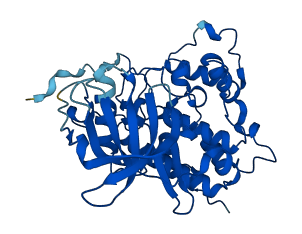
Descriptions
The autoinhibited protein was predicted that may have potential autoinhibitory elements via cis-regPred.
Autoinhibitory domains (AIDs)
Target domain |
|
Relief mechanism |
|
Assay |
cis-regPred |
Accessory elements
185-207 (Activation loop from InterPro)
Target domain |
50-334 (Protein kinase domain) |
Relief mechanism |
|
Assay |
|
Autoinhibited structure

Activated structure
1 structures for P19454
| Entry ID | Method | Resolution | Chain | Position | Source |
|---|---|---|---|---|---|
| AF-P19454-F1 | Predicted | AlphaFoldDB |
1 variants for P19454
| Variant ID(s) | Position | Change | Description | Diseaes Association | Provenance |
|---|---|---|---|---|---|
| s15-441917 | 128 | K>E | No | SGRP |
No associated diseases with P19454
Functions
| Description | ||
|---|---|---|
| EC Number | 2.7.11.1 | Protein-serine/threonine kinases |
| Subcellular Localization |
|
|
| PANTHER Family | ||
| PANTHER Subfamily | ||
| PANTHER Protein Class | ||
| PANTHER Pathway Category | No pathway information available | |
8 GO annotations of cellular component
| Name | Definition |
|---|---|
| CURI complex | A protein complex that is involved in the transcription of ribosomal genes. In Saccharomyces this complex consists of Ckb2p, Utp22p, Rrp7p and Ifh1p. |
| cytosol | The part of the cytoplasm that does not contain organelles but which does contain other particulate matter, such as protein complexes. |
| nucleolus | A small, dense body one or more of which are present in the nucleus of eukaryotic cells. It is rich in RNA and protein, is not bounded by a limiting membrane, and is not seen during mitosis. Its prime function is the transcription of the nucleolar DNA into 45S ribosomal-precursor RNA, the processing of this RNA into 5.8S, 18S, and 28S components of ribosomal RNA, and the association of these components with 5S RNA and proteins synthesized outside the nucleolus. This association results in the formation of ribonucleoprotein precursors; these pass into the cytoplasm and mature into the 40S and 60S subunits of the ribosome. |
| nucleoplasm | That part of the nuclear content other than the chromosomes or the nucleolus. |
| nucleus | A membrane-bounded organelle of eukaryotic cells in which chromosomes are housed and replicated. In most cells, the nucleus contains all of the cell's chromosomes except the organellar chromosomes, and is the site of RNA synthesis and processing. In some species, or in specialized cell types, RNA metabolism or DNA replication may be absent. |
| protein kinase CK2 complex | A protein complex that possesses protein serine/threonine kinase activity, and contains two catalytic alpha subunits and two regulatory beta subunits. Protein kinase CK2 complexes are found in nearly every subcellular compartment, and can phosphorylate many protein substrates in addition to casein. |
| small-subunit processome | A large ribonucleoprotein complex that is an early preribosomal complex. In S. cerevisiae, it has a size of 80S and consists of the 35S pre-rRNA, early-associating ribosomal proteins most of which are part of the small ribosomal subunit, the U3 snoRNA and associated proteins. |
| UTP-C complex | A protein complex that forms a subcomplex of the 90S preribosome. In S. cerevisiae, it is composed of Rrp7p, Utp22p, Ckb1p, Cka1p, Ckb2p and Cka2p. |
3 GO annotations of molecular function
| Name | Definition |
|---|---|
| ATP binding | Binding to ATP, adenosine 5'-triphosphate, a universally important coenzyme and enzyme regulator. |
| protein serine kinase activity | Catalysis of the reactions: ATP + protein serine = ADP + protein serine phosphate. |
| protein serine/threonine kinase activity | Catalysis of the reactions: ATP + protein serine = ADP + protein serine phosphate, and ATP + protein threonine = ADP + protein threonine phosphate. |
13 GO annotations of biological process
| Name | Definition |
|---|---|
| cellular response to DNA damage stimulus | Any process that results in a change in state or activity of a cell (in terms of movement, secretion, enzyme production, gene expression, etc.) as a result of a stimulus indicating damage to its DNA from environmental insults or errors during metabolism. |
| cellular response to osmotic stress | Any process that results in a change in state or activity of a cell (in terms of movement, secretion, enzyme production, gene expression, etc.) as a result of a stimulus indicating an increase or decrease in the concentration of solutes outside the organism or cell. |
| donor selection | The process that determines which donor locus a cell uses, in preference to another, in mating type switching. |
| maturation of SSU-rRNA | Any process involved in the maturation of a precursor Small SubUnit (SSU) ribosomal RNA (rRNA) molecule into a mature SSU-rRNA molecule. |
| nucleolar large rRNA transcription by RNA polymerase I | The synthesis of the large ribosomal RNA (rRNA) transcript which encodes several rRNAs, e.g. in mammals 28S, 18S and 5.8S, from a nuclear DNA template transcribed by RNA polymerase I. |
| peptidyl-serine phosphorylation | The phosphorylation of peptidyl-serine to form peptidyl-O-phospho-L-serine. |
| peptidyl-threonine phosphorylation | The phosphorylation of peptidyl-threonine to form peptidyl-O-phospho-L-threonine. |
| protein phosphorylation | The process of introducing a phosphate group on to a protein. |
| regulation of cell cycle | Any process that modulates the rate or extent of progression through the cell cycle. |
| regulation of ribosomal protein gene transcription by RNA polymerase II | Any process that modulates the frequency, rate or extent of the synthesis of RNA from ribosomal protein genes mediated by RNA polymerase II. |
| regulation of transcription by RNA polymerase I | Any process that modulates the frequency, rate or extent of transcription mediated by RNA polymerase I. |
| regulation of transcription by RNA polymerase III | Any process that modulates the frequency, rate or extent of transcription mediated by RNA ploymerase III. |
| ribosomal small subunit assembly | The aggregation, arrangement and bonding together of constituent RNAs and proteins to form the small ribosomal subunit. |
6 homologous proteins in AiPD
| UniProt AC | Gene Name | Protein Name | Species | Evidence Code |
|---|---|---|---|---|
| P15790 | CKA1 | Casein kinase II subunit alpha | Saccharomyces cerevisiae (strain ATCC 204508 / S288c) (Baker's yeast) | PR |
| P21869 | Casein kinase II subunit alpha' | Gallus gallus (Chicken) | PR | |
| P19784 | CSNK2A2 | Casein kinase II subunit alpha' | Homo sapiens (Human) | PR |
| P68400 | CSNK2A1 | Casein kinase II subunit alpha | Homo sapiens (Human) | PR |
| O64816 | CKA4 | Casein kinase II subunit alpha-4, chloroplastic | Arabidopsis thaliana (Mouse-ear cress) | PR |
| Q08466 | CKA2 | Casein kinase II subunit alpha-2 | Arabidopsis thaliana (Mouse-ear cress) | PR |
| 10 | 20 | 30 | 40 | 50 | 60 |
| MPLPPSTLNQ | KSNRVYSVAR | VYKNACEERP | QEYWDYEQGV | TIDWGKISNY | EIINKIGRGK |
| 70 | 80 | 90 | 100 | 110 | 120 |
| YSEVFSGRCI | VNNQKCVIKV | LKPVKMKKIY | RELKILTNLT | GGPNVVGLYD | IVQDADSKIP |
| 130 | 140 | 150 | 160 | 170 | 180 |
| ALIFEEIKNV | DFRTLYPTFK | LPDIQYYFTQ | LLIALDYCHS | MGIMHRDVKP | QNVMIDPTER |
| 190 | 200 | 210 | 220 | 230 | 240 |
| KLRLIDWGLA | EFYHPGVDYN | VRVASRYHKG | PELLVNLNQY | DYSLDLWSVG | CMLAAIVFKK |
| 250 | 260 | 270 | 280 | 290 | 300 |
| EPFFKGSSNP | DQLVKIATVL | GTKELLGYLG | KYGLHLPSEY | DNIMRDFTKK | SWTHFITSET |
| 310 | 320 | 330 | |||
| KLAVPEVVDL | IDNLLRYDHQ | ERLTAKEAMD | HKFFKTKFE |