P15108
Gene name |
HSC82 (YMR186W, YM8010.16) |
Protein name |
ATP-dependent molecular chaperone HSC82 |
Names |
82 kDa heat shock cognate protein, Heat shock protein Hsp90 constitutive isoform |
Species |
Saccharomyces cerevisiae (strain ATCC 204508 / S288c) (Baker's yeast) |
KEGG Pathway |
sce:YMR186W |
EC number |
|
Protein Class |
|
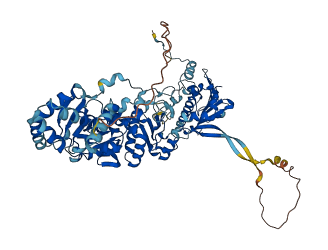
Descriptions
The autoinhibited protein was predicted that may have potential autoinhibitory elements via cis-regPred.
Autoinhibitory domains (AIDs)
Target domain |
|
Relief mechanism |
|
Assay |
cis-regPred |
Accessory elements
No accessory elements
Autoinhibited structure

Activated structure
8 structures for P15108
4 variants for P15108
| Variant ID(s) | Position | Change | Description | Diseaes Association | Provenance |
|---|---|---|---|---|---|
| s13-632567 | 72 | E>Q | No | SGRP | |
| s13-632850 | 166 | R>K | No | SGRP | |
| s13-633993 | 547 | T>I | No | SGRP | |
| s13-634463 | 704 | V>I | No | SGRP |
No associated diseases with P15108
6 GO annotations of cellular component
| Name | Definition |
|---|---|
| cytoplasm | The contents of a cell excluding the plasma membrane and nucleus, but including other subcellular structures. |
| cytosol | The part of the cytoplasm that does not contain organelles but which does contain other particulate matter, such as protein complexes. |
| mitochondrion | A semiautonomous, self replicating organelle that occurs in varying numbers, shapes, and sizes in the cytoplasm of virtually all eukaryotic cells. It is notably the site of tissue respiration. |
| perinuclear region of cytoplasm | Cytoplasm situated near, or occurring around, the nucleus. |
| plasma membrane | The membrane surrounding a cell that separates the cell from its external environment. It consists of a phospholipid bilayer and associated proteins. |
| protein-containing complex | A stable assembly of two or more macromolecules, i.e. proteins, nucleic acids, carbohydrates or lipids, in which at least one component is a protein and the constituent parts function together. |
4 GO annotations of molecular function
| Name | Definition |
|---|---|
| ATP binding | Binding to ATP, adenosine 5'-triphosphate, a universally important coenzyme and enzyme regulator. |
| ATP hydrolysis activity | Catalysis of the reaction: ATP + H2O = ADP + H+ phosphate. ATP hydrolysis is used in some reactions as an energy source, for example to catalyze a reaction or drive transport against a concentration gradient. |
| ATP-dependent protein folding chaperone | Binding to a protein or a protein-containing complex to assist the protein folding process, driven by ATP hydrolysis. |
| unfolded protein binding | Binding to an unfolded protein. |
7 GO annotations of biological process
| Name | Definition |
|---|---|
| box C/D snoRNP assembly | The aggregation, arrangement and bonding together of proteins and a box C/D snoRNA to form a box C/D small nucleolar ribonucleoprotein (snoRNP) complex. |
| cellular response to heat | Any process that results in a change in state or activity of a cell (in terms of movement, secretion, enzyme production, gene expression, etc.) as a result of a heat stimulus, a temperature stimulus above the optimal temperature for that organism. |
| proteasome assembly | The aggregation, arrangement and bonding together of a mature, active proteasome complex. |
| protein folding | The process of assisting in the covalent and noncovalent assembly of single chain polypeptides or multisubunit complexes into the correct tertiary structure. |
| protein stabilization | Any process involved in maintaining the structure and integrity of a protein and preventing it from degradation or aggregation. |
| response to oxygen levels | Any process that results in a change in state or activity of a cell or an organism (in terms of movement, secretion, enzyme production, gene expression, etc.) as a result of a stimulus reflecting the presence, absence, or concentration of oxygen. |
| telomere maintenance | Any process that contributes to the maintenance of proper telomeric length and structure by affecting and monitoring the activity of telomeric proteins, the length of telomeric DNA and the replication and repair of the DNA. These processes includes those that shorten, lengthen, replicate and repair the telomeric DNA sequences. |
6 homologous proteins in AiPD
| UniProt AC | Gene Name | Protein Name | Species | Evidence Code |
|---|---|---|---|---|
| Q0J4P2 | HSP81-1 | Heat shock protein 81-1 | Oryza sativa subsp japonica (Rice) | PR |
| P51818 | HSP90-3 | Heat shock protein 90-3 | Arabidopsis thaliana (Mouse-ear cress) | PR |
| O03986 | HSP90-4 | Heat shock protein 90-4 | Arabidopsis thaliana (Mouse-ear cress) | PR |
| P55737 | HSP90-2 | Heat shock protein 90-2 | Arabidopsis thaliana (Mouse-ear cress) | PR |
| P27323 | HSP90-1 | Heat shock protein 90-1 | Arabidopsis thaliana (Mouse-ear cress) | PR |
| P36181 | HSC80 | Heat shock cognate protein 80 | Solanum lycopersicum (Tomato) (Lycopersicon esculentum) | PR |
| 10 | 20 | 30 | 40 | 50 | 60 |
| MAGETFEFQA | EITQLMSLII | NTVYSNKEIF | LRELISNASD | ALDKIRYQAL | SDPKQLETEP |
| 70 | 80 | 90 | 100 | 110 | 120 |
| DLFIRITPKP | EEKVLEIRDS | GIGMTKAELI | NNLGTIAKSG | TKAFMEALSA | GADVSMIGQF |
| 130 | 140 | 150 | 160 | 170 | 180 |
| GVGFYSLFLV | ADRVQVISKN | NEDEQYIWES | NAGGSFTVTL | DEVNERIGRG | TVLRLFLKDD |
| 190 | 200 | 210 | 220 | 230 | 240 |
| QLEYLEEKRI | KEVIKRHSEF | VAYPIQLLVT | KEVEKEVPIP | EEEKKDEEKK | DEDDKKPKLE |
| 250 | 260 | 270 | 280 | 290 | 300 |
| EVDEEEEEKK | PKTKKVKEEV | QELEELNKTK | PLWTRNPSDI | TQEEYNAFYK | SISNDWEDPL |
| 310 | 320 | 330 | 340 | 350 | 360 |
| YVKHFSVEGQ | LEFRAILFIP | KRAPFDLFES | KKKKNNIKLY | VRRVFITDEA | EDLIPEWLSF |
| 370 | 380 | 390 | 400 | 410 | 420 |
| VKGVVDSEDL | PLNLSREMLQ | QNKIMKVIRK | NIVKKLIEAF | NEIAEDSEQF | DKFYSAFAKN |
| 430 | 440 | 450 | 460 | 470 | 480 |
| IKLGVHEDTQ | NRAALAKLLR | YNSTKSVDEL | TSLTDYVTRM | PEHQKNIYYI | TGESLKAVEK |
| 490 | 500 | 510 | 520 | 530 | 540 |
| SPFLDALKAK | NFEVLFLTDP | IDEYAFTQLK | EFEGKTLVDI | TKDFELEETD | EEKAEREKEI |
| 550 | 560 | 570 | 580 | 590 | 600 |
| KEYEPLTKAL | KDILGDQVEK | VVVSYKLLDA | PAAIRTGQFG | WSANMERIMK | AQALRDSSMS |
| 610 | 620 | 630 | 640 | 650 | 660 |
| SYMSSKKTFE | ISPKSPIIKE | LKKRVDEGGA | QDKTVKDLTN | LLFETALLTS | GFSLEEPTSF |
| 670 | 680 | 690 | 700 | ||
| ASRINRLISL | GLNIDEDEET | ETAPEASTEA | PVEEVPADTE | MEEVD |