P10711
Gene name |
Tcea1 (Tceat) |
Protein name |
Transcription elongation factor A protein 1 |
Names |
Transcription elongation factor S-II protein 1, Transcription elongation factor TFIIS.o |
Species |
Mus musculus (Mouse) |
KEGG Pathway |
mmu:21399 |
EC number |
|
Protein Class |
|
Descriptions
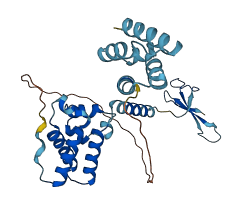
The autoinhibited protein was predicted that may have potential autoinhibitory elements via cis-regPred.
Autoinhibitory domains (AIDs)
Target domain |
|
Relief mechanism |
|
Assay |
cis-regPred |
Accessory elements
No accessory elements
Autoinhibited structure

Activated structure
1 structures for P10711
| Entry ID | Method | Resolution | Chain | Position | Source |
|---|---|---|---|---|---|
| AF-P10711-F1 | Predicted | AlphaFoldDB |
14 variants for P10711
| Variant ID(s) | Position | Change | Description | Diseaes Association | Provenance |
|---|---|---|---|---|---|
| rs3388456813 | 25 | L>F | No | EVA | |
| rs3388457127 | 25 | L>S | No | EVA | |
| rs3389602789 | 46 | I>T | No | EVA | |
| rs3388456483 | 60 | E>V | No | EVA | |
| rs3388457190 | 67 | K>R | No | EVA | |
| rs3388456150 | 70 | I>V | No | EVA | |
| rs3388456358 | 76 | L>F | No | EVA | |
| rs3388456769 | 202 | K>R | No | EVA | |
| rs3388456404 | 254 | G>S | No | EVA | |
| rs3388457405 | 286 | T>R | No | EVA | |
| rs3389598086 | 288 | F>I | No | EVA | |
| rs3389576699 | 288 | F>Y | No | EVA | |
| rs3388456230 | 296 | N>K | No | EVA | |
| rs3388456229 | 302 | C>R | No | EVA |
No associated diseases with P10711
4 regional properties for P10711
| Type | Name | Position | InterPro Accession |
|---|---|---|---|
| domain | Zinc finger, TFIIS-type | 259 - 300 | IPR001222 |
| domain | Transcription elongation factor, TFIIS/CRSP70, N-terminal, sub-type | 5 - 79 | IPR003617 |
| domain | Transcription elongation factor S-II, central domain | 136 - 256 | IPR003618 |
| domain | Transcription factor IIS, N-terminal | 3 - 80 | IPR017923 |
4 GO annotations of cellular component
| Name | Definition |
|---|---|
| nucleolus | A small, dense body one or more of which are present in the nucleus of eukaryotic cells. It is rich in RNA and protein, is not bounded by a limiting membrane, and is not seen during mitosis. Its prime function is the transcription of the nucleolar DNA into 45S ribosomal-precursor RNA, the processing of this RNA into 5.8S, 18S, and 28S components of ribosomal RNA, and the association of these components with 5S RNA and proteins synthesized outside the nucleolus. This association results in the formation of ribonucleoprotein precursors; these pass into the cytoplasm and mature into the 40S and 60S subunits of the ribosome. |
| nucleoplasm | That part of the nuclear content other than the chromosomes or the nucleolus. |
| nucleus | A membrane-bounded organelle of eukaryotic cells in which chromosomes are housed and replicated. In most cells, the nucleus contains all of the cell's chromosomes except the organellar chromosomes, and is the site of RNA synthesis and processing. In some species, or in specialized cell types, RNA metabolism or DNA replication may be absent. |
| transcription factor TFIID complex | A complex composed of TATA binding protein (TBP) and TBP associated factors (TAFs); the total mass is typically about 800 kDa. Most of the TAFs are conserved across species. In TATA-containing promoters for RNA polymerase II (Pol II), TFIID is believed to recognize at least two distinct elements, the TATA element and a downstream promoter element. TFIID is also involved in recognition of TATA-less Pol II promoters. Binding of TFIID to DNA is necessary but not sufficient for transcription initiation from most RNA polymerase II promoters. |
2 GO annotations of molecular function
| Name | Definition |
|---|---|
| DNA binding | Any molecular function by which a gene product interacts selectively and non-covalently with DNA (deoxyribonucleic acid). |
| zinc ion binding | Binding to a zinc ion (Zn). |
5 GO annotations of biological process
| Name | Definition |
|---|---|
| DNA-templated transcription | The synthesis of an RNA transcript from a DNA template. |
| erythrocyte differentiation | The process in which a myeloid precursor cell acquires specializes features of an erythrocyte. |
| positive regulation of DNA-templated transcription | Any process that activates or increases the frequency, rate or extent of cellular DNA-templated transcription. |
| positive regulation of transcription by RNA polymerase II | Any process that activates or increases the frequency, rate or extent of transcription from an RNA polymerase II promoter. |
| transcription elongation by RNA polymerase II promoter | The extension of an RNA molecule after transcription initiation and promoter clearance at an RNA polymerase II promoter by the addition of ribonucleotides catalyzed by RNA polymerase II. |
7 homologous proteins in AiPD
| UniProt AC | Gene Name | Protein Name | Species | Evidence Code |
|---|---|---|---|---|
| A5PKE4 | TCEANC2 | Transcription elongation factor A N-terminal and central domain-containing protein 2 | Bos taurus (Bovine) | PR |
| Q96MN5 | TCEANC2 | Transcription elongation factor A N-terminal and central domain-containing protein 2 | Homo sapiens (Human) | PR |
| P23193 | TCEA1 | Transcription elongation factor A protein 1 | Homo sapiens (Human) | PR |
| Q8R2M0 | Tceanc2 | Transcription elongation factor A N-terminal and central domain-containing protein 2 | Mus musculus (Mouse) | PR |
| P23881 | Tcea3 | Transcription elongation factor A protein 3 | Mus musculus (Mouse) | PR |
| Q5XIC7 | Tceanc2 | Transcription elongation factor A N-terminal and central domain-containing protein 2 | Rattus norvegicus (Rat) | PR |
| P52652 | T24H10.1 | Putative transcription elongation factor S-II | Caenorhabditis elegans | PR |
| 10 | 20 | 30 | 40 | 50 | 60 |
| MEDEVVRIAK | KMDKMVQKKN | AAGALDLLKE | LKNIPMTLEL | LQSTRIGMSV | NALRKQSTDE |
| 70 | 80 | 90 | 100 | 110 | 120 |
| EVTSLAKSLI | KSWKKLLDGP | STDKDPEEKK | KEPAISSQNS | PEAREESSSS | SNVSSRKDET |
| 130 | 140 | 150 | 160 | 170 | 180 |
| NARDTYVSSF | PRAPSTSDSV | RLKCREMLAA | ALRTGDDYVA | IGADEEELGS | QIEEAIYQEI |
| 190 | 200 | 210 | 220 | 230 | 240 |
| RNTDMKYKNR | VRSRISNLKD | AKNPNLRKNV | LCGNIPPDLF | ARMTAEEMAS | DELKEMRKNL |
| 250 | 260 | 270 | 280 | 290 | 300 |
| TKEAIREHQM | AKTGGTQTDL | FTCGKCKKKN | CTYTQVQTRS | ADEPMTTFVV | CNECGNRWKF |
| C |