P07607
Gene name |
Tyms |
Protein name |
Thymidylate synthase |
Names |
TS, TSase |
Species |
Mus musculus (Mouse) |
KEGG Pathway |
mmu:22171 |
EC number |
2.1.1.45: Methyltransferases |
Protein Class |
|
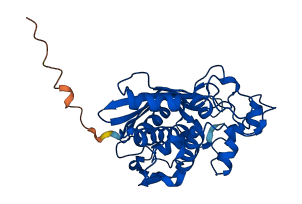
Descriptions
The autoinhibited protein was predicted that may have potential autoinhibitory elements via cis-regPred.
Autoinhibitory domains (AIDs)
Target domain |
|
Relief mechanism |
|
Assay |
cis-regPred |
Accessory elements
No accessory elements
Autoinhibited structure

Activated structure
11 structures for P07607
| Entry ID | Method | Resolution | Chain | Position | Source |
|---|---|---|---|---|---|
| 3IHI | X-ray | 194 A | A/B | 1-307 | PDB |
| 4E5O | X-ray | 170 A | A/B/C/D/E/F | 1-307 | PDB |
| 4EB4 | X-ray | 174 A | A/B/C/D | 1-307 | PDB |
| 4EIN | X-ray | 175 A | A/B | 1-307 | PDB |
| 4EZ8 | X-ray | 117 A | A | 1-307 | PDB |
| 5FCT | X-ray | 155 A | A/B | 1-307 | PDB |
| 6F6Z | X-ray | 213 A | A/B | 1-307 | PDB |
| 6GKO | X-ray | 184 A | A/B | 1-307 | PDB |
| 6GYJ | X-ray | 175 A | A/B | 1-307 | PDB |
| 6Y08 | X-ray | 230 A | A/B | 1-307 | PDB |
| AF-P07607-F1 | Predicted | AlphaFoldDB |
13 variants for P07607
| Variant ID(s) | Position | Change | Description | Diseaes Association | Provenance |
|---|---|---|---|---|---|
| rs234275993 | 16 | S>G | No | EVA | |
| rs239408217 | 21 | R>Q | No | EVA | |
| rs3388756485 | 44 | R>S | No | EVA | |
| rs3413145573 | 70 | T>A | No | EVA | |
| rs3388740318 | 124 | D>* | No | EVA | |
| rs3388746602 | 124 | D>E | No | EVA | |
| rs3388747965 | 180 | D>N | No | EVA | |
| rs3388750422 | 187 | P>S | No | EVA | |
| rs3388750571 | 191 | A>V | No | EVA | |
| rs13469121 | 271 | P>Q | No | EVA | |
| rs3388746572 | 275 | I>F | No | EVA | |
| rs3388732731 | 276 | L>V | No | EVA | |
| rs3388750150 | 295 | Y>C | No | EVA |
No associated diseases with P07607
Functions
| Description | ||
|---|---|---|
| EC Number | 2.1.1.45 | Methyltransferases |
| Subcellular Localization |
|
|
| PANTHER Family | ||
| PANTHER Subfamily | ||
| PANTHER Protein Class | ||
| PANTHER Pathway Category | No pathway information available | |
7 GO annotations of cellular component
| Name | Definition |
|---|---|
| cytoplasm | The contents of a cell excluding the plasma membrane and nucleus, but including other subcellular structures. |
| cytosol | The part of the cytoplasm that does not contain organelles but which does contain other particulate matter, such as protein complexes. |
| mitochondrial inner membrane | The inner, i.e. lumen-facing, lipid bilayer of the mitochondrial envelope. It is highly folded to form cristae. |
| mitochondrial matrix | The gel-like material, with considerable fine structure, that lies in the matrix space, or lumen, of a mitochondrion. It contains the enzymes of the tricarboxylic acid cycle and, in some organisms, the enzymes concerned with fatty acid oxidation. |
| mitochondrion | A semiautonomous, self replicating organelle that occurs in varying numbers, shapes, and sizes in the cytoplasm of virtually all eukaryotic cells. It is notably the site of tissue respiration. |
| nucleolus | A small, dense body one or more of which are present in the nucleus of eukaryotic cells. It is rich in RNA and protein, is not bounded by a limiting membrane, and is not seen during mitosis. Its prime function is the transcription of the nucleolar DNA into 45S ribosomal-precursor RNA, the processing of this RNA into 5.8S, 18S, and 28S components of ribosomal RNA, and the association of these components with 5S RNA and proteins synthesized outside the nucleolus. This association results in the formation of ribonucleoprotein precursors; these pass into the cytoplasm and mature into the 40S and 60S subunits of the ribosome. |
| nucleus | A membrane-bounded organelle of eukaryotic cells in which chromosomes are housed and replicated. In most cells, the nucleus contains all of the cell's chromosomes except the organellar chromosomes, and is the site of RNA synthesis and processing. In some species, or in specialized cell types, RNA metabolism or DNA replication may be absent. |
7 GO annotations of molecular function
| Name | Definition |
|---|---|
| folic acid binding | Binding to folic acid, pteroylglutamic acid. Folic acid is widely distributed as a member of the vitamin B complex and is essential for the synthesis of purine and pyrimidines. |
| heterocyclic compound binding | Binding to heterocyclic compound. |
| mRNA binding | Binding to messenger RNA (mRNA), an intermediate molecule between DNA and protein. mRNA includes UTR and coding sequences, but does not contain introns. |
| mRNA regulatory element binding translation repressor activity | Antagonizes the ribosome-mediated translation of mRNA into a polypeptide via direct binding (through a selective and non-covalent interaction) to nucleic acid. |
| protein homodimerization activity | Binding to an identical protein to form a homodimer. |
| sequence-specific mRNA binding | Binding to messenger RNA (mRNA) of a specific nucleotide composition or a specific sequence motif. |
| thymidylate synthase activity | Catalysis of the reaction: 5,10-methylenetetrahydrofolate + dUMP = 7,8-dihydrofolate + thymidylate. |
22 GO annotations of biological process
| Name | Definition |
|---|---|
| aging | A developmental process that is a deterioration and loss of function over time. Aging includes loss of functions such as resistance to disease, homeostasis, and fertility, as well as wear and tear. Aging includes cellular senescence, but is more inclusive. May precede death and may succeed developmental maturation (GO:0021700). |
| cartilage development | The process whose specific outcome is the progression of a cartilage element over time, from its formation to the mature structure. Cartilage elements are skeletal elements that consist of connective tissue dominated by extracellular matrix containing collagen type II and large amounts of proteoglycan, particularly chondroitin sulfate. |
| circadian rhythm | Any biological process in an organism that recurs with a regularity of approximately 24 hours. |
| developmental growth | The increase in size or mass of an entire organism, a part of an organism or a cell, where the increase in size or mass has the specific outcome of the progression of the organism over time from one condition to another. |
| dTMP biosynthetic process | The chemical reactions and pathways resulting in the formation of dTMP, deoxyribosylthymine monophosphate (2'-deoxyribosylthymine 5'-phosphate). |
| dTTP biosynthetic process | The chemical reactions and pathways resulting in the formation of dTTP, deoxyribosylthymine triphosphate. |
| intestinal epithelial cell maturation | The developmental process, independent of morphogenetic (shape) change, that is required for a columna/cuboidal epithelial cell of the intestine to attain its fully functional state. A columnar/cuboidal epithelial cell of the intestine mature as they migrate from the intestinal crypt to the villus. |
| liver regeneration | The regrowth of lost or destroyed liver. |
| methylation | The process in which a methyl group is covalently attached to a molecule. |
| negative regulation of translation | Any process that stops, prevents, or reduces the frequency, rate or extent of the chemical reactions and pathways resulting in the formation of proteins by the translation of mRNA or circRNA. |
| regulation of translation | Any process that modulates the frequency, rate or extent of the chemical reactions and pathways resulting in the formation of proteins by the translation of mRNA or circRNA. |
| response to cytokine | Any process that results in a change in state or activity of a cell or an organism (in terms of movement, secretion, enzyme production, gene expression, etc.) as a result of a cytokine stimulus. |
| response to ethanol | Any process that results in a change in state or activity of a cell or an organism (in terms of movement, secretion, enzyme production, gene expression, etc.) as a result of an ethanol stimulus. |
| response to folic acid | Any process that results in a change in state or activity of a cell or an organism (in terms of movement, secretion, enzyme production, gene expression, etc.) as a result of a folic acid stimulus. |
| response to glucocorticoid | Any process that results in a change in state or activity of a cell or an organism (in terms of movement, secretion, enzyme production, gene expression, etc.) as a result of a glucocorticoid stimulus. Glucocorticoids are hormonal C21 corticosteroids synthesized from cholesterol with the ability to bind with the cortisol receptor and trigger similar effects. Glucocorticoids act primarily on carbohydrate and protein metabolism, and have anti-inflammatory effects. |
| response to organophosphorus | Any process that results in a change in state or activity of a cell or an organism (in terms of movement, secretion, enzyme production, gene expression, etc.) as a result of an organophosphorus stimulus. Organophosphorus is a compound containing phosphorus bound to an organic molecule; several organophosphorus compounds are used as insecticides, and they are highly toxic cholinesterase inhibitors. |
| response to progesterone | Any process that results in a change in state or activity of a cell or an organism (in terms of movement, secretion, enzyme production, gene expression, etc.) as a result of a progesterone stimulus. |
| response to toxic substance | Any process that results in a change in state or activity of a cell or an organism (in terms of movement, secretion, enzyme production, gene expression, etc.) as a result of a toxic stimulus. |
| response to vitamin A | Any process that results in a change in state or activity of a cell or an organism (in terms of movement, secretion, enzyme production, gene expression, etc.) as a result of a vitamin A stimulus. |
| response to xenobiotic stimulus | Any process that results in a change in state or activity of a cell or an organism (in terms of movement, secretion, enzyme production, gene expression, etc.) as a result of a stimulus from a xenobiotic, a compound foreign to the organim exposed to it. It may be synthesized by another organism (like ampicilin) or it can be a synthetic chemical. |
| tetrahydrofolate interconversion | The chemical reactions and pathways by which one-carbon (C1) units are transferred between tetrahydrofolate molecules, to synthesise other tetrahydrofolate molecules. |
| uracil metabolic process | The chemical reactions and pathways involving uracil, 2,4-dioxopyrimidine, one of the pyrimidine bases occurring in RNA, but not in DNA. |
5 homologous proteins in AiPD
| UniProt AC | Gene Name | Protein Name | Species | Evidence Code |
|---|---|---|---|---|
| O76511 | Ts | Thymidylate synthase | Drosophila melanogaster (Fruit fly) | PR |
| P04818 | TYMS | Thymidylate synthase | Homo sapiens (Human) | PR |
| O81395 | DRTS | Bifunctional dihydrofolate reductase-thymidylate synthase | Zea mays (Maize) | PR |
| P45352 | Tyms | Thymidylate synthase | Rattus norvegicus (Rat) | PR |
| Q05763 | THY-2 | Bifunctional dihydrofolate reductase-thymidylate synthase 2 | Arabidopsis thaliana (Mouse-ear cress) | PR |
| 10 | 20 | 30 | 40 | 50 | 60 |
| MLVVGSELQS | DAQQLSAEAP | RHGELQYLRQ | VEHILRCGFK | KEDRTGTGTL | SVFGMQARYS |
| 70 | 80 | 90 | 100 | 110 | 120 |
| LRDEFPLLTT | KRVFWKGVLE | ELLWFIKGST | NAKELSSKGV | RIWDANGSRD | FLDSLGFSAR |
| 130 | 140 | 150 | 160 | 170 | 180 |
| QEGDLGPVYG | FQWRHFGAEY | KDMDSDYSGQ | GVDQLQKVID | TIKTNPDDRR | IIMCAWNPKD |
| 190 | 200 | 210 | 220 | 230 | 240 |
| LPLMALPPCH | ALCQFYVVNG | ELSCQLYQRS | GDMGLGVPFN | IASYALLTYM | IAHITGLQPG |
| 250 | 260 | 270 | 280 | 290 | 300 |
| DFVHTLGDAH | IYLNHIEPLK | IQLQREPRPF | PKLKILRKVE | TIDDFKVEDF | QIEGYNPHPT |
| IKMEMAV |