O23310
Gene name |
NFYB3 |
Protein name |
Nuclear transcription factor Y subunit B-3 |
Names |
AtNF-YB-3, AtNF-YB3, Transcriptional activator HAP3C |
Species |
Arabidopsis thaliana (Mouse-ear cress) |
KEGG Pathway |
ath:AT4G14540 |
EC number |
|
Protein Class |
|
Descriptions
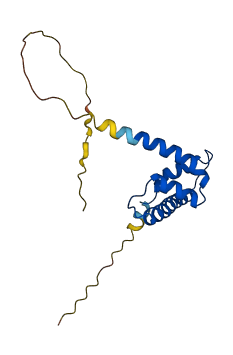
The autoinhibited protein was predicted that may have potential autoinhibitory elements via cis-regPred.
Autoinhibitory domains (AIDs)
Target domain |
|
Relief mechanism |
|
Assay |
cis-regPred |
Accessory elements
No accessory elements
Autoinhibited structure

Activated structure
2 structures for O23310
| Entry ID | Method | Resolution | Chain | Position | Source |
|---|---|---|---|---|---|
| 7CVO | X-ray | 260 A | B/G | 18-120 | PDB |
| AF-O23310-F1 | Predicted | AlphaFoldDB |
10 variants for O23310
| Variant ID(s) | Position | Change | Description | Diseaes Association | Provenance |
|---|---|---|---|---|---|
| tmp_4_8344684_T_C | 8 | S>P | No | 1000Genomes | |
| tmp_4_8344695_C_G | 11 | H>Q | No | 1000Genomes | |
| tmp_4_8344705_G_A | 15 | G>R | No | 1000Genomes | |
| tmp_4_8344852_A_T | 64 | I>F | No | 1000Genomes | |
| tmp_4_8345054_G_T | 131 | G>V | No | 1000Genomes | |
| ENSVATH14190652 | 132 | G>V | No | 1000Genomes | |
| tmp_4_8345063_C_A,T | 134 | A>D | No | 1000Genomes | |
| tmp_4_8345063_C_A,T | 134 | A>V | No | 1000Genomes | |
| ENSVATH14190653 | 150 | T>N | No | 1000Genomes | |
| tmp_4_8345118_G_A | 152 | M>I | No | 1000Genomes |
No associated diseases with O23310
Functions
3 GO annotations of cellular component
| Name | Definition |
|---|---|
| CCAAT-binding factor complex | A heteromeric transcription factor complex that binds to the CCAAT-box upstream of promoters; functions as both an activator and a repressor, depending on its interacting cofactors. Typically trimeric consisting of NFYA, NFYB and NFYC subunits. In Saccharomyces, it activates the transcription of genes in response to growth in a nonfermentable carbon source and consists of four known subunits: HAP2, HAP3, HAP4 and HAP5. |
| cytosol | The part of the cytoplasm that does not contain organelles but which does contain other particulate matter, such as protein complexes. |
| nucleus | A membrane-bounded organelle of eukaryotic cells in which chromosomes are housed and replicated. In most cells, the nucleus contains all of the cell's chromosomes except the organellar chromosomes, and is the site of RNA synthesis and processing. In some species, or in specialized cell types, RNA metabolism or DNA replication may be absent. |
5 GO annotations of molecular function
| Name | Definition |
|---|---|
| DNA-binding transcription activator activity, RNA polymerase II-specific | A DNA-binding transcription factor activity that activates or increases transcription of specific gene sets transcribed by RNA polymerase II. |
| DNA-binding transcription factor activity | A transcription regulator activity that modulates transcription of gene sets via selective and non-covalent binding to a specific double-stranded genomic DNA sequence (sometimes referred to as a motif) within a cis-regulatory region. Regulatory regions include promoters (proximal and distal) and enhancers. Genes are transcriptional units, and include bacterial operons. |
| DNA-binding transcription factor activity, RNA polymerase II-specific | A DNA-binding transcription factor activity that modulates the transcription of specific gene sets transcribed by RNA polymerase II. |
| protein heterodimerization activity | Binding to a nonidentical protein to form a heterodimer. |
| sequence-specific DNA binding | Binding to DNA of a specific nucleotide composition, e.g. GC-rich DNA binding, or with a specific sequence motif or type of DNA e.g. promotor binding or rDNA binding. |
4 GO annotations of biological process
| Name | Definition |
|---|---|
| positive regulation of DNA-templated transcription | Any process that activates or increases the frequency, rate or extent of cellular DNA-templated transcription. |
| regulation of transcription by RNA polymerase II | Any process that modulates the frequency, rate or extent of transcription mediated by RNA polymerase II. |
| response to heat | Any process that results in a change in state or activity of a cell or an organism (in terms of movement, secretion, enzyme production, gene expression, etc.) as a result of a heat stimulus, a temperature stimulus above the optimal temperature for that organism. |
| response to water deprivation | Any process that results in a change in state or activity of a cell or an organism (in terms of movement, secretion, enzyme production, gene expression, etc.) as a result of a water deprivation stimulus, prolonged deprivation of water. |
4 homologous proteins in AiPD
| UniProt AC | Gene Name | Protein Name | Species | Evidence Code |
|---|---|---|---|---|
| Q32KW0 | NFYB | Nuclear transcription factor Y subunit beta | Bos taurus (Bovine) | PR |
| Q6RG77 | NFYB | Nuclear transcription factor Y subunit beta | Equus caballus (Horse) | PR |
| Q67XJ2 | NFYB10 | Nuclear transcription factor Y subunit B-10 | Arabidopsis thaliana (Mouse-ear cress) | PR |
| Q8VYK4 | NFYB8 | Nuclear transcription factor Y subunit B-8 | Arabidopsis thaliana (Mouse-ear cress) | PR |
| 10 | 20 | 30 | 40 | 50 | 60 |
| MADSDNDSGG | HKDGGNASTR | EQDRFLPIAN | VSRIMKKALP | ANAKISKDAK | ETVQECVSEF |
| 70 | 80 | 90 | 100 | 110 | 120 |
| ISFITGEASD | KCQREKRKTI | NGDDLLWAMT | TLGFEDYVEP | LKVYLQKYRE | VEGEKTTTAG |
| 130 | 140 | 150 | 160 | ||
| RQGDKEGGGG | GGGAGSGSGG | APMYGGGMVT | TMGHQFSHHF | S |