O08599
Gene name |
Stxbp1 |
Protein name |
Syntaxin-binding protein 1 |
Names |
Protein unc-18 homolog 1, Unc18-1, Protein unc-18 homolog A, Unc-18A |
Species |
Mus musculus (Mouse) |
KEGG Pathway |
mmu:20910 |
EC number |
|
Protein Class |
|
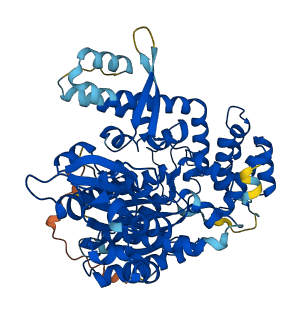
Descriptions
The autoinhibited protein was predicted that may have potential autoinhibitory elements via cis-regPred.
Autoinhibitory domains (AIDs)
Target domain |
|
Relief mechanism |
|
Assay |
cis-regPred |
Accessory elements
No accessory elements
Autoinhibited structure

Activated structure
1 structures for O08599
| Entry ID | Method | Resolution | Chain | Position | Source |
|---|---|---|---|---|---|
| AF-O08599-F1 | Predicted | AlphaFoldDB |
26 variants for O08599
| Variant ID(s) | Position | Change | Description | Diseaes Association | Provenance |
|---|---|---|---|---|---|
| rs3388545458 | 23 | K>SDG* | No | EVA | |
| rs3388548068 | 25 | K>E | No | EVA | |
| rs3388546424 | 36 | L>I | No | EVA | |
| rs3388547481 | 56 | T>I | No | EVA | |
| rs3388544169 | 130 | L>P | No | EVA | |
| rs254766834 | 150 | A>G | No | EVA | |
| rs3388545468 | 195 | Y>D | No | EVA | |
| rs3388544095 | 196 | K>N | No | EVA | |
| rs3388548117 | 208 | K>N | No | EVA | |
| rs27207771 | 216 | D>N | strain: DBA/2J [UniProt] | No | EVA |
| rs3388543554 | 253 | S>N | No | EVA | |
| rs3388547491 | 263 | V>F | No | EVA | |
| rs3388549132 | 285 | D>Y | No | EVA | |
| rs3388547489 | 293 | H>Y | No | EVA | |
| rs3388545428 | 323 | T>S | No | EVA | |
| rs3388538736 | 350 | L>P | No | EVA | |
| rs3388549140 | 351 | A>D | No | EVA | |
| rs3391296069 | 385 | D>G | No | EVA | |
| rs3388538567 | 401 | T>N | No | EVA | |
| rs3388548058 | 444 | A>T | No | EVA | |
| rs3391307511 | 448 | V>L | No | EVA | |
| rs3391421980 | 453 | D>E | No | EVA | |
| rs3388543809 | 477 | R>* | No | EVA | |
| rs3388547751 | 522 | W>* | No | EVA | |
| rs3388543807 | 530 | E>K | No | EVA | |
| rs3388543510 | 567 | I>K | No | EVA |
No associated diseases with O08599
No regional properties for O08599
| Type | Name | Position | InterPro Accession |
|---|---|---|---|
| No domain, repeats, and functional sites for O08599 | |||
19 GO annotations of cellular component
| Name | Definition |
|---|---|
| axon | The long process of a neuron that conducts nerve impulses, usually away from the cell body to the terminals and varicosities, which are sites of storage and release of neurotransmitter. |
| cytoplasm | The contents of a cell excluding the plasma membrane and nucleus, but including other subcellular structures. |
| cytoskeleton | A cellular structure that forms the internal framework of eukaryotic and prokaryotic cells. The cytoskeleton includes intermediate filaments, microfilaments, microtubules, the microtrabecular lattice, and other structures characterized by a polymeric filamentous nature and long-range order within the cell. The various elements of the cytoskeleton not only serve in the maintenance of cellular shape but also have roles in other cellular functions, including cellular movement, cell division, endocytosis, and movement of organelles. |
| cytosol | The part of the cytoplasm that does not contain organelles but which does contain other particulate matter, such as protein complexes. |
| extrinsic component of presynaptic active zone membrane | The component of the presynaptic active zone membrane consisting of gene products and protein complexes that are loosely bound to one of its surfaces, but not integrated into the hydrophobic region. |
| glutamatergic synapse | A synapse that uses glutamate as a neurotransmitter. |
| mitochondrion | A semiautonomous, self replicating organelle that occurs in varying numbers, shapes, and sizes in the cytoplasm of virtually all eukaryotic cells. It is notably the site of tissue respiration. |
| myelin sheath | An electrically insulating fatty layer that surrounds the axons of many neurons. It is an outgrowth of glial cells: Schwann cells supply the myelin for peripheral neurons while oligodendrocytes supply it to those of the central nervous system. |
| nucleoplasm | That part of the nuclear content other than the chromosomes or the nucleolus. |
| nucleus | A membrane-bounded organelle of eukaryotic cells in which chromosomes are housed and replicated. In most cells, the nucleus contains all of the cell's chromosomes except the organellar chromosomes, and is the site of RNA synthesis and processing. In some species, or in specialized cell types, RNA metabolism or DNA replication may be absent. |
| perinuclear region of cytoplasm | Cytoplasm situated near, or occurring around, the nucleus. |
| phagocytic vesicle | A membrane-bounded intracellular vesicle that arises from the ingestion of particulate material by phagocytosis. |
| plasma membrane | The membrane surrounding a cell that separates the cell from its external environment. It consists of a phospholipid bilayer and associated proteins. |
| platelet alpha granule | A secretory organelle found in blood platelets, which is unique in that it exhibits further compartmentalization and acquires its protein content via two distinct mechanisms: (1) biosynthesis predominantly at the megakaryocyte (MK) level (with some vestigial platelet synthesis) (e.g. platelet factor 4) and (2) endocytosis and pinocytosis at both the MK and circulating platelet levels (e.g. fibrinogen (Fg) and IgG). |
| postsynapse | The part of a synapse that is part of the post-synaptic cell. |
| presynapse | The part of a synapse that is part of the presynaptic cell. |
| presynaptic active zone membrane | The membrane portion of the presynaptic active zone; it is the site where docking and fusion of synaptic vesicles occurs for the release of neurotransmitters. |
| protein-containing complex | A stable assembly of two or more macromolecules, i.e. proteins, nucleic acids, carbohydrates or lipids, in which at least one component is a protein and the constituent parts function together. |
| secretory granule | A small subcellular vesicle, surrounded by a membrane, that is formed from the Golgi apparatus and contains a highly concentrated protein destined for secretion. Secretory granules move towards the periphery of the cell and upon stimulation, their membranes fuse with the cell membrane, and their protein load is exteriorized. Processing of the contained protein may take place in secretory granules. |
8 GO annotations of molecular function
| Name | Definition |
|---|---|
| identical protein binding | Binding to an identical protein or proteins. |
| phospholipase binding | Binding to a phospholipase. |
| protein domain specific binding | Binding to a specific domain of a protein. |
| protein kinase binding | Binding to a protein kinase, any enzyme that catalyzes the transfer of a phosphate group, usually from ATP, to a protein substrate. |
| protein N-terminus binding | Binding to a protein N-terminus, the end of any peptide chain at which the 2-amino (or 2-imino) function of a constituent amino acid is not attached in peptide linkage to another amino-acid residue. |
| SNARE binding | Binding to a SNARE (soluble N-ethylmaleimide-sensitive factor attached protein receptor) protein. |
| syntaxin binding | Binding to a syntaxin, a SNAP receptor involved in the docking of synaptic vesicles at the presynaptic zone of a synapse. |
| syntaxin-1 binding | Binding to a syntaxin-1 SNAP receptor. |
33 GO annotations of biological process
| Name | Definition |
|---|---|
| axon target recognition | The process in which an axon recognizes and binds to a set of cells with which it may form stable connections. |
| cellular response to interferon-gamma | Any process that results in a change in state or activity of a cell (in terms of movement, secretion, enzyme production, gene expression, etc.) as a result of an interferon-gamma stimulus. Interferon gamma is the only member of the type II interferon found so far. |
| developmental process involved in reproduction | A developmental process in which a progressive change in the state of some part of an organism, germline or somatic, specifically contributes to its ability to form offspring. |
| establishment of localization in cell | Any process, occuring in a cell, that localizes a substance or cellular component. This may occur via movement, tethering or selective degradation. |
| exocytosis | A process of secretion by a cell that results in the release of intracellular molecules (e.g. hormones, matrix proteins) contained within a membrane-bounded vesicle. Exocytosis can occur either by full fusion, when the vesicle collapses into the plasma membrane, or by a kiss-and-run mechanism that involves the formation of a transient contact, a pore, between a granule (for exemple of chromaffin cells) and the plasma membrane. The latter process most of the time leads to only partial secretion of the granule content. Exocytosis begins with steps that prepare vesicles for fusion with the membrane (tethering and docking) and ends when molecules are secreted from the cell. |
| intracellular protein transport | The directed movement of proteins in a cell, including the movement of proteins between specific compartments or structures within a cell, such as organelles of a eukaryotic cell. |
| long-term synaptic depression | A process that modulates synaptic plasticity such that synapses are changed resulting in the decrease in the rate, or frequency of synaptic transmission at the synapse. |
| negative regulation of neuron apoptotic process | Any process that stops, prevents, or reduces the frequency, rate or extent of cell death by apoptotic process in neurons. |
| negative regulation of protein-containing complex assembly | Any process that stops, prevents, or reduces the frequency, rate or extent of protein complex assembly. |
| negative regulation of synaptic transmission, GABAergic | Any process that stops, prevents, or reduces the frequency, rate or extent of GABAergic synaptic transmission, the process of communication from a neuron to another neuron across a synapse using the neurotransmitter gamma-aminobutyric acid (GABA). |
| neuromuscular synaptic transmission | The process of synaptic transmission from a neuron to a muscle, across a synapse. |
| neuron apoptotic process | Any apoptotic process in a neuron, the basic cellular unit of nervous tissue. Each neuron consists of a body, an axon, and dendrites. Their purpose is to receive, conduct, and transmit impulses in the nervous system. |
| neurotransmitter secretion | The regulated release of neurotransmitter from the presynapse into the synaptic cleft via calcium-regulated exocytosis during synaptic transmission. |
| platelet aggregation | The adhesion of one platelet to one or more other platelets via adhesion molecules. |
| platelet degranulation | The regulated exocytosis of secretory granules containing preformed mediators such as histamine and serotonin by a platelet. |
| positive regulation of calcium ion-dependent exocytosis | Any process that activates or increases the frequency, rate or extent of calcium ion-dependent exocytosis. |
| positive regulation of exocytosis | Any process that activates or increases the frequency, rate or extent of exocytosis. |
| positive regulation of glutamate secretion, neurotransmission | Any process that activates or increases the frequency, rate or extent of glutamate secretion, where glutamate acts as a neurotransmitter. |
| positive regulation of mast cell degranulation | Any process that activates or increases the frequency, rate or extent of mast cell degranulation. |
| positive regulation of vesicle docking | Any process that activates or increases the frequency, rate or extent of vesicle docking. |
| presynaptic dense core vesicle exocytosis | The secretion of molecules (e.g. neuropeptides and neuromodulators such as serotonin and dopamine) contained within a membrane-bounced dense in response to increased presynaptic cytosolic calcium levels. |
| protein localization to plasma membrane | A process in which a protein is transported to, or maintained in, a specific location in the plasma membrane. |
| protein stabilization | Any process involved in maintaining the structure and integrity of a protein and preventing it from degradation or aggregation. |
| regulation of acrosomal vesicle exocytosis | Any process that modulates the frequency, rate or extent of acrosomal vesicle exocytosis. |
| regulation of synaptic vesicle priming | Any process that modulates the frequency, rate or extent of synaptic vesicle priming. Synaptic vesicle priming is the formation of SNARE-containing complexes, bringing synaptic vesicle membrane and plasma membranes into close proximity and thereby facilitating membrane fusion. |
| regulation of vesicle fusion | Any process that modulates the frequency, rate or extent of vesicle fusion. |
| response to estradiol | Any process that results in a change in state or activity of a cell or an organism (in terms of movement, secretion, enzyme production, gene expression, etc.) as a result of stimulus by estradiol, a C18 steroid hormone hydroxylated at C3 and C17 that acts as a potent estrogen. |
| SNARE complex assembly | The aggregation, arrangement and bonding together of a set of components to form a SNARE complex, a protein complex involved in membrane fusion; a stable ternary complex consisting of a four-helix bundle, usually formed from one R-SNARE and three Q-SNAREs with an ionic layer sandwiched between hydrophobic layers. |
| synaptic vesicle fusion to presynaptic active zone membrane | Fusion of the membrane of a synaptic vesicle with the presynaptic active zone membrane, thereby releasing its cargo neurotransmitters into the synaptic cleft. |
| synaptic vesicle maturation | Steps required to form an initiated synaptic vesicle into a fully formed and transmissible synaptic vesicle. |
| synaptic vesicle priming | A process that converts synaptic vesicles to a state of competence for calcium triggered fusion with the active zone membrane by bringing the two membranes into very close proximity. Priming typically (but not always) occurs after docking (Jahn and Fasshauer, 2012). Primed vesicles are also capable of spontaneously fusing with the active zone membrane. |
| vesicle docking involved in exocytosis | The initial attachment of a vesicle membrane to a target membrane, mediated by proteins protruding from the membrane of the vesicle and the target membrane, that contributes to exocytosis. |
| vesicle-mediated transport | A cellular transport process in which transported substances are moved in membrane-bounded vesicles; transported substances are enclosed in the vesicle lumen or located in the vesicle membrane. The process begins with a step that directs a substance to the forming vesicle, and includes vesicle budding and coating. Vesicles are then targeted to, and fuse with, an acceptor membrane. |
7 homologous proteins in AiPD
| UniProt AC | Gene Name | Protein Name | Species | Evidence Code |
|---|---|---|---|---|
| P30619 | SEC1 | Protein transport protein SEC1 | Saccharomyces cerevisiae (strain ATCC 204508 / S288c) (Baker's yeast) | PR |
| Q15833 | STXBP2 | Syntaxin-binding protein 2 | Homo sapiens (Human) | PR |
| Q64324 | Stxbp2 | Syntaxin-binding protein 2 | Mus musculus (Mouse) | PR |
| P59016 | Vps33b | Vacuolar protein sorting-associated protein 33B | Mus musculus (Mouse) | PR |
| Q62753 | Stxbp2 | Syntaxin-binding protein 2 | Rattus norvegicus (Rat) | PR |
| Q5VNU3 | Os06g0135900 | Probable protein transport Sec1b | Oryza sativa subsp japonica (Rice) | PR |
| Q9C5P7 | SEC1A | Protein transport Sec1a | Arabidopsis thaliana (Mouse-ear cress) | PR |
| 10 | 20 | 30 | 40 | 50 | 60 |
| MAPIGLKAVV | GEKIMHDVIK | KVKKKGEWKV | LVVDQLSMRM | LSSCCKMTDI | MTEGITIVED |
| 70 | 80 | 90 | 100 | 110 | 120 |
| INKRREPLPS | LEAVYLITPS | EKSVHSLISD | FKDPPTAKYR | AAHVFFTDSC | PDALFNELVK |
| 130 | 140 | 150 | 160 | 170 | 180 |
| SRAAKVIKTL | TEINIAFLPY | ESQVYSLDSA | DSFQSFYSPH | KAQMKNPILE | RLAEQIATLC |
| 190 | 200 | 210 | 220 | 230 | 240 |
| ATLKEYPAVR | YRGEYKDNAL | LAQLIQDKLD | AYKADDPTMG | EGPDKARSQL | LILDRGFDPS |
| 250 | 260 | 270 | 280 | 290 | 300 |
| SPVLHELTFQ | AMSYDLLPIE | NDVYKYETSG | IGEARVKEVL | LDEDDDLWIA | LRHKHIAEVS |
| 310 | 320 | 330 | 340 | 350 | 360 |
| QEVTRSLKDF | SSSKRMNTGE | KTTMRDLSQM | LKKMPQYQKE | LSKYSTHLHL | AEDCMKHYQG |
| 370 | 380 | 390 | 400 | 410 | 420 |
| TVDKLCRVEQ | DLAMGTDAEG | EKIKDPMRAI | VPILLDANVS | TYDKIRIILL | YIFLKNGITE |
| 430 | 440 | 450 | 460 | 470 | 480 |
| ENLNKLIQHA | QIPPEDSEII | TNMAHLGVPI | VTDSTLRRRS | KPERKERISE | QTYQLSRWTP |
| 490 | 500 | 510 | 520 | 530 | 540 |
| IIKDIMEDTI | EDKLDTKHYP | YISTRSSASF | STTAVSARYG | HWHKNKAPGE | YRSGPRLIIF |
| 550 | 560 | 570 | 580 | 590 | |
| ILGGVSLNEM | RCAYEVTQAN | GKWEVLIGST | HILTPQKLLD | TLKKLNKTDE | EISS |