Q62753
Gene name |
Stxbp2 (Unc18b) |
Protein name |
Syntaxin-binding protein 2 |
Names |
Protein unc-18 homolog 2, Munc18-2, Unc18-2, Protein unc-18 homolog B, Unc-18B |
Species |
Rattus norvegicus (Rat) |
KEGG Pathway |
rno:81804 |
EC number |
|
Protein Class |
|
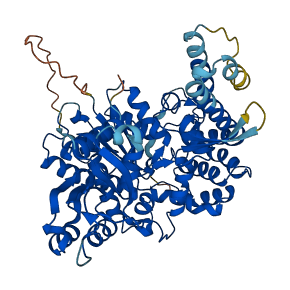
Descriptions
The autoinhibited protein was predicted that may have potential autoinhibitory elements via cis-regPred.
Autoinhibitory domains (AIDs)
Target domain |
|
Relief mechanism |
|
Assay |
cis-regPred |
Accessory elements
No accessory elements
Autoinhibited structure

Activated structure
1 structures for Q62753
| Entry ID | Method | Resolution | Chain | Position | Source |
|---|---|---|---|---|---|
| AF-Q62753-F1 | Predicted | AlphaFoldDB |
No variants for Q62753
| Variant ID(s) | Position | Change | Description | Diseaes Association | Provenance |
|---|---|---|---|---|---|
| No variants for Q62753 | |||||
No associated diseases with Q62753
No regional properties for Q62753
| Type | Name | Position | InterPro Accession |
|---|---|---|---|
| No domain, repeats, and functional sites for Q62753 | |||
12 GO annotations of cellular component
| Name | Definition |
|---|---|
| apical plasma membrane | The region of the plasma membrane located at the apical end of the cell. |
| azurophil granule | Primary lysosomal granule found in neutrophil granulocytes. Contains a wide range of hydrolytic enzymes and is released into the extracellular fluid. |
| cytolytic granule | A specialized secretory lysosome that is present in cells with cytolytic capability such as cytotoxic T lymphocytes and natural killer cells. Cytolytic granules mediate the storage and regulated excretion of lytic molecules for killing of target cells. |
| cytoplasm | The contents of a cell excluding the plasma membrane and nucleus, but including other subcellular structures. |
| lamellipodium | A thin sheetlike process extended by the leading edge of a migrating cell or extending cell process; contains a dense meshwork of actin filaments. |
| phagocytic vesicle | A membrane-bounded intracellular vesicle that arises from the ingestion of particulate material by phagocytosis. |
| plasma membrane | The membrane surrounding a cell that separates the cell from its external environment. It consists of a phospholipid bilayer and associated proteins. |
| presynapse | The part of a synapse that is part of the presynaptic cell. |
| protein-containing complex | A stable assembly of two or more macromolecules, i.e. proteins, nucleic acids, carbohydrates or lipids, in which at least one component is a protein and the constituent parts function together. |
| specific granule | Granule with a membranous, tubular internal structure, found primarily in mature neutrophil cells. Most are released into the extracellular fluid. Specific granules contain lactoferrin, lysozyme, vitamin B12 binding protein and elastase. |
| tertiary granule | A secretory granule that contains cathepsin and gelatinase and is readily exocytosed upon cell activation; found primarily in mature neutrophil cells. |
| zymogen granule membrane | The lipid bilayer surrounding a zymogen granule. |
3 GO annotations of molecular function
| Name | Definition |
|---|---|
| syntaxin binding | Binding to a syntaxin, a SNAP receptor involved in the docking of synaptic vesicles at the presynaptic zone of a synapse. |
| syntaxin-1 binding | Binding to a syntaxin-1 SNAP receptor. |
| syntaxin-3 binding | Binding to a syntaxin-3 SNAP receptor. |
12 GO annotations of biological process
| Name | Definition |
|---|---|
| cellular response to interferon-gamma | Any process that results in a change in state or activity of a cell (in terms of movement, secretion, enzyme production, gene expression, etc.) as a result of an interferon-gamma stimulus. Interferon gamma is the only member of the type II interferon found so far. |
| exocytosis | A process of secretion by a cell that results in the release of intracellular molecules (e.g. hormones, matrix proteins) contained within a membrane-bounded vesicle. Exocytosis can occur either by full fusion, when the vesicle collapses into the plasma membrane, or by a kiss-and-run mechanism that involves the formation of a transient contact, a pore, between a granule (for exemple of chromaffin cells) and the plasma membrane. The latter process most of the time leads to only partial secretion of the granule content. Exocytosis begins with steps that prepare vesicles for fusion with the membrane (tethering and docking) and ends when molecules are secreted from the cell. |
| intracellular protein transport | The directed movement of proteins in a cell, including the movement of proteins between specific compartments or structures within a cell, such as organelles of a eukaryotic cell. |
| leukocyte mediated cytotoxicity | The directed killing of a target cell by a leukocyte. |
| neurotransmitter secretion | The regulated release of neurotransmitter from the presynapse into the synaptic cleft via calcium-regulated exocytosis during synaptic transmission. |
| neutrophil degranulation | The regulated exocytosis of secretory granules containing preformed mediators such as proteases, lipases, and inflammatory mediators by a neutrophil. |
| positive regulation of mast cell degranulation | Any process that activates or increases the frequency, rate or extent of mast cell degranulation. |
| regulation of mast cell degranulation | Any process that modulates the frequency, rate, or extent of mast cell degranulation. |
| response to acidic pH | Any process that results in a change in state or activity of a cell or an organism (in terms of movement, secretion, enzyme production, gene expression, etc.) as a result of a pH stimulus with pH < 7. pH is a measure of the acidity or basicity of an aqueous solution. |
| synaptic vesicle exocytosis | Fusion of intracellular membrane-bounded vesicles with the pre-synaptic membrane of the neuronal cell resulting in release of neurotransmitter into the synaptic cleft. |
| vesicle docking involved in exocytosis | The initial attachment of a vesicle membrane to a target membrane, mediated by proteins protruding from the membrane of the vesicle and the target membrane, that contributes to exocytosis. |
| vesicle-mediated transport | A cellular transport process in which transported substances are moved in membrane-bounded vesicles; transported substances are enclosed in the vesicle lumen or located in the vesicle membrane. The process begins with a step that directs a substance to the forming vesicle, and includes vesicle budding and coating. Vesicles are then targeted to, and fuse with, an acceptor membrane. |
7 homologous proteins in AiPD
| UniProt AC | Gene Name | Protein Name | Species | Evidence Code |
|---|---|---|---|---|
| P30619 | SEC1 | Protein transport protein SEC1 | Saccharomyces cerevisiae (strain ATCC 204508 / S288c) (Baker's yeast) | PR |
| Q15833 | STXBP2 | Syntaxin-binding protein 2 | Homo sapiens (Human) | PR |
| O08599 | Stxbp1 | Syntaxin-binding protein 1 | Mus musculus (Mouse) | PR |
| Q64324 | Stxbp2 | Syntaxin-binding protein 2 | Mus musculus (Mouse) | PR |
| Q63616 | Vps33b | Vacuolar protein sorting-associated protein 33B | Rattus norvegicus (Rat) | PR |
| Q5VNU3 | Os06g0135900 | Probable protein transport Sec1b | Oryza sativa subsp japonica (Rice) | PR |
| Q9C5P7 | SEC1A | Protein transport Sec1a | Arabidopsis thaliana (Mouse-ear cress) | PR |
| 10 | 20 | 30 | 40 | 50 | 60 |
| MAPLGLKAVV | VEKILSGVIR | SVKKDGEWKV | LIMDHPSMRI | LSSCCKMSDI | LAEGITIVED |
| 70 | 80 | 90 | 100 | 110 | 120 |
| INKRREPIPS | LEAIYLLSPT | EKSVQALIAD | FQGTPTFTYK | AAHIFFTDTC | PEPLFSELGR |
| 130 | 140 | 150 | 160 | 170 | 180 |
| SRLAKVVKTL | KEIHLAFLPY | EAQVFSLDAP | HSTYNLYCPF | RAGERGRQLD | VLAQQIATLC |
| 190 | 200 | 210 | 220 | 230 | 240 |
| ATLQEYPSIR | YRKGPEDTAQ | LAHAVLAKLN | AFKADTPSLG | EGPEKTRSQL | LIMDRAADPV |
| 250 | 260 | 270 | 280 | 290 | 300 |
| SPLLHELTFQ | AMAYDLLHIE | QDTYRYETTG | LSESREKAVL | LDEDDDLWVE | LRHMHIADVS |
| 310 | 320 | 330 | 340 | 350 | 360 |
| KKVTELLKTF | CESKRLTTDK | ANIKDLSHIL | KKMPQYQKEL | NKYSTHLHLA | DDCMKHFKGS |
| 370 | 380 | 390 | 400 | 410 | 420 |
| VEKLCGVEQD | LAMGSDAEGE | KIKDTMKLIV | PVLLDASVPP | YDKIRVLLLY | ILLRNGVSEE |
| 430 | 440 | 450 | 460 | 470 | 480 |
| NLAKLIQHAN | VQSYSNLIRN | LEQLGGTVTN | SAGSGTSSRL | ERRERMEPTY | QLSRWSPVIK |
| 490 | 500 | 510 | 520 | 530 | 540 |
| DVMEDVVEDR | LDRKLWPFVS | DPAPVSSSQA | AVSSARFGHW | HKNKAGIEAR | AGPRLIVYIV |
| 550 | 560 | 570 | 580 | 590 | |
| GGVAMSEMRA | AYEVTRATEG | KWEVLIGSSH | ILTPTRFLDD | LRTLDQKLED | IALP |