B0BNE4
Gene name |
Pabpn1l (Epabp2, Pabpnl1) |
Protein name |
Embryonic polyadenylate-binding protein 2 |
Names |
Embryonic poly(A)-binding protein 2, ePABP-2, ePABP2, Embryonic poly(A)-binding protein type II, Poly(A)-binding protein nuclear-like 1 |
Species |
Rattus norvegicus (Rat) |
KEGG Pathway |
rno:307920 |
EC number |
|
Protein Class |
|
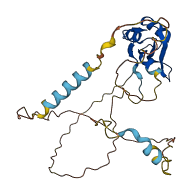
Descriptions
The autoinhibited protein was predicted that may have potential autoinhibitory elements via cis-regPred.
Autoinhibitory domains (AIDs)
Target domain |
|
Relief mechanism |
|
Assay |
cis-regPred |
Accessory elements
No accessory elements
Autoinhibited structure

Activated structure
1 structures for B0BNE4
| Entry ID | Method | Resolution | Chain | Position | Source |
|---|---|---|---|---|---|
| AF-B0BNE4-F1 | Predicted | AlphaFoldDB |
No variants for B0BNE4
| Variant ID(s) | Position | Change | Description | Diseaes Association | Provenance |
|---|---|---|---|---|---|
| No variants for B0BNE4 | |||||
No associated diseases with B0BNE4
1 regional properties for B0BNE4
| Type | Name | Position | InterPro Accession |
|---|---|---|---|
| domain | RNA recognition motif domain | 139 - 216 | IPR000504 |
1 GO annotations of cellular component
| Name | Definition |
|---|---|
| cytoplasm | The contents of a cell excluding the plasma membrane and nucleus, but including other subcellular structures. |
2 GO annotations of molecular function
| Name | Definition |
|---|---|
| poly(A) binding | Binding to a sequence of adenylyl residues in an RNA molecule, such as the poly(A) tail, a sequence of adenylyl residues at the 3' end of eukaryotic mRNA. |
| RNA binding | Binding to an RNA molecule or a portion thereof. |
5 GO annotations of biological process
| Name | Definition |
|---|---|
| maternal-to-zygotic transition of gene expression | Any process that modulates the frequency, rate or extent of gene expression by which developmental control passes from the maternal genome to the zygotic genome. |
| negative regulation of protein binding | Any process that stops, prevents, or reduces the frequency, rate or extent of protein binding. |
| negative regulation of protein ubiquitination | Any process that stops, prevents, or reduces the frequency, rate or extent of the addition of ubiquitin groups to a protein. |
| negative regulation of SCF-dependent proteasomal ubiquitin-dependent catabolic process | Any process that stops or decreases the rate, frequency or extent of SCF-dependent proteasomal ubiquitin-dependent protein catabolic process, the chemical reactions and pathways resulting in the breakdown of a protein or peptide by hydrolysis of its peptide bonds, initiated by the covalent attachment of ubiquitin, with ubiquitin-protein ligation catalyzed by an SCF (Skp1/Cul1/F-box protein) complex, and mediated by the proteasome. |
| nuclear-transcribed mRNA catabolic process, deadenylation-dependent decay | A major pathway of degradation of nuclear-transcribed mRNAs that proceeds through a series of ordered steps that includes poly(A) tail shortening and that can regulate mRNA stability. |
4 homologous proteins in AiPD
| UniProt AC | Gene Name | Protein Name | Species | Evidence Code |
|---|---|---|---|---|
| Q28165 | PABPN1 | Polyadenylate-binding protein 2 | Bos taurus (Bovine) | PR |
| Q86U42 | PABPN1 | Polyadenylate-binding protein 2 | Homo sapiens (Human) | PR |
| Q8CCS6 | Pabpn1 | Polyadenylate-binding protein 2 | Mus musculus (Mouse) | PR |
| Q5XFR0 | Pabpn1l | Embryonic polyadenylate-binding protein 2 | Mus musculus (Mouse) | PR |
| 10 | 20 | 30 | 40 | 50 | 60 |
| MWPSLSNELF | PPPTEVWLQT | VSSDPEAQGW | GAWGRTEKTS | LVPSAGSDKE | AEENEDSSFL |
| 70 | 80 | 90 | 100 | 110 | 120 |
| LSLLEPENLA | KSPVYNQELE | AIRLKLWTME | HAEVLPEPPS | VQRKATEEER | AEARELLSPE |
| 130 | 140 | 150 | 160 | 170 | 180 |
| TIGCFFPGAP | KENVEADHRS | VYVGNVDYGG | SAAELEAYFS | PCGEIHRVTI | LCDKFSGHPK |
| 190 | 200 | 210 | 220 | 230 | 240 |
| GYAYIEFASK | SSVQAAVRLD | ESTFRGRVIK | VLPKRTNFPG | ISSTDRGGLR | THSSSRAAFL |
| 250 | 260 | ||||
| QGSLQRKPRL | RPHGQSRGRG | RASPWFSPY |